


Description
Given an integer n and an integer array rounds. We have a circular track which consists of n sectors labeled from 1 to n. A marathon will be held on this track, the marathon consists of m rounds. The ith round starts at sector rounds[i - 1] and ends at sector rounds[i]. For example, round 1 starts at sector rounds[0] and ends at sector rounds[1]
Return an array of the most visited sectors sorted in ascending order.
Notice that you circulate the track in ascending order of sector numbers in the counter-clockwise direction (See the first example).
Example 1:
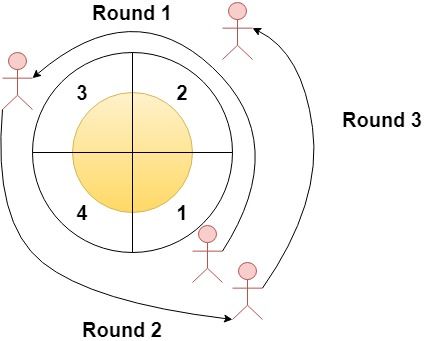
Input: n = 4, rounds = [1,3,1,2]
Output: [1,2]
Explanation: The marathon starts at sector 1. The order of the visited sectors is as follows:
1 --> 2 --> 3 (end of round 1) --> 4 --> 1 (end of round 2) --> 2 (end of round 3 and the marathon)
We can see that both sectors 1 and 2 are visited twice and they are the most visited sectors. Sectors 3 and 4 are visited only once.
Example 2:
Input: n = 2, rounds = [2,1,2,1,2,1,2,1,2]
Output: [2]
Example 3:
Input: n = 7, rounds = [1,3,5,7]
Output: [1,2,3,4,5,6,7]
Constraints:
2 <= n <= 1001 <= m <= 100rounds.length == m + 11 <= rounds[i] <= nrounds[i] != rounds[i + 1]for0 <= i < m
Solutions
Solution 1: Considering the Relationship Between Start and End Positions
Since the end position of each stage is the start position of the next stage, and each stage is in a counterclockwise direction, we can determine the number of times each sector is passed based on the relationship between the start and end positions.
If rounds[0] ≤ rounds[m], then the sectors from rounds[0] to rounds[m] are passed the most times, and we can directly return all sectors within this interval.
Otherwise, the sectors from 1 to rounds[m] and the sectors from rounds[0] to n form the union of the most passed sectors, and we can return the union of these two intervals.
The time complexity is O(n), where n is the number of sectors. Ignoring the space consumption of the answer array, the space complexity is O(1).
class Solution: def mostVisited(self, n: int, rounds: List[int]) -> List[int]: if rounds[0] <= rounds[-1]: return list(range(rounds[0], rounds[-1] + 1)) return list(range(1, rounds[-1] + 1)) + list(range(rounds[0], n + 1))(code-box)
