
Description
Given a 2D array of characters grid of size m x n, you need to find if there exists any cycle consisting of the same value in grid.
A cycle is a path of length 4 or more in the grid that starts and ends at the same cell. From a given cell, you can move to one of the cells adjacent to it - in one of the four directions (up, down, left, or right), if it has the same value of the current cell.
Also, you cannot move to the cell that you visited in your last move. For example, the cycle (1, 1) -> (1, 2) -> (1, 1) is invalid because from (1, 2) we visited (1, 1) which was the last visited cell.
Return true if any cycle of the same value exists in grid, otherwise, return false.
Example 1:
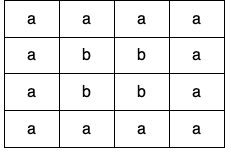
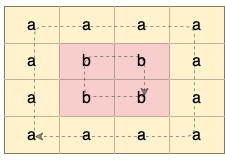
Input: grid = [["a","a","a","a"],["a","b","b","a"],["a","b","b","a"],["a","a","a","a"]]
Output: true
Explanation: There are two valid cycles shown in different colors in the image below:
Example 2:
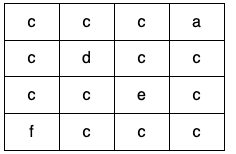
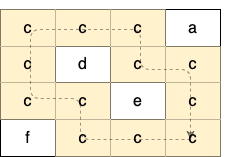
Input: grid = [["c","c","c","a"],["c","d","c","c"],["c","c","e","c"],["f","c","c","c"]]
Output: true
Explanation: There is only one valid cycle highlighted in the image below:
Example 3:
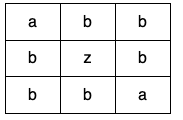
Input: grid = [["a","b","b"],["b","z","b"],["b","b","a"]]
Output: false
Constraints:
m == grid.lengthn == grid[i].length1 <= m, n <= 500grid consists only of lowercase English letters.
Solutions
Solution 1: BFS
We can traverse each cell in the 2D grid. For each cell, if the cell grid[i][j] has not been visited, we start a breadth-first search (BFS) from that cell. During the search, we need to record the parent node of each cell and the coordinates of the previous cell. If the value of the next cell is the same as the current cell, and it is not the previous cell, and it has already been visited, then it indicates the presence of a cycle, and we return true. After traversing all cells, if no cycle is found, we return false.
The time complexity is O(m × n), and the space complexity is O(m × n). Here, m and n are the number of rows and columns of the 2D grid, respectively.
PythonJavaC++GoTypeScriptRustJavaScript
class Solution:
def containsCycle(self, grid: List[List[str]]) -> bool:
m, n = len(grid), len(grid[0])
vis = [[False] * n for _ in range(m)]
dirs = (-1, 0, 1, 0, -1)
for i, row in enumerate(grid):
for j, x in enumerate(row):
if vis[i][j]:
continue
vis[i][j] = True
q = [(i, j, -1, -1)]
while q:
x, y, px, py = q.pop()
for dx, dy in pairwise(dirs):
nx, ny = x + dx, y + dy
if 0 <= nx < m and 0 <= ny < n:
if grid[nx][ny] != grid[i][j] or (nx == px and ny == py):
continue
if vis[nx][ny]:
return True
vis[nx][ny] = True
q.append((nx, ny, x, y))
return False(code-box)
class Solution {
public boolean containsCycle(char[][] grid) {
int m = grid.length, n = grid[0].length;
boolean[][] vis = new boolean[m][n];
final int[] dirs = {-1, 0, 1, 0, -1};
for (int i = 0; i < m; ++i) {
for (int j = 0; j < n; ++j) {
if (!vis[i][j]) {
Deque<int[]> q = new ArrayDeque<>();
q.offer(new int[] {i, j, -1, -1});
vis[i][j] = true;
while (!q.isEmpty()) {
int[] p = q.poll();
int x = p[0], y = p[1], px = p[2], py = p[3];
for (int k = 0; k < 4; ++k) {
int nx = x + dirs[k], ny = y + dirs[k + 1];
if (nx >= 0 && nx < m && ny >= 0 && ny < n) {
if (grid[nx][ny] != grid[x][y] || (nx == px && ny == py)) {
continue;
}
if (vis[nx][ny]) {
return true;
}
q.offer(new int[] {nx, ny, x, y});
vis[nx][ny] = true;
}
}
}
}
}
}
return false;
}
}(code-box)
class Solution {
public:
bool containsCycle(vector<vector<char>>& grid) {
int m = grid.size(), n = grid[0].size();
vector<vector<bool>> vis(m, vector<bool>(n));
const vector<int> dirs = {-1, 0, 1, 0, -1};
for (int i = 0; i < m; ++i) {
for (int j = 0; j < n; ++j) {
if (!vis[i][j]) {
queue<array<int, 4>> q;
q.push({i, j, -1, -1});
vis[i][j] = true;
while (!q.empty()) {
auto p = q.front();
q.pop();
int x = p[0], y = p[1], px = p[2], py = p[3];
for (int k = 0; k < 4; ++k) {
int nx = x + dirs[k], ny = y + dirs[k + 1];
if (nx >= 0 && nx < m && ny >= 0 && ny < n) {
if (grid[nx][ny] != grid[x][y] || (nx == px && ny == py)) {
continue;
}
if (vis[nx][ny]) {
return true;
}
q.push({nx, ny, x, y});
vis[nx][ny] = true;
}
}
}
}
}
}
return false;
}
};(code-box)
func containsCycle(grid [][]byte) bool {
m, n := len(grid), len(grid[0])
vis := make([][]bool, m)
for i := range vis {
vis[i] = make([]bool, n)
}
dirs := []int{-1, 0, 1, 0, -1}
for i := 0; i < m; i++ {
for j := 0; j < n; j++ {
if !vis[i][j] {
q := [][]int{{i, j, -1, -1}}
vis[i][j] = true
for len(q) > 0 {
p := q[0]
q = q[1:]
x, y, px, py := p[0], p[1], p[2], p[3]
for k := 0; k < 4; k++ {
nx, ny := x+dirs[k], y+dirs[k+1]
if nx >= 0 && nx < m && ny >= 0 && ny < n {
if grid[nx][ny] != grid[x][y] || (nx == px && ny == py) {
continue
}
if vis[nx][ny] {
return true
}
q = append(q, []int{nx, ny, x, y})
vis[nx][ny] = true
}
}
}
}
}
}
return false
}(code-box)
function containsCycle(grid: string[][]): boolean {
const [m, n] = [grid.length, grid[0].length];
const vis: boolean[][] = Array.from({ length: m }, () => Array(n).fill(false));
const dirs = [-1, 0, 1, 0, -1];
for (let i = 0; i < m; i++) {
for (let j = 0; j < n; j++) {
if (!vis[i][j]) {
const q: [number, number, number, number][] = [[i, j, -1, -1]];
vis[i][j] = true;
for (const [x, y, px, py] of q) {
for (let k = 0; k < 4; k++) {
const [nx, ny] = [x + dirs[k], y + dirs[k + 1]];
if (nx >= 0 && nx < m && ny >= 0 && ny < n) {
if (grid[nx][ny] !== grid[x][y] || (nx === px && ny === py)) {
continue;
}
if (vis[nx][ny]) {
return true;
}
q.push([nx, ny, x, y]);
vis[nx][ny] = true;
}
}
}
}
}
}
return false;
}(code-box)
impl Solution {
pub fn contains_cycle(grid: Vec<Vec<char>>) -> bool {
let m = grid.len();
let n = grid[0].len();
let mut vis = vec![vec![false; n]; m];
let dirs = vec![-1, 0, 1, 0, -1];
for i in 0..m {
for j in 0..n {
if !vis[i][j] {
let mut q = vec![(i as isize, j as isize, -1, -1)];
vis[i][j] = true;
while !q.is_empty() {
let (x, y, px, py) = q.pop().unwrap();
for k in 0..4 {
let nx = x + dirs[k];
let ny = y + dirs[k + 1];
if nx >= 0 && nx < m as isize && ny >= 0 && ny < n as isize {
let nx = nx as usize;
let ny = ny as usize;
if grid[nx][ny] != grid[x as usize][y as usize]
|| (nx == px as usize && ny == py as usize)
{
continue;
}
if vis[nx][ny] {
return true;
}
q.push((nx as isize, ny as isize, x, y));
vis[nx][ny] = true;
}
}
}
}
}
}
false
}
}(code-box)
/**
* @param {character[][]} grid
* @return {boolean}
*/
var containsCycle = function (grid) {
const [m, n] = [grid.length, grid[0].length];
const vis = Array.from({ length: m }, () => Array(n).fill(false));
const dirs = [-1, 0, 1, 0, -1];
for (let i = 0; i < m; i++) {
for (let j = 0; j < n; j++) {
if (!vis[i][j]) {
const q = [[i, j, -1, -1]];
vis[i][j] = true;
for (const [x, y, px, py] of q) {
for (let k = 0; k < 4; k++) {
const [nx, ny] = [x + dirs[k], y + dirs[k + 1]];
if (nx >= 0 && nx < m && ny >= 0 && ny < n) {
if (grid[nx][ny] !== grid[x][y] || (nx === px && ny === py)) {
continue;
}
if (vis[nx][ny]) {
return true;
}
q.push([nx, ny, x, y]);
vis[nx][ny] = true;
}
}
}
}
}
}
return false;
};(code-box)
Solution 2: DFS
We can traverse each cell in the 2D grid. For each cell, if the cell grid[i][j] has not been visited, we start a depth-first search (DFS) from that cell. During the search, we need to record the parent node of each cell and the coordinates of the previous cell. If the value of the next cell is the same as the current cell, and it is not the previous cell, and it has already been visited, then it indicates the presence of a cycle, and we return true. After traversing all cells, if no cycle is found, we return false.
The time complexity is O(m × n), and the space complexity is O(m × n). Here, m and n are the number of rows and columns of the 2D grid, respectively.
PythonJavaC++GoTypeScriptRust
class Solution:
def containsCycle(self, grid: List[List[str]]) -> bool:
def dfs(x: int, y: int, px: int, py: int) -> bool:
vis[x][y] = True
for dx, dy in pairwise(dirs):
nx, ny = x + dx, y + dy
if 0 <= nx < m and 0 <= ny < n:
if grid[nx][ny] != grid[x][y] or (nx == px and ny == py):
continue
if vis[nx][ny] or dfs(nx, ny, x, y):
return True
return False
m, n = len(grid), len(grid[0])
vis = [[False] * n for _ in range(m)]
dirs = (-1, 0, 1, 0, -1)
for i in range(m):
for j in range(n):
if vis[i][j]:
continue
if dfs(i, j, -1, -1):
return True
return False(code-box)
class Solution {
private char[][] grid;
private boolean[][] vis;
private final int[] dirs = {-1, 0, 1, 0, -1};
private int m;
private int n;
public boolean containsCycle(char[][] grid) {
this.grid = grid;
m = grid.length;
n = grid[0].length;
vis = new boolean[m][n];
for (int i = 0; i < m; ++i) {
for (int j = 0; j < n; ++j) {
if (!vis[i][j] && dfs(i, j, -1, -1)) {
return true;
}
}
}
return false;
}
private boolean dfs(int x, int y, int px, int py) {
vis[x][y] = true;
for (int k = 0; k < 4; ++k) {
int nx = x + dirs[k], ny = y + dirs[k + 1];
if (nx >= 0 && nx < m && ny >= 0 && ny < n) {
if (grid[nx][ny] != grid[x][y] || (nx == px && ny == py)) {
continue;
}
if (vis[nx][ny] || dfs(nx, ny, x, y)) {
return true;
}
}
}
return false;
}
}(code-box)
class Solution {
public:
bool containsCycle(vector<vector<char>>& grid) {
int m = grid.size(), n = grid[0].size();
vector<vector<bool>> vis(m, vector<bool>(n));
const vector<int> dirs = {-1, 0, 1, 0, -1};
auto dfs = [&](this auto&& dfs, int x, int y, int px, int py) -> bool {
vis[x][y] = true;
for (int k = 0; k < 4; ++k) {
int nx = x + dirs[k], ny = y + dirs[k + 1];
if (nx >= 0 && nx < m && ny >= 0 && ny < n) {
if (grid[nx][ny] != grid[x][y] || (nx == px && ny == py)) {
continue;
}
if (vis[nx][ny] || dfs(nx, ny, x, y)) {
return true;
}
}
}
return false;
};
for (int i = 0; i < m; ++i) {
for (int j = 0; j < n; ++j) {
if (!vis[i][j] && dfs(i, j, -1, -1)) {
return true;
}
}
}
return false;
}
};(code-box)
func containsCycle(grid [][]byte) bool {
m, n := len(grid), len(grid[0])
vis := make([][]bool, m)
for i := range vis {
vis[i] = make([]bool, n)
}
dirs := []int{-1, 0, 1, 0, -1}
var dfs func(x, y, px, py int) bool
dfs = func(x, y, px, py int) bool {
vis[x][y] = true
for k := 0; k < 4; k++ {
nx, ny := x+dirs[k], y+dirs[k+1]
if nx >= 0 && nx < m && ny >= 0 && ny < n {
if grid[nx][ny] != grid[x][y] || (nx == px && ny == py) {
continue
}
if vis[nx][ny] || dfs(nx, ny, x, y) {
return true
}
}
}
return false
}
for i := 0; i < m; i++ {
for j := 0; j < n; j++ {
if !vis[i][j] && dfs(i, j, -1, -1) {
return true
}
}
}
return false
}(code-box)
function containsCycle(grid: string[][]): boolean {
const [m, n] = [grid.length, grid[0].length];
const vis: boolean[][] = Array.from({ length: m }, () => Array(n).fill(false));
const dfs = (x: number, y: number, px: number, py: number): boolean => {
vis[x][y] = true;
const dirs = [-1, 0, 1, 0, -1];
for (let k = 0; k < 4; k++) {
const [nx, ny] = [x + dirs[k], y + dirs[k + 1]];
if (nx >= 0 && nx < m && ny >= 0 && ny < n) {
if (grid[nx][ny] !== grid[x][y] || (nx === px && ny === py)) {
continue;
}
if (vis[nx][ny] || dfs(nx, ny, x, y)) {
return true;
}
}
}
return false;
};
for (let i = 0; i < m; i++) {
for (let j = 0; j < n; j++) {
if (!vis[i][j] && dfs(i, j, -1, -1)) {
return true;
}
}
}
return false;
}(code-box)
impl Solution {
pub fn contains_cycle(grid: Vec<Vec<char>>) -> bool {
let m = grid.len();
let n = grid[0].len();
let mut vis = vec![vec![false; n]; m];
let dirs = vec![-1, 0, 1, 0, -1];
fn dfs(
x: usize,
y: usize,
px: isize,
py: isize,
grid: &Vec<Vec<char>>,
vis: &mut Vec<Vec<bool>>,
dirs: &Vec<isize>,
) -> bool {
vis[x][y] = true;
for k in 0..4 {
let nx = (x as isize + dirs[k]) as usize;
let ny = (y as isize + dirs[k + 1]) as usize;
if nx < grid.len() && ny < grid[0].len() {
if grid[nx][ny] != grid[x][y] || (nx as isize == px && ny as isize == py) {
continue;
}
if vis[nx][ny] || dfs(nx, ny, x as isize, y as isize, grid, vis, dirs) {
return true;
}
}
}
false
}
for i in 0..m {
for j in 0..n {
if !vis[i][j] && dfs(i, j, -1, -1, &grid, &mut vis, &dirs) {
return true;
}
}
}
false
}
}(code-box)


