
Description
You are given a rows x cols matrix grid representing a field of cherries where grid[i][j] represents the number of cherries that you can collect from the (i, j) cell.
You have two robots that can collect cherries for you:
- Robot #1 is located at the top-left corner
(0, 0), and
- Robot #2 is located at the top-right corner
(0, cols - 1).
Return the maximum number of cherries collection using both robots by following the rules below:
- From a cell
(i, j), robots can move to cell (i + 1, j - 1), (i + 1, j), or (i + 1, j + 1).
- When any robot passes through a cell, It picks up all cherries, and the cell becomes an empty cell.
- When both robots stay in the same cell, only one takes the cherries.
- Both robots cannot move outside of the grid at any moment.
- Both robots should reach the bottom row in
grid.
Example 1:
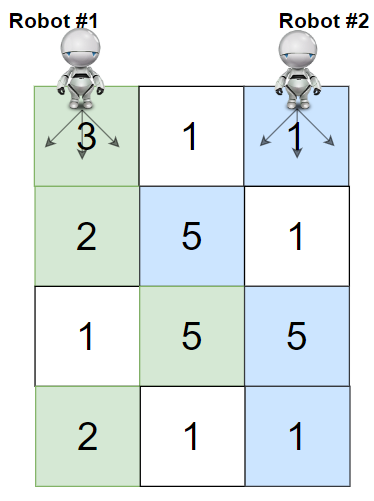
Input: grid = [[3,1,1],[2,5,1],[1,5,5],[2,1,1]]
Output: 24
Explanation: Path of robot #1 and #2 are described in color green and blue respectively.
Cherries taken by Robot #1, (3 + 2 + 5 + 2) = 12.
Cherries taken by Robot #2, (1 + 5 + 5 + 1) = 12.
Total of cherries: 12 + 12 = 24.
Example 2:
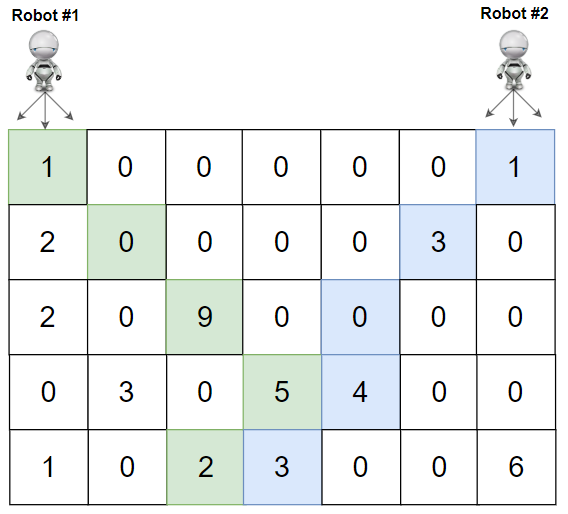
Input: grid = [[1,0,0,0,0,0,1],[2,0,0,0,0,3,0],[2,0,9,0,0,0,0],[0,3,0,5,4,0,0],[1,0,2,3,0,0,6]]
Output: 28
Explanation: Path of robot #1 and #2 are described in color green and blue respectively.
Cherries taken by Robot #1, (1 + 9 + 5 + 2) = 17.
Cherries taken by Robot #2, (1 + 3 + 4 + 3) = 11.
Total of cherries: 17 + 11 = 28.
Constraints:
rows == grid.lengthcols == grid[i].length2 <= rows, cols <= 700 <= grid[i][j] <= 100
Solutions
Solution 1: Dynamic Programming
We define f[i][j1][j2] as the maximum number of cherries that can be picked when the two robots are at positions j1 and j2 in the i-th row. Initially, f[0][0][n-1] = grid[0][0] + grid[0][n-1], and the other values are -1. The answer is max_{0 ≤ j1, j2 < n} f[m-1][j1][j2].
Consider f[i][j1][j2]. If j1 ≠ j2, then the number of cherries that the robots can pick in the i-th row is grid[i][j1] + grid[i][j2]. If j1 = j2, then the number of cherries that the robots can pick in the i-th row is grid[i][j1]. We can enumerate the previous state of the two robots f[i-1][y1][y2], where y1, y2 are the positions of the two robots in the (i-1)-th row, then y1 ∈ {j1-1, j1, j1+1} and y2 ∈ {j2-1, j2, j2+1}. The state transition equation is as follows:
f[i][j1][j2] = max_{y1 ∈ {j1-1, j1, j1+1}, y2 ∈ {j2-1, j2, j2+1}} f[i-1][y1][y2] + \begin{cases} grid[i][j1] + grid[i][j2], & j1 ≠ j2 \ grid[i][j1], & j1 = j2 \end{cases}
Where f[i-1][y1][y2] is ignored when it is -1.
The final answer is max_{0 ≤ j1, j2 < n} f[m-1][j1][j2].
The time complexity is O(m × n2), and the space complexity is O(m × n2). Where m and n are the number of rows and columns of the grid, respectively.
PythonJavaC++GoTypeScript
class Solution:
def cherryPickup(self, grid: List[List[int]]) -> int:
m, n = len(grid), len(grid[0])
f = [[[-1] * n for _ in range(n)] for _ in range(m)]
f[0][0][n - 1] = grid[0][0] + grid[0][n - 1]
for i in range(1, m):
for j1 in range(n):
for j2 in range(n):
x = grid[i][j1] + (0 if j1 == j2 else grid[i][j2])
for y1 in range(j1 - 1, j1 + 2):
for y2 in range(j2 - 1, j2 + 2):
if 0 <= y1 < n and 0 <= y2 < n and f[i - 1][y1][y2] != -1:
f[i][j1][j2] = max(f[i][j1][j2], f[i - 1][y1][y2] + x)
return max(f[-1][j1][j2] for j1, j2 in product(range(n), range(n)))(code-box)
class Solution {
public int cherryPickup(int[][] grid) {
int m = grid.length, n = grid[0].length;
int[][][] f = new int[m][n][n];
for (var g : f) {
for (var h : g) {
Arrays.fill(h, -1);
}
}
f[0][0][n - 1] = grid[0][0] + grid[0][n - 1];
for (int i = 1; i < m; ++i) {
for (int j1 = 0; j1 < n; ++j1) {
for (int j2 = 0; j2 < n; ++j2) {
int x = grid[i][j1] + (j1 == j2 ? 0 : grid[i][j2]);
for (int y1 = j1 - 1; y1 <= j1 + 1; ++y1) {
for (int y2 = j2 - 1; y2 <= j2 + 1; ++y2) {
if (y1 >= 0 && y1 < n && y2 >= 0 && y2 < n && f[i - 1][y1][y2] != -1) {
f[i][j1][j2] = Math.max(f[i][j1][j2], f[i - 1][y1][y2] + x);
}
}
}
}
}
}
int ans = 0;
for (int j1 = 0; j1 < n; ++j1) {
for (int j2 = 0; j2 < n; ++j2) {
ans = Math.max(ans, f[m - 1][j1][j2]);
}
}
return ans;
}
}(code-box)
class Solution {
public:
int cherryPickup(vector<vector<int>>& grid) {
int m = grid.size(), n = grid[0].size();
int f[m][n][n];
memset(f, -1, sizeof(f));
f[0][0][n - 1] = grid[0][0] + grid[0][n - 1];
for (int i = 1; i < m; ++i) {
for (int j1 = 0; j1 < n; ++j1) {
for (int j2 = 0; j2 < n; ++j2) {
int x = grid[i][j1] + (j1 == j2 ? 0 : grid[i][j2]);
for (int y1 = j1 - 1; y1 <= j1 + 1; ++y1) {
for (int y2 = j2 - 1; y2 <= j2 + 1; ++y2) {
if (y1 >= 0 && y1 < n && y2 >= 0 && y2 < n && f[i - 1][y1][y2] != -1) {
f[i][j1][j2] = max(f[i][j1][j2], f[i - 1][y1][y2] + x);
}
}
}
}
}
}
int ans = 0;
for (int j1 = 0; j1 < n; ++j1) {
for (int j2 = 0; j2 < n; ++j2) {
ans = max(ans, f[m - 1][j1][j2]);
}
}
return ans;
}
};(code-box)
func cherryPickup(grid [][]int) (ans int) {
m, n := len(grid), len(grid[0])
f := make([][][]int, m)
for i := range f {
f[i] = make([][]int, n)
for j := range f[i] {
f[i][j] = make([]int, n)
for k := range f[i][j] {
f[i][j][k] = -1
}
}
}
f[0][0][n-1] = grid[0][0] + grid[0][n-1]
for i := 1; i < m; i++ {
for j1 := 0; j1 < n; j1++ {
for j2 := 0; j2 < n; j2++ {
x := grid[i][j1]
if j1 != j2 {
x += grid[i][j2]
}
for y1 := j1 - 1; y1 <= j1+1; y1++ {
for y2 := j2 - 1; y2 <= j2+1; y2++ {
if y1 >= 0 && y1 < n && y2 >= 0 && y2 < n && f[i-1][y1][y2] != -1 {
f[i][j1][j2] = max(f[i][j1][j2], f[i-1][y1][y2]+x)
}
}
}
}
}
}
for j1 := 0; j1 < n; j1++ {
ans = max(ans, slices.Max(f[m-1][j1]))
}
return
}(code-box)
function cherryPickup(grid: number[][]): number {
const m = grid.length;
const n = grid[0].length;
const f = Array.from({ length: m }, () =>
Array.from({ length: n }, () => Array.from({ length: n }, () => -1)),
);
f[0][0][n - 1] = grid[0][0] + grid[0][n - 1];
for (let i = 1; i < m; ++i) {
for (let j1 = 0; j1 < n; ++j1) {
for (let j2 = 0; j2 < n; ++j2) {
const x = grid[i][j1] + (j1 === j2 ? 0 : grid[i][j2]);
for (let y1 = j1 - 1; y1 <= j1 + 1; ++y1) {
for (let y2 = j2 - 1; y2 <= j2 + 1; ++y2) {
if (y1 >= 0 && y1 < n && y2 >= 0 && y2 < n && f[i - 1][y1][y2] !== -1) {
f[i][j1][j2] = Math.max(f[i][j1][j2], f[i - 1][y1][y2] + x);
}
}
}
}
}
}
return Math.max(...f[m - 1].flat());
}(code-box)
Solution 2: Dynamic Programming (Space Optimization)
Notice that the calculation of f[i][j1][j2] is only related to f[i-1][y1][y2]. Therefore, we can use a rolling array to optimize the space complexity. After optimizing the space complexity, the time complexity is O(n2).
PythonJavaC++GoTypeScript
class Solution:
def cherryPickup(self, grid: List[List[int]]) -> int:
m, n = len(grid), len(grid[0])
f = [[-1] * n for _ in range(n)]
g = [[-1] * n for _ in range(n)]
f[0][n - 1] = grid[0][0] + grid[0][n - 1]
for i in range(1, m):
for j1 in range(n):
for j2 in range(n):
x = grid[i][j1] + (0 if j1 == j2 else grid[i][j2])
for y1 in range(j1 - 1, j1 + 2):
for y2 in range(j2 - 1, j2 + 2):
if 0 <= y1 < n and 0 <= y2 < n and f[y1][y2] != -1:
g[j1][j2] = max(g[j1][j2], f[y1][y2] + x)
f, g = g, f
return max(f[j1][j2] for j1, j2 in product(range(n), range(n)))(code-box)
class Solution {
public int cherryPickup(int[][] grid) {
int m = grid.length, n = grid[0].length;
int[][] f = new int[n][n];
int[][] g = new int[n][n];
for (int i = 0; i < n; ++i) {
Arrays.fill(f[i], -1);
Arrays.fill(g[i], -1);
}
f[0][n - 1] = grid[0][0] + grid[0][n - 1];
for (int i = 1; i < m; ++i) {
for (int j1 = 0; j1 < n; ++j1) {
for (int j2 = 0; j2 < n; ++j2) {
int x = grid[i][j1] + (j1 == j2 ? 0 : grid[i][j2]);
for (int y1 = j1 - 1; y1 <= j1 + 1; ++y1) {
for (int y2 = j2 - 1; y2 <= j2 + 1; ++y2) {
if (y1 >= 0 && y1 < n && y2 >= 0 && y2 < n && f[y1][y2] != -1) {
g[j1][j2] = Math.max(g[j1][j2], f[y1][y2] + x);
}
}
}
}
}
int[][] t = f;
f = g;
g = t;
}
int ans = 0;
for (int j1 = 0; j1 < n; ++j1) {
for (int j2 = 0; j2 < n; ++j2) {
ans = Math.max(ans, f[j1][j2]);
}
}
return ans;
}
}(code-box)
class Solution {
public:
int cherryPickup(vector<vector<int>>& grid) {
int m = grid.size(), n = grid[0].size();
vector<vector<int>> f(n, vector<int>(n, -1));
vector<vector<int>> g(n, vector<int>(n, -1));
f[0][n - 1] = grid[0][0] + grid[0][n - 1];
for (int i = 1; i < m; ++i) {
for (int j1 = 0; j1 < n; ++j1) {
for (int j2 = 0; j2 < n; ++j2) {
int x = grid[i][j1] + (j1 == j2 ? 0 : grid[i][j2]);
for (int y1 = j1 - 1; y1 <= j1 + 1; ++y1) {
for (int y2 = j2 - 1; y2 <= j2 + 1; ++y2) {
if (y1 >= 0 && y1 < n && y2 >= 0 && y2 < n && f[y1][y2] != -1) {
g[j1][j2] = max(g[j1][j2], f[y1][y2] + x);
}
}
}
}
}
swap(f, g);
}
int ans = 0;
for (int j1 = 0; j1 < n; ++j1) {
for (int j2 = 0; j2 < n; ++j2) {
ans = max(ans, f[j1][j2]);
}
}
return ans;
}
};(code-box)
func cherryPickup(grid [][]int) (ans int) {
m, n := len(grid), len(grid[0])
f := make([][]int, n)
g := make([][]int, n)
for i := range f {
f[i] = make([]int, n)
g[i] = make([]int, n)
for j := range f[i] {
f[i][j] = -1
g[i][j] = -1
}
}
f[0][n-1] = grid[0][0] + grid[0][n-1]
for i := 1; i < m; i++ {
for j1 := 0; j1 < n; j1++ {
for j2 := 0; j2 < n; j2++ {
x := grid[i][j1]
if j1 != j2 {
x += grid[i][j2]
}
for y1 := j1 - 1; y1 <= j1+1; y1++ {
for y2 := j2 - 1; y2 <= j2+1; y2++ {
if y1 >= 0 && y1 < n && y2 >= 0 && y2 < n && f[y1][y2] != -1 {
g[j1][j2] = max(g[j1][j2], f[y1][y2]+x)
}
}
}
}
}
f, g = g, f
}
for j1 := 0; j1 < n; j1++ {
ans = max(ans, slices.Max(f[j1]))
}
return
}(code-box)
function cherryPickup(grid: number[][]): number {
const m = grid.length;
const n = grid[0].length;
let f: number[][] = Array.from({ length: n }, () => Array.from({ length: n }, () => -1));
let g: number[][] = Array.from({ length: n }, () => Array.from({ length: n }, () => -1));
f[0][n - 1] = grid[0][0] + grid[0][n - 1];
for (let i = 1; i < m; ++i) {
for (let j1 = 0; j1 < n; ++j1) {
for (let j2 = 0; j2 < n; ++j2) {
const x = grid[i][j1] + (j1 === j2 ? 0 : grid[i][j2]);
for (let y1 = j1 - 1; y1 <= j1 + 1; ++y1) {
for (let y2 = j2 - 1; y2 <= j2 + 1; ++y2) {
if (y1 >= 0 && y1 < n && y2 >= 0 && y2 < n && f[y1][y2] !== -1) {
g[j1][j2] = Math.max(g[j1][j2], f[y1][y2] + x);
}
}
}
}
}
[f, g] = [g, f];
}
return Math.max(...f.flat());
}(code-box)


