


Description
There are a total of numCourses courses you have to take, labeled from 0 to numCourses - 1. You are given an array prerequisites where prerequisites[i] = [ai, bi] indicates that you must take course ai first if you want to take course bi.
- For example, the pair
[0, 1]indicates that you have to take course0before you can take course1.
Prerequisites can also be indirect. If course a is a prerequisite of course b, and course b is a prerequisite of course c, then course a is a prerequisite of course c.
You are also given an array queries where queries[j] = [uj, vj]. For the jth query, you should answer whether course uj is a prerequisite of course vj or not.
Return a boolean array answer, where answer[j] is the answer to the jth query.
Example 1:
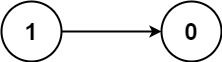
Input: numCourses = 2, prerequisites = [[1,0]], queries = [[0,1],[1,0]]
Output: [false,true]
Explanation: The pair [1, 0] indicates that you have to take course 1 before you can take course 0.
Course 0 is not a prerequisite of course 1, but the opposite is true.
Example 2:
Input: numCourses = 2, prerequisites = [], queries = [[1,0],[0,1]]
Output: [false,false]
Explanation: There are no prerequisites, and each course is independent.
Example 3:
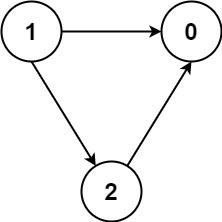
Input: numCourses = 3, prerequisites = [[1,2],[1,0],[2,0]], queries = [[1,0],[1,2]]
Output: [true,true]
Constraints:
2 <= numCourses <= 1000 <= prerequisites.length <= (numCourses * (numCourses - 1) / 2)prerequisites[i].length == 20 <= ai, bi <= numCourses - 1ai != bi- All the pairs
[ai, bi]are unique. - The prerequisites graph has no cycles.
1 <= queries.length <= 1040 <= ui, vi <= numCourses - 1ui != vi
Solutions
Solution 1: Floyd's Algorithm
We create a 2D array f, where f[i][j] indicates whether node i can reach node j.
Next, we iterate through the prerequisites array prerequisites. For each item [a, b] in it, we set f[a][b] to true.
Then, we use Floyd's algorithm to compute the reachability between all pairs of nodes.
Specifically, we use three nested loops: first enumerating the intermediate node k, then the starting node i, and finally the ending node j. For each iteration, if node i can reach node k and node k can reach node j, then node i can also reach node j, and we set f[i][j] to true.
After computing the reachability between all pairs of nodes, for each query [a, b], we can directly return f[a][b].
The time complexity is O(n3), and the space complexity is O(n2), where n is the number of nodes.
class Solution: def checkIfPrerequisite( self, n: int, prerequisites: List[List[int]], queries: List[List[int]] ) -> List[bool]: f = [[False] * n for _ in range(n)] for a, b in prerequisites: f[a][b] = True for k in range(n): for i in range(n): for j in range(n): if f[i][k] and f[k][j]: f[i][j] = True return [f[a][b] for a, b in queries](code-box)
Solution 2: Topological Sorting
Similar to Solution 1, we create a 2D array f, where f[i][j] indicates whether node i can reach node j. Additionally, we create an adjacency list g, where g[i] represents all successor nodes of node i, and an array indeg, where indeg[i] represents the in-degree of node i.
Next, we iterate through the prerequisites array prerequisites. For each item [a, b] in it, we update the adjacency list g and the in-degree array indeg.
Then, we use topological sorting to compute the reachability between all pairs of nodes.
We define a queue q, initially adding all nodes with an in-degree of 0 to the queue. Then, we continuously perform the following operations: remove the front node i from the queue, then iterate through all nodes j in g[i], setting f[i][j] to true. Next, we enumerate node h, and if f[h][i] is true, we also set f[h][j] to true. After this, we decrease the in-degree of j by 1. If the in-degree of j becomes 0, we add j to the queue.
After computing the reachability between all pairs of nodes, for each query [a, b], we can directly return f[a][b].
The time complexity is O(n3), and the space complexity is O(n2), where n is the number of nodes.
class Solution: def checkIfPrerequisite( self, n: int, prerequisites: List[List[int]], queries: List[List[int]] ) -> List[bool]: f = [[False] * n for _ in range(n)] g = [[] for _ in range(n)] indeg = [0] * n for a, b in prerequisites: g[a].append(b) indeg[b] += 1 q = deque(i for i, x in enumerate(indeg) if x == 0) while q: i = q.popleft() for j in g[i]: f[i][j] = True for h in range(n): f[h][j] = f[h][j] or f[h][i] indeg[j] -= 1 if indeg[j] == 0: q.append(j) return [f[a][b] for a, b in queries](code-box)
