
Description
You are given two lists of closed intervals, firstList and secondList, where firstList[i] = [starti, endi] and secondList[j] = [startj, endj]. Each list of intervals is pairwise disjoint and in sorted order.
Return the intersection of these two interval lists.
A closed interval [a, b] (with a <= b) denotes the set of real numbers x with a <= x <= b.
The intersection of two closed intervals is a set of real numbers that are either empty or represented as a closed interval. For example, the intersection of [1, 3] and [2, 4] is [2, 3].
Example 1:
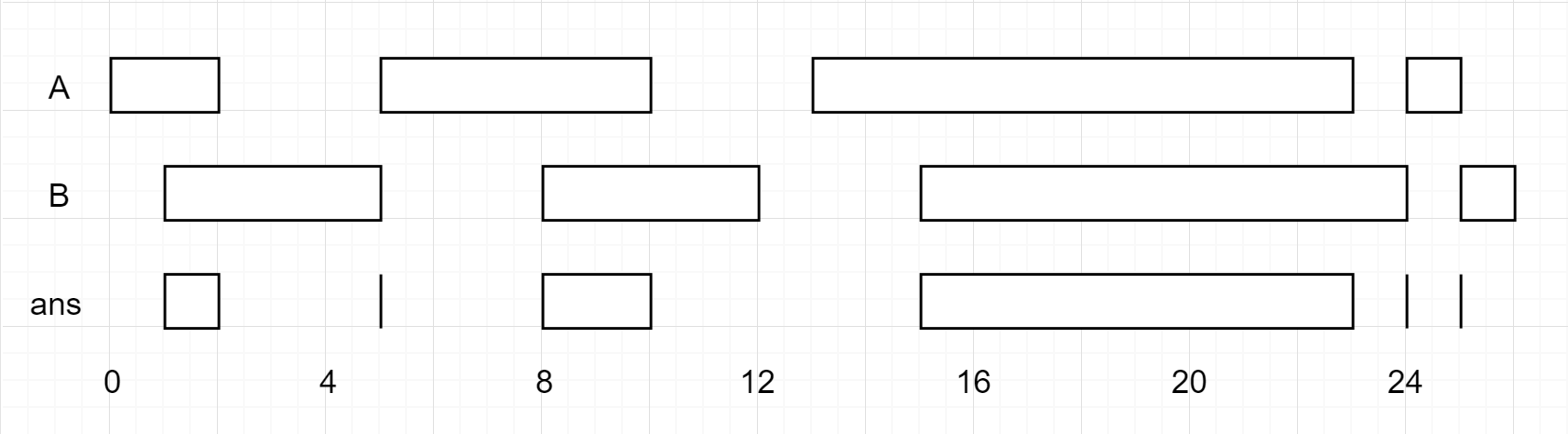
Input: firstList = [[0,2],[5,10],[13,23],[24,25]], secondList = [[1,5],[8,12],[15,24],[25,26]]
Output: [[1,2],[5,5],[8,10],[15,23],[24,24],[25,25]]
Example 2:
Input: firstList = [[1,3],[5,9]], secondList = []
Output: []
Constraints:
0 <= firstList.length, secondList.length <= 1000firstList.length + secondList.length >= 10 <= starti < endi <= 109endi < starti+10 <= startj < endj <= 109 endj < startj+1
Solutions
Solution 1
PythonJavaC++GoTypeScriptRust
class Solution:
def intervalIntersection(
self, firstList: List[List[int]], secondList: List[List[int]]
) -> List[List[int]]:
i = j = 0
ans = []
while i < len(firstList) and j < len(secondList):
s1, e1, s2, e2 = *firstList[i], *secondList[j]
l, r = max(s1, s2), min(e1, e2)
if l <= r:
ans.append([l, r])
if e1 < e2:
i += 1
else:
j += 1
return ans(code-box)
class Solution {
public int[][] intervalIntersection(int[][] firstList, int[][] secondList) {
List<int[]> ans = new ArrayList<>();
int m = firstList.length, n = secondList.length;
for (int i = 0, j = 0; i < m && j < n;) {
int l = Math.max(firstList[i][0], secondList[j][0]);
int r = Math.min(firstList[i][1], secondList[j][1]);
if (l <= r) {
ans.add(new int[] {l, r});
}
if (firstList[i][1] < secondList[j][1]) {
++i;
} else {
++j;
}
}
return ans.toArray(new int[ans.size()][]);
}
}(code-box)
class Solution {
public:
vector<vector<int>> intervalIntersection(vector<vector<int>>& firstList, vector<vector<int>>& secondList) {
vector<vector<int>> ans;
int m = firstList.size(), n = secondList.size();
for (int i = 0, j = 0; i < m && j < n;) {
int l = max(firstList[i][0], secondList[j][0]);
int r = min(firstList[i][1], secondList[j][1]);
if (l <= r) ans.push_back({l, r});
if (firstList[i][1] < secondList[j][1])
++i;
else
++j;
}
return ans;
}
};(code-box)
func intervalIntersection(firstList [][]int, secondList [][]int) [][]int {
m, n := len(firstList), len(secondList)
var ans [][]int
for i, j := 0, 0; i < m && j < n; {
l := max(firstList[i][0], secondList[j][0])
r := min(firstList[i][1], secondList[j][1])
if l <= r {
ans = append(ans, []int{l, r})
}
if firstList[i][1] < secondList[j][1] {
i++
} else {
j++
}
}
return ans
}(code-box)
function intervalIntersection(firstList: number[][], secondList: number[][]): number[][] {
const n = firstList.length;
const m = secondList.length;
const res = [];
let i = 0;
let j = 0;
while (i < n && j < m) {
const start = Math.max(firstList[i][0], secondList[j][0]);
const end = Math.min(firstList[i][1], secondList[j][1]);
if (start <= end) {
res.push([start, end]);
}
if (firstList[i][1] < secondList[j][1]) {
i++;
} else {
j++;
}
}
return res;
}(code-box)
impl Solution {
pub fn interval_intersection(
first_list: Vec<Vec<i32>>,
second_list: Vec<Vec<i32>>,
) -> Vec<Vec<i32>> {
let n = first_list.len();
let m = second_list.len();
let mut res = Vec::new();
let (mut i, mut j) = (0, 0);
while i < n && j < m {
let start = first_list[i][0].max(second_list[j][0]);
let end = first_list[i][1].min(second_list[j][1]);
if start <= end {
res.push(vec![start, end]);
}
if first_list[i][1] < second_list[j][1] {
i += 1;
} else {
j += 1;
}
}
res
}
}(code-box)


