
Description
Given the root of a binary tree, return the maximum width of the given tree.
The maximum width of a tree is the maximum width among all levels.
The width of one level is defined as the length between the end-nodes (the leftmost and rightmost non-null nodes), where the null nodes between the end-nodes that would be present in a complete binary tree extending down to that level are also counted into the length calculation.
It is guaranteed that the answer will in the range of a 32-bit signed integer.
Example 1:
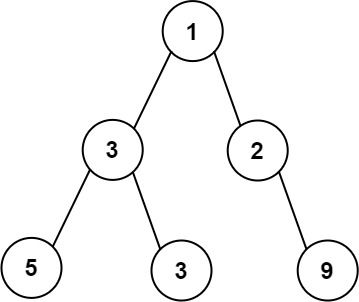
Input: root = [1,3,2,5,3,null,9]
Output: 4
Explanation: The maximum width exists in the third level with length 4 (5,3,null,9).
Example 2:
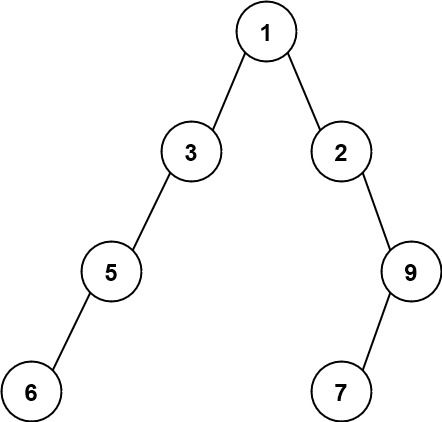
Input: root = [1,3,2,5,null,null,9,6,null,7]
Output: 7
Explanation: The maximum width exists in the fourth level with length 7 (6,null,null,null,null,null,7).
Example 3:
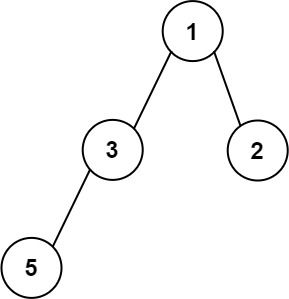
Input: root = [1,3,2,5]
Output: 2
Explanation: The maximum width exists in the second level with length 2 (3,2).
Constraints:
- The number of nodes in the tree is in the range
[1, 3000].
-100 <= Node.val <= 100
Solutions
Solution 1
PythonJavaC++Go
# Definition for a binary tree node.
# class TreeNode:
# def __init__(self, val=0, left=None, right=None):
# self.val = val
# self.left = left
# self.right = right
class Solution:
def widthOfBinaryTree(self, root: Optional[TreeNode]) -> int:
ans = 0
q = deque([(root, 1)])
while q:
ans = max(ans, q[-1][1] - q[0][1] + 1)
for _ in range(len(q)):
root, i = q.popleft()
if root.left:
q.append((root.left, i << 1))
if root.right:
q.append((root.right, i << 1 | 1))
return ans(code-box)
/**
* Definition for a binary tree node.
* public class TreeNode {
* int val;
* TreeNode left;
* TreeNode right;
* TreeNode() {}
* TreeNode(int val) { this.val = val; }
* TreeNode(int val, TreeNode left, TreeNode right) {
* this.val = val;
* this.left = left;
* this.right = right;
* }
* }
*/
class Solution {
public int widthOfBinaryTree(TreeNode root) {
Deque<Pair<TreeNode, Integer>> q = new ArrayDeque<>();
q.offer(new Pair<>(root, 1));
int ans = 0;
while (!q.isEmpty()) {
ans = Math.max(ans, q.peekLast().getValue() - q.peekFirst().getValue() + 1);
for (int n = q.size(); n > 0; --n) {
var p = q.pollFirst();
root = p.getKey();
int i = p.getValue();
if (root.left != null) {
q.offer(new Pair<>(root.left, i << 1));
}
if (root.right != null) {
q.offer(new Pair<>(root.right, i << 1 | 1));
}
}
}
return ans;
}
}(code-box)
/**
* Definition for a binary tree node.
* struct TreeNode {
* int val;
* TreeNode *left;
* TreeNode *right;
* TreeNode() : val(0), left(nullptr), right(nullptr) {}
* TreeNode(int x) : val(x), left(nullptr), right(nullptr) {}
* TreeNode(int x, TreeNode *left, TreeNode *right) : val(x), left(left), right(right) {}
* };
*/
class Solution {
public:
int widthOfBinaryTree(TreeNode* root) {
queue<pair<TreeNode*, int>> q;
q.push({root, 1});
int ans = 0;
while (!q.empty()) {
ans = max(ans, q.back().second - q.front().second + 1);
int i = q.front().second;
for (int n = q.size(); n; --n) {
auto p = q.front();
q.pop();
root = p.first;
int j = p.second;
if (root->left) q.push({root->left, (j << 1) - (i << 1)});
if (root->right) q.push({root->right, (j << 1 | 1) - (i << 1)});
}
}
return ans;
}
};(code-box)
/**
* Definition for a binary tree node.
* type TreeNode struct {
* Val int
* Left *TreeNode
* Right *TreeNode
* }
*/
func widthOfBinaryTree(root *TreeNode) int {
q := []pair{{root, 1}}
ans := 0
for len(q) > 0 {
ans = max(ans, q[len(q)-1].i-q[0].i+1)
for n := len(q); n > 0; n-- {
p := q[0]
q = q[1:]
root = p.node
if root.Left != nil {
q = append(q, pair{root.Left, p.i << 1})
}
if root.Right != nil {
q = append(q, pair{root.Right, p.i<<1 | 1})
}
}
}
return ans
}
type pair struct {
node *TreeNode
i int
}(code-box)
Solution 2
PythonJavaC++Go
# Definition for a binary tree node.
# class TreeNode:
# def __init__(self, val=0, left=None, right=None):
# self.val = val
# self.left = left
# self.right = right
class Solution:
def widthOfBinaryTree(self, root: Optional[TreeNode]) -> int:
def dfs(root, depth, i):
if root is None:
return
if len(t) == depth:
t.append(i)
else:
nonlocal ans
ans = max(ans, i - t[depth] + 1)
dfs(root.left, depth + 1, i << 1)
dfs(root.right, depth + 1, i << 1 | 1)
ans = 1
t = []
dfs(root, 0, 1)
return ans(code-box)
/**
* Definition for a binary tree node.
* public class TreeNode {
* int val;
* TreeNode left;
* TreeNode right;
* TreeNode() {}
* TreeNode(int val) { this.val = val; }
* TreeNode(int val, TreeNode left, TreeNode right) {
* this.val = val;
* this.left = left;
* this.right = right;
* }
* }
*/
class Solution {
private int ans = 1;
private List<Integer> t = new ArrayList<>();
public int widthOfBinaryTree(TreeNode root) {
dfs(root, 0, 1);
return ans;
}
private void dfs(TreeNode root, int depth, int i) {
if (root == null) {
return;
}
if (t.size() == depth) {
t.add(i);
} else {
ans = Math.max(ans, i - t.get(depth) + 1);
}
dfs(root.left, depth + 1, i << 1);
dfs(root.right, depth + 1, i << 1 | 1);
}
}(code-box)
/**
* Definition for a binary tree node.
* struct TreeNode {
* int val;
* TreeNode *left;
* TreeNode *right;
* TreeNode() : val(0), left(nullptr), right(nullptr) {}
* TreeNode(int x) : val(x), left(nullptr), right(nullptr) {}
* TreeNode(int x, TreeNode *left, TreeNode *right) : val(x), left(left), right(right) {}
* };
*/
class Solution {
public:
vector<int> t;
int ans = 1;
using ull = unsigned long long;
int widthOfBinaryTree(TreeNode* root) {
dfs(root, 0, 1);
return ans;
}
void dfs(TreeNode* root, int depth, ull i) {
if (!root) return;
if (t.size() == depth) {
t.push_back(i);
} else {
ans = max(ans, (int) (i - t[depth] + 1));
}
dfs(root->left, depth + 1, i << 1);
dfs(root->right, depth + 1, i << 1 | 1);
}
};(code-box)
/**
* Definition for a binary tree node.
* type TreeNode struct {
* Val int
* Left *TreeNode
* Right *TreeNode
* }
*/
func widthOfBinaryTree(root *TreeNode) int {
ans := 1
t := []int{}
var dfs func(root *TreeNode, depth, i int)
dfs = func(root *TreeNode, depth, i int) {
if root == nil {
return
}
if len(t) == depth {
t = append(t, i)
} else {
ans = max(ans, i-t[depth]+1)
}
dfs(root.Left, depth+1, i<<1)
dfs(root.Right, depth+1, i<<1|1)
}
dfs(root, 0, 1)
return ans
}(code-box)


