


Description
An image smoother is a filter of the size 3 x 3 that can be applied to each cell of an image by rounding down the average of the cell and the eight surrounding cells (i.e., the average of the nine cells in the blue smoother). If one or more of the surrounding cells of a cell is not present, we do not consider it in the average (i.e., the average of the four cells in the red smoother).
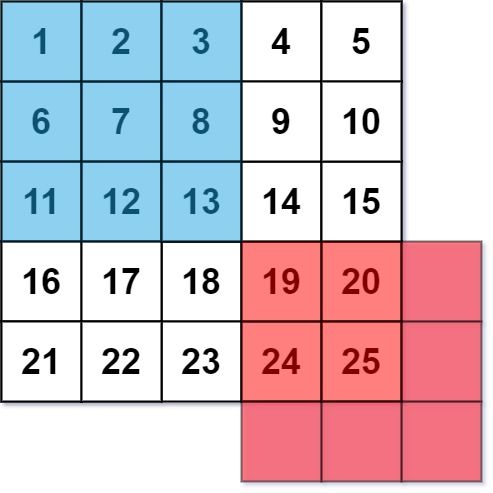
Given an m x n integer matrix img representing the grayscale of an image, return the image after applying the smoother on each cell of it.
Example 1:
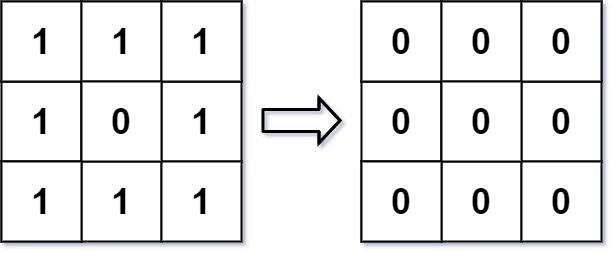
Input: img = [[1,1,1],[1,0,1],[1,1,1]]
Output: [[0,0,0],[0,0,0],[0,0,0]]
Explanation:
For the points (0,0), (0,2), (2,0), (2,2): floor(3/4) = floor(0.75) = 0
For the points (0,1), (1,0), (1,2), (2,1): floor(5/6) = floor(0.83333333) = 0
For the point (1,1): floor(8/9) = floor(0.88888889) = 0
Example 2:
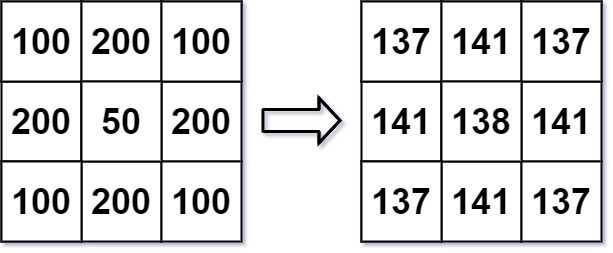
Input: img = [[100,200,100],[200,50,200],[100,200,100]]
Output: [[137,141,137],[141,138,141],[137,141,137]]
Explanation:
For the points (0,0), (0,2), (2,0), (2,2): floor((100+200+200+50)/4) = floor(137.5) = 137
For the points (0,1), (1,0), (1,2), (2,1): floor((200+200+50+200+100+100)/6) = floor(141.666667) = 141
For the point (1,1): floor((50+200+200+200+200+100+100+100+100)/9) = floor(138.888889) = 138
Constraints:
m == img.lengthn == img[i].length1 <= m, n <= 2000 <= img[i][j] <= 255
Solutions
Solution 1: Direct Traversal
We create a 2D array ans of size m × n, where ans[i][j] represents the smoothed value of the cell in the i-th row and j-th column of the image.
For ans[i][j], we traverse the cell in the i-th row and j-th column of img and its surrounding 8 cells, calculate their sum s and count cnt, then compute the average value s / cnt and store it in ans[i][j].
After the traversal, we return ans.
The time complexity is O(m × n), where m and n are the number of rows and columns of img, respectively. Ignoring the space consumption of the answer array, the space complexity is O(1).
class Solution: def imageSmoother(self, img: List[List[int]]) -> List[List[int]]: m, n = len(img), len(img[0]) ans = [[0] * n for _ in range(m)] for i in range(m): for j in range(n): s = cnt = 0 for x in range(i - 1, i + 2): for y in range(j - 1, j + 2): if 0 <= x < m and 0 <= y < n: cnt += 1 s += img[x][y] ans[i][j] = s // cnt return ans(code-box)
