
Description
Given strings s1, s2, and s3, find whether s3 is formed by an interleaving of s1 and s2.
An interleaving of two strings s and t is a configuration where s and t are divided into n and m substrings respectively, such that:
s = s1 + s2 + ... + snt = t1 + t2 + ... + tm|n - m| <= 1- The interleaving is
s1 + t1 + s2 + t2 + s3 + t3 + ... or t1 + s1 + t2 + s2 + t3 + s3 + ...
Note: a + b is the concatenation of strings a and b.
Example 1:
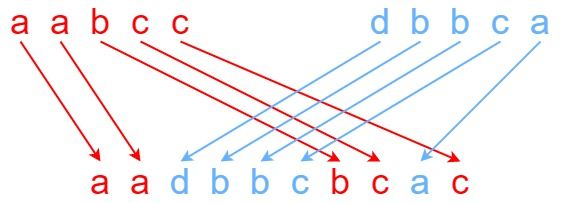
Input: s1 = "aabcc", s2 = "dbbca", s3 = "aadbbcbcac"
Output: true
Explanation: One way to obtain s3 is:
Split s1 into s1 = "aa" + "bc" + "c", and s2 into s2 = "dbbc" + "a".
Interleaving the two splits, we get "aa" + "dbbc" + "bc" + "a" + "c" = "aadbbcbcac".
Since s3 can be obtained by interleaving s1 and s2, we return true.
Example 2:
Input: s1 = "aabcc", s2 = "dbbca", s3 = "aadbbbaccc"
Output: false
Explanation: Notice how it is impossible to interleave s2 with any other string to obtain s3.
Example 3:
Input: s1 = "", s2 = "", s3 = ""
Output: true
Constraints:
0 <= s1.length, s2.length <= 1000 <= s3.length <= 200s1, s2, and s3 consist of lowercase English letters.
Follow up: Could you solve it using only O(s2.length) additional memory space?
Solutions
Solution 1: Memoization Search
Let's denote the length of string s_1 as m and the length of string s_2 as n. If m + n ≠ |s_3|, then s_3 is definitely not an interleaving string of s_1 and s_2, so we return false.
Next, we design a function dfs(i, j), which represents whether the remaining part of s_3 can be interleaved from the ith character of s_1 and the jth character of s_2. The answer is dfs(0, 0).
The calculation process of function dfs(i, j) is as follows:
If i ≥ m and j ≥ n, it means that both s_1 and s_2 have been traversed, so we return true.
If i < m and s_1[i] = s_3[i + j], it means that the character s_1[i] is part of s_3[i + j]. Therefore, we recursively call dfs(i + 1, j) to check whether the next character of s_1 can match the current character of s_2. If it can match, we return true.
Similarly, if j < n and s_2[j] = s_3[i + j], it means that the character s_2[j] is part of s_3[i + j]. Therefore, we recursively call dfs(i, j + 1) to check whether the next character of s_2 can match the current character of s_1. If it can match, we return true.
Otherwise, we return false.
To avoid repeated calculations, we can use memoization search.
The time complexity is O(m × n), and the space complexity is O(m × n). Here, m and n are the lengths of strings s_1 and s_2 respectively.
PythonJavaC++GoTypeScriptRustC#
class Solution:
def isInterleave(self, s1: str, s2: str, s3: str) -> bool:
@cache
def dfs(i: int, j: int) -> bool:
if i >= m and j >= n:
return True
k = i + j
if i < m and s1[i] == s3[k] and dfs(i + 1, j):
return True
if j < n and s2[j] == s3[k] and dfs(i, j + 1):
return True
return False
m, n = len(s1), len(s2)
if m + n != len(s3):
return False
return dfs(0, 0)(code-box)
class Solution {
private Map<List<Integer>, Boolean> f = new HashMap<>();
private String s1;
private String s2;
private String s3;
private int m;
private int n;
public boolean isInterleave(String s1, String s2, String s3) {
m = s1.length();
n = s2.length();
if (m + n != s3.length()) {
return false;
}
this.s1 = s1;
this.s2 = s2;
this.s3 = s3;
return dfs(0, 0);
}
private boolean dfs(int i, int j) {
if (i >= m && j >= n) {
return true;
}
var key = List.of(i, j);
if (f.containsKey(key)) {
return f.get(key);
}
int k = i + j;
boolean ans = false;
if (i < m && s1.charAt(i) == s3.charAt(k) && dfs(i + 1, j)) {
ans = true;
}
if (!ans && j < n && s2.charAt(j) == s3.charAt(k) && dfs(i, j + 1)) {
ans = true;
}
f.put(key, ans);
return ans;
}
}(code-box)
class Solution {
public:
bool isInterleave(string s1, string s2, string s3) {
int m = s1.size(), n = s2.size();
if (m + n != s3.size()) {
return false;
}
vector<vector<int>> f(m + 1, vector<int>(n + 1, -1));
function<bool(int, int)> dfs = [&](int i, int j) {
if (i >= m && j >= n) {
return true;
}
if (f[i][j] != -1) {
return f[i][j] == 1;
}
f[i][j] = 0;
int k = i + j;
if (i < m && s1[i] == s3[k] && dfs(i + 1, j)) {
f[i][j] = 1;
}
if (!f[i][j] && j < n && s2[j] == s3[k] && dfs(i, j + 1)) {
f[i][j] = 1;
}
return f[i][j] == 1;
};
return dfs(0, 0);
}
};(code-box)
func isInterleave(s1 string, s2 string, s3 string) bool {
m, n := len(s1), len(s2)
if m+n != len(s3) {
return false
}
f := map[int]bool{}
var dfs func(int, int) bool
dfs = func(i, j int) bool {
if i >= m && j >= n {
return true
}
if v, ok := f[i*200+j]; ok {
return v
}
k := i + j
f[i*200+j] = (i < m && s1[i] == s3[k] && dfs(i+1, j)) || (j < n && s2[j] == s3[k] && dfs(i, j+1))
return f[i*200+j]
}
return dfs(0, 0)
}(code-box)
function isInterleave(s1: string, s2: string, s3: string): boolean {
const m = s1.length;
const n = s2.length;
if (m + n !== s3.length) {
return false;
}
const f: number[][] = new Array(m + 1).fill(0).map(() => new Array(n + 1).fill(0));
const dfs = (i: number, j: number): boolean => {
if (i >= m && j >= n) {
return true;
}
if (f[i][j]) {
return f[i][j] === 1;
}
f[i][j] = -1;
if (i < m && s1[i] === s3[i + j] && dfs(i + 1, j)) {
f[i][j] = 1;
}
if (f[i][j] === -1 && j < n && s2[j] === s3[i + j] && dfs(i, j + 1)) {
f[i][j] = 1;
}
return f[i][j] === 1;
};
return dfs(0, 0);
}(code-box)
impl Solution {
#[allow(dead_code)]
pub fn is_interleave(s1: String, s2: String, s3: String) -> bool {
let n = s1.len();
let m = s2.len();
if s1.len() + s2.len() != s3.len() {
return false;
}
let mut record = vec![vec![-1; m + 1]; n + 1];
Self::dfs(
&mut record,
n,
m,
0,
0,
&s1.chars().collect(),
&s2.chars().collect(),
&s3.chars().collect(),
)
}
#[allow(dead_code)]
fn dfs(
record: &mut Vec<Vec<i32>>,
n: usize,
m: usize,
i: usize,
j: usize,
s1: &Vec<char>,
s2: &Vec<char>,
s3: &Vec<char>,
) -> bool {
if i >= n && j >= m {
return true;
}
if record[i][j] != -1 {
return record[i][j] == 1;
}
// Set the initial value
record[i][j] = 0;
let k = i + j;
// Let's try `s1` first
if i < n && s1[i] == s3[k] && Self::dfs(record, n, m, i + 1, j, s1, s2, s3) {
record[i][j] = 1;
}
// If the first approach does not succeed, let's then try `s2`
if record[i][j] == 0
&& j < m
&& s2[j] == s3[k]
&& Self::dfs(record, n, m, i, j + 1, s1, s2, s3)
{
record[i][j] = 1;
}
record[i][j] == 1
}
}(code-box)
public class Solution {
private int m;
private int n;
private string s1;
private string s2;
private string s3;
private int[,] f;
public bool IsInterleave(string s1, string s2, string s3) {
m = s1.Length;
n = s2.Length;
if (m + n != s3.Length) {
return false;
}
this.s1 = s1;
this.s2 = s2;
this.s3 = s3;
f = new int[m + 1, n + 1];
return dfs(0, 0);
}
private bool dfs(int i, int j) {
if (i >= m && j >= n) {
return true;
}
if (f[i, j] != 0) {
return f[i, j] == 1;
}
f[i, j] = -1;
if (i < m && s1[i] == s3[i + j] && dfs(i + 1, j)) {
f[i, j] = 1;
}
if (f[i, j] == -1 && j < n && s2[j] == s3[i + j] && dfs(i, j + 1)) {
f[i, j] = 1;
}
return f[i, j] == 1;
}
}(code-box)
Solution 2: Dynamic Programming
We can convert the memoization search in Solution 1 into dynamic programming.
We define f[i][j] to represent whether the first i characters of string s_1 and the first j characters of string s_2 can interleave to form the first i + j characters of string s_3. When transitioning states, we can consider whether the current character is obtained from the last character of s_1 or the last character of s_2. Therefore, we have the state transition equation:
$$
f[i][j] = \begin{cases}
f[i - 1][j] & \textit{if } s_1[i - 1] = s_3[i + j - 1] \
\textit{or } f[i][j - 1] & \textit{if } s_2[j - 1] = s_3[i + j - 1] \
\textit{false} & \textit{otherwise}
\end{cases}
$$
where f[0][0] = true indicates that an empty string is an interleaving string of two empty strings.
The answer is f[m][n].
The time complexity is O(m × n), and the space complexity is O(m × n). Here, m and n are the lengths of strings s_1 and s_2 respectively.
We notice that the state f[i][j] is only related to the states f[i - 1][j], f[i][j - 1], and f[i - 1][j - 1]. Therefore, we can use a rolling array to optimize the space complexity, reducing the original space complexity from O(m × n) to O(n).
PythonJavaC++GoTypeScriptC#PythonJavaC++GoTypeScriptC#
class Solution:
def isInterleave(self, s1: str, s2: str, s3: str) -> bool:
m, n = len(s1), len(s2)
if m + n != len(s3):
return False
f = [[False] * (n + 1) for _ in range(m + 1)]
f[0][0] = True
for i in range(m + 1):
for j in range(n + 1):
k = i + j - 1
if i and s1[i - 1] == s3[k]:
f[i][j] = f[i - 1][j]
if j and s2[j - 1] == s3[k]:
f[i][j] |= f[i][j - 1]
return f[m][n](code-box)
class Solution {
public boolean isInterleave(String s1, String s2, String s3) {
int m = s1.length(), n = s2.length();
if (m + n != s3.length()) {
return false;
}
boolean[][] f = new boolean[m + 1][n + 1];
f[0][0] = true;
for (int i = 0; i <= m; ++i) {
for (int j = 0; j <= n; ++j) {
int k = i + j - 1;
if (i > 0 && s1.charAt(i - 1) == s3.charAt(k)) {
f[i][j] = f[i - 1][j];
}
if (j > 0 && s2.charAt(j - 1) == s3.charAt(k)) {
f[i][j] |= f[i][j - 1];
}
}
}
return f[m][n];
}
}(code-box)
class Solution {
public:
bool isInterleave(string s1, string s2, string s3) {
int m = s1.size(), n = s2.size();
if (m + n != s3.size()) {
return false;
}
bool f[m + 1][n + 1];
memset(f, false, sizeof(f));
f[0][0] = true;
for (int i = 0; i <= m; ++i) {
for (int j = 0; j <= n; ++j) {
int k = i + j - 1;
if (i > 0 && s1[i - 1] == s3[k]) {
f[i][j] = f[i - 1][j];
}
if (j > 0 && s2[j - 1] == s3[k]) {
f[i][j] |= f[i][j - 1];
}
}
}
return f[m][n];
}
};(code-box)
func isInterleave(s1 string, s2 string, s3 string) bool {
m, n := len(s1), len(s2)
if m+n != len(s3) {
return false
}
f := make([][]bool, m+1)
for i := range f {
f[i] = make([]bool, n+1)
}
f[0][0] = true
for i := 0; i <= m; i++ {
for j := 0; j <= n; j++ {
k := i + j - 1
if i > 0 && s1[i-1] == s3[k] {
f[i][j] = f[i-1][j]
}
if j > 0 && s2[j-1] == s3[k] {
f[i][j] = (f[i][j] || f[i][j-1])
}
}
}
return f[m][n]
}(code-box)
function isInterleave(s1: string, s2: string, s3: string): boolean {
const m = s1.length;
const n = s2.length;
if (m + n !== s3.length) {
return false;
}
const f: boolean[][] = new Array(m + 1).fill(0).map(() => new Array(n + 1).fill(false));
f[0][0] = true;
for (let i = 0; i <= m; ++i) {
for (let j = 0; j <= n; ++j) {
const k = i + j - 1;
if (i > 0 && s1[i - 1] === s3[k]) {
f[i][j] = f[i - 1][j];
}
if (j > 0 && s2[j - 1] === s3[k]) {
f[i][j] = f[i][j] || f[i][j - 1];
}
}
}
return f[m][n];
}(code-box)
public class Solution {
public bool IsInterleave(string s1, string s2, string s3) {
int m = s1.Length, n = s2.Length;
if (m + n != s3.Length) {
return false;
}
bool[,] f = new bool[m + 1, n + 1];
f[0, 0] = true;
for (int i = 0; i <= m; ++i) {
for (int j = 0; j <= n; ++j) {
int k = i + j - 1;
if (i > 0 && s1[i - 1] == s3[k]) {
f[i, j] = f[i - 1, j];
}
if (j > 0 && s2[j - 1] == s3[k]) {
f[i, j] |= f[i, j - 1];
}
}
}
return f[m, n];
}
}(code-box)
class Solution:
def isInterleave(self, s1: str, s2: str, s3: str) -> bool:
m, n = len(s1), len(s2)
if m + n != len(s3):
return False
f = [True] + [False] * n
for i in range(m + 1):
for j in range(n + 1):
k = i + j - 1
if i:
f[j] &= s1[i - 1] == s3[k]
if j:
f[j] |= f[j - 1] and s2[j - 1] == s3[k]
return f[n](code-box)
class Solution {
public boolean isInterleave(String s1, String s2, String s3) {
int m = s1.length(), n = s2.length();
if (m + n != s3.length()) {
return false;
}
boolean[] f = new boolean[n + 1];
f[0] = true;
for (int i = 0; i <= m; ++i) {
for (int j = 0; j <= n; ++j) {
int k = i + j - 1;
if (i > 0) {
f[j] &= s1.charAt(i - 1) == s3.charAt(k);
}
if (j > 0) {
f[j] |= (f[j - 1] & s2.charAt(j - 1) == s3.charAt(k));
}
}
}
return f[n];
}
}(code-box)
class Solution {
public:
bool isInterleave(string s1, string s2, string s3) {
int m = s1.size(), n = s2.size();
if (m + n != s3.size()) {
return false;
}
bool f[n + 1];
memset(f, false, sizeof(f));
f[0] = true;
for (int i = 0; i <= m; ++i) {
for (int j = 0; j <= n; ++j) {
int k = i + j - 1;
if (i) {
f[j] &= s1[i - 1] == s3[k];
}
if (j) {
f[j] |= (s2[j - 1] == s3[k] && f[j - 1]);
}
}
}
return f[n];
}
};(code-box)
func isInterleave(s1 string, s2 string, s3 string) bool {
m, n := len(s1), len(s2)
if m+n != len(s3) {
return false
}
f := make([]bool, n+1)
f[0] = true
for i := 0; i <= m; i++ {
for j := 0; j <= n; j++ {
k := i + j - 1
if i > 0 {
f[j] = (f[j] && s1[i-1] == s3[k])
}
if j > 0 {
f[j] = (f[j] || (s2[j-1] == s3[k] && f[j-1]))
}
}
}
return f[n]
}(code-box)
function isInterleave(s1: string, s2: string, s3: string): boolean {
const m = s1.length;
const n = s2.length;
if (m + n !== s3.length) {
return false;
}
const f: boolean[] = new Array(n + 1).fill(false);
f[0] = true;
for (let i = 0; i <= m; ++i) {
for (let j = 0; j <= n; ++j) {
const k = i + j - 1;
if (i) {
f[j] = f[j] && s1[i - 1] === s3[k];
}
if (j) {
f[j] = f[j] || (f[j - 1] && s2[j - 1] === s3[k]);
}
}
}
return f[n];
}(code-box)
public class Solution {
public bool IsInterleave(string s1, string s2, string s3) {
int m = s1.Length, n = s2.Length;
if (m + n != s3.Length) {
return false;
}
bool[] f = new bool[n + 1];
f[0] = true;
for (int i = 0; i <= m; ++i) {
for (int j = 0; j <= n; ++j) {
int k = i + j - 1;
if (i > 0) {
f[j] &= s1[i - 1] == s3[k];
}
if (j > 0) {
f[j] |= (f[j - 1] & s2[j - 1] == s3[k]);
}
}
}
return f[n];
}
}(code-box)


