
Description
Given an integer n, return the number of structurally unique BST's (binary search trees) which has exactly n nodes of unique values from 1 to n.
Example 1:
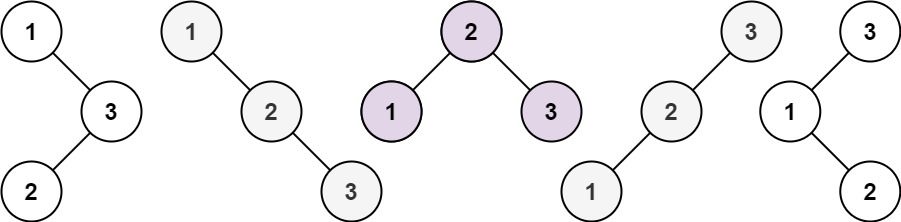
Input: n = 3
Output: 5
Example 2:
Input: n = 1
Output: 1
Constraints:
Solutions
Solution 1: Dynamic Programming
We define f[i] to represent the number of binary search trees that can be generated from [1, i]. Initially, f[0] = 1, and the answer is f[n].
We can enumerate the number of nodes i, then the number of nodes in the left subtree j ∈ [0, i - 1], and the number of nodes in the right subtree k = i - j - 1. The number of combinations of the number of nodes in the left subtree and the right subtree is f[j] × f[k], so f[i] = ∑_{j = 0}^{i - 1} f[j] × f[i - j - 1].
Finally, return f[n].
The time complexity is O(n), and the space complexity is O(n). Here, n is the number of nodes.
PythonJavaC++GoTypeScriptRustC#
class Solution:
def numTrees(self, n: int) -> int:
f = [1] + [0] * n
for i in range(n + 1):
for j in range(i):
f[i] += f[j] * f[i - j - 1]
return f[n](code-box)
class Solution {
public int numTrees(int n) {
int[] f = new int[n + 1];
f[0] = 1;
for (int i = 1; i <= n; ++i) {
for (int j = 0; j < i; ++j) {
f[i] += f[j] * f[i - j - 1];
}
}
return f[n];
}
}(code-box)
class Solution {
public:
int numTrees(int n) {
vector<int> f(n + 1);
f[0] = 1;
for (int i = 1; i <= n; ++i) {
for (int j = 0; j < i; ++j) {
f[i] += f[j] * f[i - j - 1];
}
}
return f[n];
}
};(code-box)
func numTrees(n int) int {
f := make([]int, n+1)
f[0] = 1
for i := 1; i <= n; i++ {
for j := 0; j < i; j++ {
f[i] += f[j] * f[i-j-1]
}
}
return f[n]
}(code-box)
function numTrees(n: number): number {
const f: number[] = Array(n + 1).fill(0);
f[0] = 1;
for (let i = 1; i <= n; ++i) {
for (let j = 0; j < i; ++j) {
f[i] += f[j] * f[i - j - 1];
}
}
return f[n];
}(code-box)
impl Solution {
pub fn num_trees(n: i32) -> i32 {
let n = n as usize;
let mut f = vec![0; n + 1];
f[0] = 1;
for i in 1..=n {
for j in 0..i {
f[i] += f[j] * f[i - j - 1];
}
}
f[n] as i32
}
}(code-box)
public class Solution {
public int NumTrees(int n) {
int[] f = new int[n + 1];
f[0] = 1;
for (int i = 1; i <= n; ++i) {
for (int j = 0; j < i; ++j) {
f[i] += f[j] * f[i - j - 1];
}
}
return f[n];
}
}(code-box)


