


Description
A train line going through a city has two routes, the regular route and the express route. Both routes go through the same n + 1 stops labeled from 0 to n. Initially, you start on the regular route at stop 0.
You are given two 1-indexed integer arrays regular and express, both of length n. regular[i] describes the cost it takes to go from stop i - 1 to stop i using the regular route, and express[i] describes the cost it takes to go from stop i - 1 to stop i using the express route.
You are also given an integer expressCost which represents the cost to transfer from the regular route to the express route.
Note that:
- There is no cost to transfer from the express route back to the regular route.
- You pay
expressCostevery time you transfer from the regular route to the express route. - There is no extra cost to stay on the express route.
Return a 1-indexed array costs of length n, where costs[i] is the minimum cost to reach stop i from stop 0.
Note that a stop can be counted as reached from either route.
Example 1:
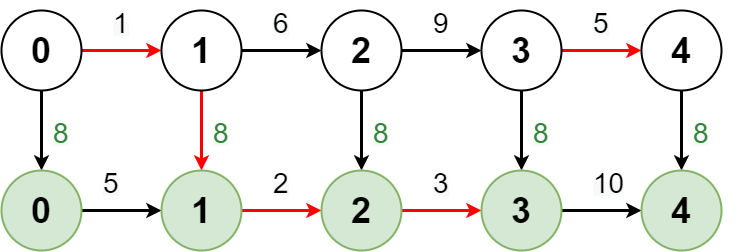
Input: regular = [1,6,9,5], express = [5,2,3,10], expressCost = 8
Output: [1,7,14,19]
Explanation: The diagram above shows how to reach stop 4 from stop 0 with minimum cost.
- Take the regular route from stop 0 to stop 1, costing 1.
- Take the express route from stop 1 to stop 2, costing 8 + 2 = 10.
- Take the express route from stop 2 to stop 3, costing 3.
- Take the regular route from stop 3 to stop 4, costing 5.
The total cost is 1 + 10 + 3 + 5 = 19.
Note that a different route could be taken to reach the other stops with minimum cost.
Example 2:
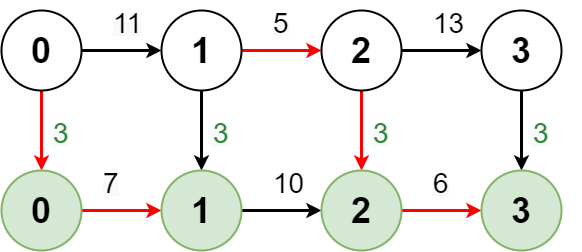
Input: regular = [11,5,13], express = [7,10,6], expressCost = 3
Output: [10,15,24]
Explanation: The diagram above shows how to reach stop 3 from stop 0 with minimum cost.
- Take the express route from stop 0 to stop 1, costing 3 + 7 = 10.
- Take the regular route from stop 1 to stop 2, costing 5.
- Take the express route from stop 2 to stop 3, costing 3 + 6 = 9.
The total cost is 10 + 5 + 9 = 24.
Note that the expressCost is paid again to transfer back to the express route.
Constraints:
n == regular.length == express.length1 <= n <= 1051 <= regular[i], express[i], expressCost <= 105
Solutions
Solution 1: Dynamic Programming
We define f[i] as the minimum cost from station 0 to station i when arriving at station i by the regular route, and g[i] as the minimum cost from station 0 to station i when arriving at station i by the express route. Initially, f[0]=0, g[0]=∞.
Next, we consider how to transition the states of f[i] and g[i].
If we arrive at station i by the regular route, we can either come from station i-1 by the regular route or switch from the express route at station i-1 to the regular route. Therefore, we can get the state transition equation:
where ai represents the cost of taking the regular route from station i-1 to station i.
If we arrive at station i by the express route, we can either switch from the regular route at station i-1 to the express route or continue on the express route from station i-1. Therefore, we can get the state transition equation:
where bi represents the cost of taking the express route from station i-1 to station i.
We denote the answer array as cost, where cost[i] represents the minimum cost from station 0 to station i. Since we can reach station i from any route, we have cost[i]=min{f[i], g[i]}.
Finally, we return cost.
The time complexity is O(n) and the space complexity is O(n), where n is the number of stations.
We notice that in the state transition equations of f[i] and g[i], we only need to use f[i-1] and g[i-1]. Therefore, we can use two variables f and g to record the values of f[i-1] and g[i-1] respectively. This allows us to optimize the space complexity to O(1).
class Solution: def minimumCosts( self, regular: List[int], express: List[int], expressCost: int ) -> List[int]: n = len(regular) f = [0] * (n + 1) g = [inf] * (n + 1) cost = [0] * n for i, (a, b) in enumerate(zip(regular, express), 1): f[i] = min(f[i - 1] + a, g[i - 1] + a) g[i] = min(f[i - 1] + expressCost + b, g[i - 1] + b) cost[i - 1] = min(f[i], g[i]) return cost(code-box)
