
Description
You are given a directed graph of n nodes numbered from 0 to n - 1, where each node has at most one outgoing edge.
The graph is represented with a given 0-indexed array edges of size n, indicating that there is a directed edge from node i to node edges[i]. If there is no outgoing edge from node i, then edges[i] == -1.
Return the length of the longest cycle in the graph. If no cycle exists, return -1.
A cycle is a path that starts and ends at the same node.
Example 1:
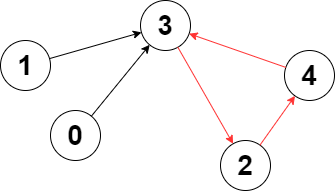
Input: edges = [3,3,4,2,3]
Output: 3
Explanation: The longest cycle in the graph is the cycle: 2 -> 4 -> 3 -> 2.
The length of this cycle is 3, so 3 is returned.
Example 2:
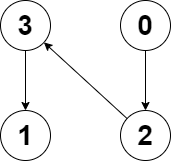
Input: edges = [2,-1,3,1]
Output: -1
Explanation: There are no cycles in this graph.
Constraints:
n == edges.length2 <= n <= 105-1 <= edges[i] < nedges[i] != i
Solutions
Solution 1: Traverse Starting Points
We can traverse each node in the range [0,..,n-1]. If a node has not been visited, we start from this node and search for adjacent nodes until we encounter a cycle or a node that has already been visited. If we encounter a cycle, we update the answer.
The time complexity is O(n) and the space complexity is O(n), where n is the number of nodes.
Similar problems:
PythonJavaC++GoTypeScriptRust
class Solution:
def longestCycle(self, edges: List[int]) -> int:
n = len(edges)
vis = [False] * n
ans = -1
for i in range(n):
if vis[i]:
continue
j = i
cycle = []
while j != -1 and not vis[j]:
vis[j] = True
cycle.append(j)
j = edges[j]
if j == -1:
continue
m = len(cycle)
k = next((k for k in range(m) if cycle[k] == j), inf)
ans = max(ans, m - k)
return ans(code-box)
class Solution {
public int longestCycle(int[] edges) {
int n = edges.length;
boolean[] vis = new boolean[n];
int ans = -1;
for (int i = 0; i < n; ++i) {
if (vis[i]) {
continue;
}
int j = i;
List<Integer> cycle = new ArrayList<>();
for (; j != -1 && !vis[j]; j = edges[j]) {
vis[j] = true;
cycle.add(j);
}
if (j == -1) {
continue;
}
for (int k = 0; k < cycle.size(); ++k) {
if (cycle.get(k) == j) {
ans = Math.max(ans, cycle.size() - k);
break;
}
}
}
return ans;
}
}(code-box)
class Solution {
public:
int longestCycle(vector<int>& edges) {
int n = edges.size();
vector<bool> vis(n);
int ans = -1;
for (int i = 0; i < n; ++i) {
if (vis[i]) {
continue;
}
int j = i;
vector<int> cycle;
for (; j != -1 && !vis[j]; j = edges[j]) {
vis[j] = true;
cycle.push_back(j);
}
if (j == -1) {
continue;
}
for (int k = 0; k < cycle.size(); ++k) {
if (cycle[k] == j) {
ans = max(ans, (int) cycle.size() - k);
break;
}
}
}
return ans;
}
};(code-box)
func longestCycle(edges []int) int {
vis := make([]bool, len(edges))
ans := -1
for i := range edges {
if vis[i] {
continue
}
j := i
cycle := []int{}
for ; j != -1 && !vis[j]; j = edges[j] {
vis[j] = true
cycle = append(cycle, j)
}
if j == -1 {
continue
}
for k := range cycle {
if cycle[k] == j {
ans = max(ans, len(cycle)-k)
break
}
}
}
return ans
}(code-box)
function longestCycle(edges: number[]): number {
const n = edges.length;
const vis: boolean[] = Array(n).fill(false);
let ans = -1;
for (let i = 0; i < n; ++i) {
if (vis[i]) {
continue;
}
let j = i;
const cycle: number[] = [];
for (; j !== -1 && !vis[j]; j = edges[j]) {
vis[j] = true;
cycle.push(j);
}
if (j === -1) {
continue;
}
for (let k = 0; k < cycle.length; ++k) {
if (cycle[k] === j) {
ans = Math.max(ans, cycle.length - k);
break;
}
}
}
return ans;
}(code-box)
impl Solution {
pub fn longest_cycle(edges: Vec<i32>) -> i32 {
let n = edges.len();
let mut vis = vec![false; n];
let mut ans = -1;
for i in 0..n {
if vis[i] {
continue;
}
let mut j = i as i32;
let mut cycle = Vec::new();
while j != -1 && !vis[j as usize] {
vis[j as usize] = true;
cycle.push(j);
j = edges[j as usize];
}
if j == -1 {
continue;
}
for k in 0..cycle.len() {
if cycle[k] == j {
ans = ans.max((cycle.len() - k) as i32);
break;
}
}
}
ans
}
}(code-box)


