
Description
We have n buildings numbered from 0 to n - 1. Each building has a number of employees. It's transfer season, and some employees want to change the building they reside in.
You are given an array requests where requests[i] = [fromi, toi] represents an employee's request to transfer from building fromi to building toi.
All buildings are full, so a list of requests is achievable only if for each building, the net change in employee transfers is zero. This means the number of employees leaving is equal to the number of employees moving in. For example if n = 3 and two employees are leaving building 0, one is leaving building 1, and one is leaving building 2, there should be two employees moving to building 0, one employee moving to building 1, and one employee moving to building 2.
Return the maximum number of achievable requests.
Example 1:
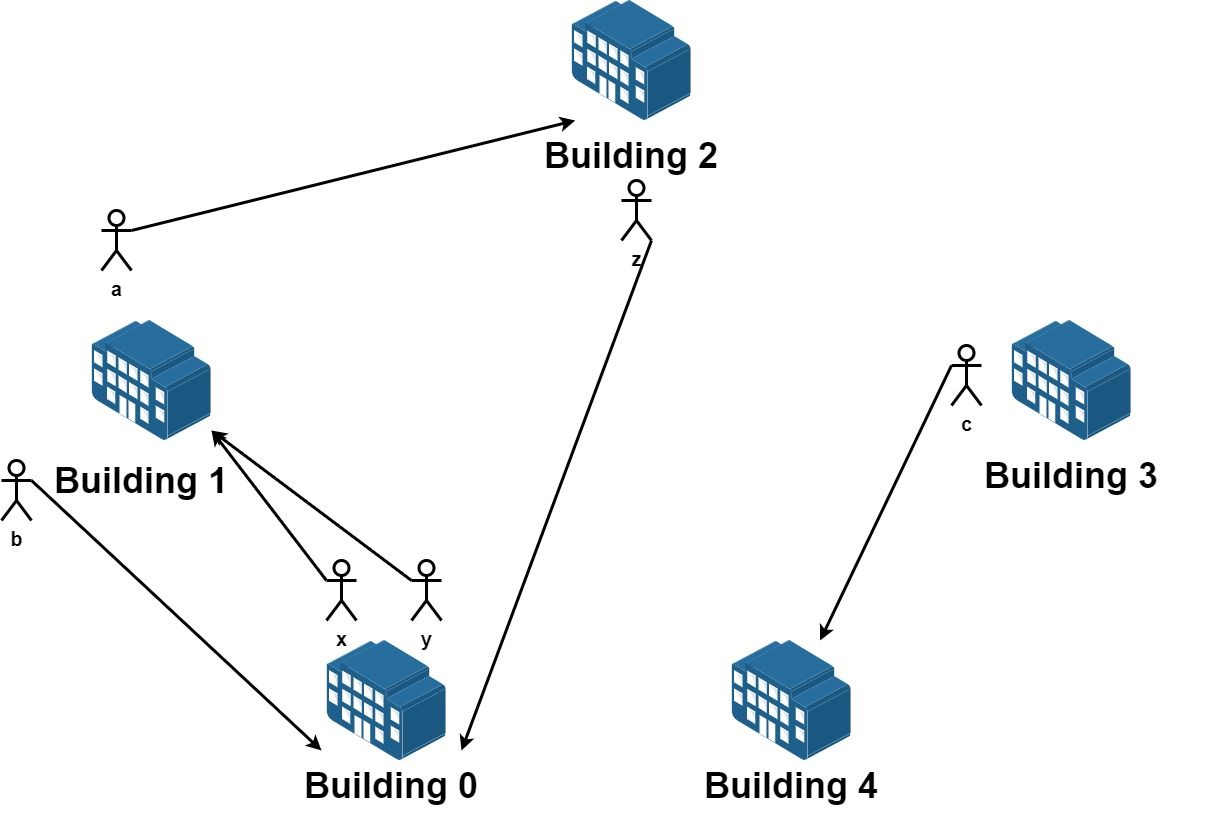
Input: n = 5, requests = [[0,1],[1,0],[0,1],[1,2],[2,0],[3,4]]
Output: 5
Explantion: Let's see the requests:
From building 0 we have employees x and y and both want to move to building 1.
From building 1 we have employees a and b and they want to move to buildings 2 and 0 respectively.
From building 2 we have employee z and they want to move to building 0.
From building 3 we have employee c and they want to move to building 4.
From building 4 we don't have any requests.
We can achieve the requests of users x and b by swapping their places.
We can achieve the requests of users y, a and z by swapping the places in the 3 buildings.
Example 2:
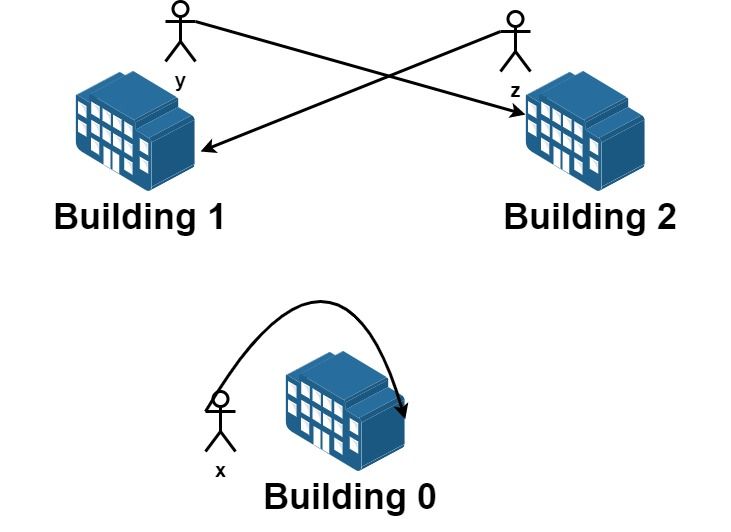
Input: n = 3, requests = [[0,0],[1,2],[2,1]]
Output: 3
Explantion: Let's see the requests:
From building 0 we have employee x and they want to stay in the same building 0.
From building 1 we have employee y and they want to move to building 2.
From building 2 we have employee z and they want to move to building 1.
We can achieve all the requests.
Example 3:
Input: n = 4, requests = [[0,3],[3,1],[1,2],[2,0]]
Output: 4
Constraints:
1 <= n <= 201 <= requests.length <= 16requests[i].length == 20 <= fromi, toi < n
Solutions
Solution 1: Binary Enumeration
We note that the length of the room change request list does not exceed 16. Therefore, we can use the method of binary enumeration to enumerate all room change request lists. Specifically, we can use a binary number of length 16 to represent a room change request list, where the i-th bit being 1 means the i-th room change request is selected, and 0 means the i-th room change request is not selected.
We enumerate all binary numbers in the range of [1, 2m), for each binary number mask, we first calculate how many 1s are in its binary representation, denoted as cnt. If cnt is larger than the current answer ans, then we judge whether mask is a feasible room change request list. If it is, then we update the answer ans with cnt. To judge whether mask is a feasible room change request list, we only need to check whether the net inflow of each room is 0.
The time complexity is O(2m × (m + n)), and the space complexity is O(n), where m and n are the lengths of the room change request list and the number of rooms, respectively.
PythonJavaC++GoTypeScriptJavaScriptC#
class Solution:
def maximumRequests(self, n: int, requests: List[List[int]]) -> int:
def check(mask: int) -> bool:
cnt = [0] * n
for i, (f, t) in enumerate(requests):
if mask >> i & 1:
cnt[f] -= 1
cnt[t] += 1
return all(v == 0 for v in cnt)
ans = 0
for mask in range(1 << len(requests)):
cnt = mask.bit_count()
if ans < cnt and check(mask):
ans = cnt
return ans(code-box)
class Solution {
private int m;
private int n;
private int[][] requests;
public int maximumRequests(int n, int[][] requests) {
m = requests.length;
this.n = n;
this.requests = requests;
int ans = 0;
for (int mask = 0; mask < 1 << m; ++mask) {
int cnt = Integer.bitCount(mask);
if (ans < cnt && check(mask)) {
ans = cnt;
}
}
return ans;
}
private boolean check(int mask) {
int[] cnt = new int[n];
for (int i = 0; i < m; ++i) {
if ((mask >> i & 1) == 1) {
int f = requests[i][0], t = requests[i][1];
--cnt[f];
++cnt[t];
}
}
for (int v : cnt) {
if (v != 0) {
return false;
}
}
return true;
}
}(code-box)
class Solution {
public:
int maximumRequests(int n, vector<vector<int>>& requests) {
int m = requests.size();
int ans = 0;
auto check = [&](int mask) -> bool {
int cnt[n];
memset(cnt, 0, sizeof(cnt));
for (int i = 0; i < m; ++i) {
if (mask >> i & 1) {
int f = requests[i][0], t = requests[i][1];
--cnt[f];
++cnt[t];
}
}
for (int v : cnt) {
if (v) {
return false;
}
}
return true;
};
for (int mask = 0; mask < 1 << m; ++mask) {
int cnt = __builtin_popcount(mask);
if (ans < cnt && check(mask)) {
ans = cnt;
}
}
return ans;
}
};(code-box)
func maximumRequests(n int, requests [][]int) (ans int) {
m := len(requests)
check := func(mask int) bool {
cnt := make([]int, n)
for i, r := range requests {
if mask>>i&1 == 1 {
f, t := r[0], r[1]
cnt[f]--
cnt[t]++
}
}
for _, v := range cnt {
if v != 0 {
return false
}
}
return true
}
for mask := 0; mask < 1<<m; mask++ {
cnt := bits.OnesCount(uint(mask))
if ans < cnt && check(mask) {
ans = cnt
}
}
return
}(code-box)
function maximumRequests(n: number, requests: number[][]): number {
const m = requests.length;
let ans = 0;
const check = (mask: number): boolean => {
const cnt = Array(n).fill(0);
for (let i = 0; i < m; ++i) {
if ((mask >> i) & 1) {
const [f, t] = requests[i];
--cnt[f];
++cnt[t];
}
}
return cnt.every(v => v === 0);
};
for (let mask = 0; mask < 1 << m; ++mask) {
const cnt = bitCount(mask);
if (ans < cnt && check(mask)) {
ans = cnt;
}
}
return ans;
}
function bitCount(i: number): number {
i = i - ((i >>> 1) & 0x55555555);
i = (i & 0x33333333) + ((i >>> 2) & 0x33333333);
i = (i + (i >>> 4)) & 0x0f0f0f0f;
i = i + (i >>> 8);
i = i + (i >>> 16);
return i & 0x3f;
}(code-box)
/**
* @param {number} n
* @param {number[][]} requests
* @return {number}
*/
var maximumRequests = function (n, requests) {
const m = requests.length;
let ans = 0;
const check = mask => {
const cnt = new Array(n).fill(0);
for (let i = 0; i < m; ++i) {
if ((mask >> i) & 1) {
const [f, t] = requests[i];
--cnt[f];
++cnt[t];
}
}
return cnt.every(v => v === 0);
};
for (let mask = 0; mask < 1 << m; ++mask) {
const cnt = bitCount(mask);
if (ans < cnt && check(mask)) {
ans = cnt;
}
}
return ans;
};
function bitCount(i) {
i = i - ((i >>> 1) & 0x55555555);
i = (i & 0x33333333) + ((i >>> 2) & 0x33333333);
i = (i + (i >>> 4)) & 0x0f0f0f0f;
i = i + (i >>> 8);
i = i + (i >>> 16);
return i & 0x3f;
}(code-box)
public class Solution {
private int m;
private int n;
private int[][] requests;
public int MaximumRequests(int n, int[][] requests) {
m = requests.Length;
this.n = n;
this.requests = requests;
int ans = 0;
for (int mask = 0; mask < (1 << m); ++mask) {
int cnt = CountBits(mask);
if (ans < cnt && Check(mask)) {
ans = cnt;
}
}
return ans;
}
private bool Check(int mask) {
int[] cnt = new int[n];
for (int i = 0; i < m; ++i) {
if (((mask >> i) & 1) == 1) {
int f = requests[i][0], t = requests[i][1];
--cnt[f];
++cnt[t];
}
}
foreach (int v in cnt) {
if (v != 0) {
return false;
}
}
return true;
}
private int CountBits(int n) {
int count = 0;
while (n > 0) {
n -= n & -n;
++count;
}
return count;
}
}(code-box)


