
Description
Given a weighted undirected connected graph with n vertices numbered from 0 to n - 1, and an array edges where edges[i] = [ai, bi, weighti] represents a bidirectional and weighted edge between nodes ai and bi. A minimum spanning tree (MST) is a subset of the graph's edges that connects all vertices without cycles and with the minimum possible total edge weight.
Find all the critical and pseudo-critical edges in the given graph's minimum spanning tree (MST). An MST edge whose deletion from the graph would cause the MST weight to increase is called a critical edge. On the other hand, a pseudo-critical edge is that which can appear in some MSTs but not all.
Note that you can return the indices of the edges in any order.
Example 1:
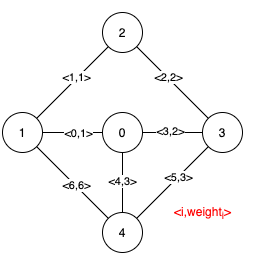
Input: n = 5, edges = [[0,1,1],[1,2,1],[2,3,2],[0,3,2],[0,4,3],[3,4,3],[1,4,6]]
Output: [[0,1],[2,3,4,5]]
Explanation: The figure above describes the graph.
The following figure shows all the possible MSTs:
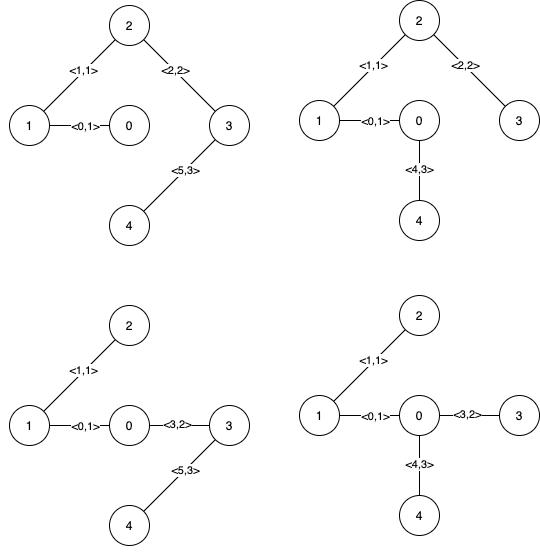 Notice that the two edges 0 and 1 appear in all MSTs, therefore they are critical edges, so we return them in the first list of the output.
The edges 2, 3, 4, and 5 are only part of some MSTs, therefore they are considered pseudo-critical edges. We add them to the second list of the output.
Notice that the two edges 0 and 1 appear in all MSTs, therefore they are critical edges, so we return them in the first list of the output.
The edges 2, 3, 4, and 5 are only part of some MSTs, therefore they are considered pseudo-critical edges. We add them to the second list of the output.
Example 2:
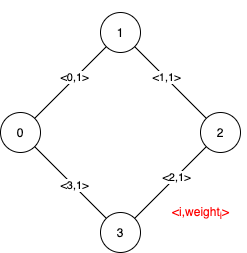
Input: n = 4, edges = [[0,1,1],[1,2,1],[2,3,1],[0,3,1]]
Output: [[],[0,1,2,3]]
Explanation: We can observe that since all 4 edges have equal weight, choosing any 3 edges from the given 4 will yield an MST. Therefore all 4 edges are pseudo-critical.
Constraints:
2 <= n <= 1001 <= edges.length <= min(200, n * (n - 1) / 2)edges[i].length == 30 <= ai < bi < n1 <= weighti <= 1000- All pairs
(ai, bi) are distinct.
Solutions
Solution 1
PythonJavaC++Go
class UnionFind:
def __init__(self, n):
self.p = list(range(n))
self.n = n
def union(self, a, b):
if self.find(a) == self.find(b):
return False
self.p[self.find(a)] = self.find(b)
self.n -= 1
return True
def find(self, x):
if self.p[x] != x:
self.p[x] = self.find(self.p[x])
return self.p[x]
class Solution:
def findCriticalAndPseudoCriticalEdges(
self, n: int, edges: List[List[int]]
) -> List[List[int]]:
for i, e in enumerate(edges):
e.append(i)
edges.sort(key=lambda x: x[2])
uf = UnionFind(n)
v = sum(w for f, t, w, _ in edges if uf.union(f, t))
ans = [[], []]
for f, t, w, i in edges:
uf = UnionFind(n)
k = sum(z for x, y, z, j in edges if j != i and uf.union(x, y))
if uf.n > 1 or (uf.n == 1 and k > v):
ans[0].append(i)
continue
uf = UnionFind(n)
uf.union(f, t)
k = w + sum(z for x, y, z, j in edges if j != i and uf.union(x, y))
if k == v:
ans[1].append(i)
return ans(code-box)
class Solution {
public List<List<Integer>> findCriticalAndPseudoCriticalEdges(int n, int[][] edges) {
for (int i = 0; i < edges.length; ++i) {
int[] e = edges[i];
int[] t = new int[4];
System.arraycopy(e, 0, t, 0, 3);
t[3] = i;
edges[i] = t;
}
Arrays.sort(edges, Comparator.comparingInt(a -> a[2]));
int v = 0;
UnionFind uf = new UnionFind(n);
for (int[] e : edges) {
int f = e[0], t = e[1], w = e[2];
if (uf.union(f, t)) {
v += w;
}
}
List<List<Integer>> ans = new ArrayList<>();
for (int i = 0; i < 2; ++i) {
ans.add(new ArrayList<>());
}
for (int[] e : edges) {
int f = e[0], t = e[1], w = e[2], i = e[3];
uf = new UnionFind(n);
int k = 0;
for (int[] ne : edges) {
int x = ne[0], y = ne[1], z = ne[2], j = ne[3];
if (j != i && uf.union(x, y)) {
k += z;
}
}
if (uf.getN() > 1 || (uf.getN() == 1 && k > v)) {
ans.get(0).add(i);
continue;
}
uf = new UnionFind(n);
uf.union(f, t);
k = w;
for (int[] ne : edges) {
int x = ne[0], y = ne[1], z = ne[2], j = ne[3];
if (j != i && uf.union(x, y)) {
k += z;
}
}
if (k == v) {
ans.get(1).add(i);
}
}
return ans;
}
}
class UnionFind {
private int[] p;
private int n;
public UnionFind(int n) {
p = new int[n];
this.n = n;
for (int i = 0; i < n; ++i) {
p[i] = i;
}
}
public int getN() {
return n;
}
public boolean union(int a, int b) {
if (find(a) == find(b)) {
return false;
}
p[find(a)] = find(b);
--n;
return true;
}
public int find(int x) {
if (p[x] != x) {
p[x] = find(p[x]);
}
return p[x];
}
}(code-box)
class UnionFind {
public:
vector<int> p;
int n;
UnionFind(int _n)
: n(_n)
, p(_n) {
iota(p.begin(), p.end(), 0);
}
bool unite(int a, int b) {
if (find(a) == find(b)) return false;
p[find(a)] = find(b);
--n;
return true;
}
int find(int x) {
if (p[x] != x) p[x] = find(p[x]);
return p[x];
}
};
class Solution {
public:
vector<vector<int>> findCriticalAndPseudoCriticalEdges(int n, vector<vector<int>>& edges) {
for (int i = 0; i < edges.size(); ++i) edges[i].push_back(i);
sort(edges.begin(), edges.end(), [](auto& a, auto& b) { return a[2] < b[2]; });
int v = 0;
UnionFind uf(n);
for (auto& e : edges) {
int f = e[0], t = e[1], w = e[2];
if (uf.unite(f, t)) v += w;
}
vector<vector<int>> ans(2);
for (auto& e : edges) {
int f = e[0], t = e[1], w = e[2], i = e[3];
UnionFind ufa(n);
int k = 0;
for (auto& ne : edges) {
int x = ne[0], y = ne[1], z = ne[2], j = ne[3];
if (j != i && ufa.unite(x, y)) k += z;
}
if (ufa.n > 1 || (ufa.n == 1 && k > v)) {
ans[0].push_back(i);
continue;
}
UnionFind ufb(n);
ufb.unite(f, t);
k = w;
for (auto& ne : edges) {
int x = ne[0], y = ne[1], z = ne[2], j = ne[3];
if (j != i && ufb.unite(x, y)) k += z;
}
if (k == v) ans[1].push_back(i);
}
return ans;
}
};(code-box)
type unionFind struct {
p []int
n int
}
func newUnionFind(n int) *unionFind {
p := make([]int, n)
for i := range p {
p[i] = i
}
return &unionFind{p, n}
}
func (uf *unionFind) find(x int) int {
if uf.p[x] != x {
uf.p[x] = uf.find(uf.p[x])
}
return uf.p[x]
}
func (uf *unionFind) union(a, b int) bool {
if uf.find(a) == uf.find(b) {
return false
}
uf.p[uf.find(a)] = uf.find(b)
uf.n--
return true
}
func findCriticalAndPseudoCriticalEdges(n int, edges [][]int) [][]int {
for i := range edges {
edges[i] = append(edges[i], i)
}
sort.Slice(edges, func(i, j int) bool {
return edges[i][2] < edges[j][2]
})
v := 0
uf := newUnionFind(n)
for _, e := range edges {
f, t, w := e[0], e[1], e[2]
if uf.union(f, t) {
v += w
}
}
ans := make([][]int, 2)
for _, e := range edges {
f, t, w, i := e[0], e[1], e[2], e[3]
uf = newUnionFind(n)
k := 0
for _, ne := range edges {
x, y, z, j := ne[0], ne[1], ne[2], ne[3]
if j != i && uf.union(x, y) {
k += z
}
}
if uf.n > 1 || (uf.n == 1 && k > v) {
ans[0] = append(ans[0], i)
continue
}
uf = newUnionFind(n)
uf.union(f, t)
k = w
for _, ne := range edges {
x, y, z, j := ne[0], ne[1], ne[2], ne[3]
if j != i && uf.union(x, y) {
k += z
}
}
if k == v {
ans[1] = append(ans[1], i)
}
}
return ans
}(code-box)


