
Description
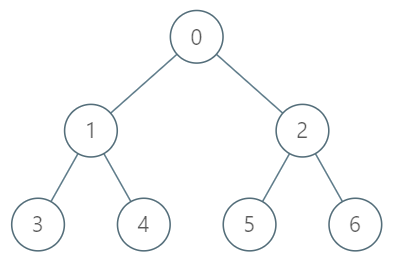
You are given a tree with n nodes numbered from 0 to n - 1 in the form of a parent array parent where parent[i] is the parent of ith node. The root of the tree is node 0. Find the kth ancestor of a given node.
The kth ancestor of a tree node is the kth node in the path from that node to the root node.
Implement the TreeAncestor class:
TreeAncestor(int n, int[] parent) Initializes the object with the number of nodes in the tree and the parent array.int getKthAncestor(int node, int k) return the kth ancestor of the given node node. If there is no such ancestor, return -1.
Example 1:
Input
["TreeAncestor", "getKthAncestor", "getKthAncestor", "getKthAncestor"]
[[7, [-1, 0, 0, 1, 1, 2, 2]], [3, 1], [5, 2], [6, 3]]
Output
[null, 1, 0, -1]

Explanation
TreeAncestor treeAncestor = new TreeAncestor(7, [-1, 0, 0, 1, 1, 2, 2]);
treeAncestor.getKthAncestor(3, 1); // returns 1 which is the parent of 3
treeAncestor.getKthAncestor(5, 2); // returns 0 which is the grandparent of 5
treeAncestor.getKthAncestor(6, 3); // returns -1 because there is no such ancestor
Constraints:
1 <= k <= n <= 5 * 104parent.length == nparent[0] == -10 <= parent[i] < n for all 0 < i < n0 <= node < n- There will be at most
5 * 104 queries.
Solutions
Solution 1: Dynamic Programming + Binary Lifting
The problem asks us to find the k-th ancestor node of a node node. If we solve it by brute force, we need to traverse upwards from node for k times, which has a time complexity of O(k) and will obviously exceed the time limit.
We can use dynamic programming combined with the idea of binary lifting to handle this.
We define p[i][j] as the 2j-th ancestor node of node i, i.e., the node reached by moving 2j steps upwards from node i. Then we can get the state transition equation:
p[i][j] = p[p[i][j-1]][j-1]
That is, to find the 2j-th ancestor node of node i, we can first find the 2j-1-th ancestor node of node i, and then find the 2j-1-th ancestor node of this node. Therefore, we need to find the ancestor node of each node at a distance of 2j, until we reach the maximum height of the tree.
For each query later, we can decompose k into its binary representation, and then according to the positions of 1 in the binary, we accumulate the queries upwards, and finally get the k-th ancestor node of node node.
In terms of time complexity, the initialization is O(n × log n), and the query is O(log n). The space complexity is O(n × log n), where n is the number of nodes in the tree.
Similar problems:
PythonJavaC++GoTypeScriptC#
class TreeAncestor:
def __init__(self, n: int, parent: List[int]):
self.p = [[-1] * 18 for _ in range(n)]
for i, fa in enumerate(parent):
self.p[i][0] = fa
for j in range(1, 18):
for i in range(n):
if self.p[i][j - 1] == -1:
continue
self.p[i][j] = self.p[self.p[i][j - 1]][j - 1]
def getKthAncestor(self, node: int, k: int) -> int:
for i in range(17, -1, -1):
if k >> i & 1:
node = self.p[node][i]
if node == -1:
break
return node
# Your TreeAncestor object will be instantiated and called as such:
# obj = TreeAncestor(n, parent)
# param_1 = obj.getKthAncestor(node,k)(code-box)
class TreeAncestor {
private int[][] p;
public TreeAncestor(int n, int[] parent) {
p = new int[n][18];
for (var e : p) {
Arrays.fill(e, -1);
}
for (int i = 0; i < n; ++i) {
p[i][0] = parent[i];
}
for (int j = 1; j < 18; ++j) {
for (int i = 0; i < n; ++i) {
if (p[i][j - 1] == -1) {
continue;
}
p[i][j] = p[p[i][j - 1]][j - 1];
}
}
}
public int getKthAncestor(int node, int k) {
for (int i = 17; i >= 0; --i) {
if (((k >> i) & 1) == 1) {
node = p[node][i];
if (node == -1) {
break;
}
}
}
return node;
}
}
/**
* Your TreeAncestor object will be instantiated and called as such:
* TreeAncestor obj = new TreeAncestor(n, parent);
* int param_1 = obj.getKthAncestor(node,k);
*/(code-box)
class TreeAncestor {
public:
TreeAncestor(int n, vector<int>& parent) {
p = vector<vector<int>>(n, vector<int>(18, -1));
for (int i = 0; i < n; ++i) {
p[i][0] = parent[i];
}
for (int j = 1; j < 18; ++j) {
for (int i = 0; i < n; ++i) {
if (p[i][j - 1] == -1) {
continue;
}
p[i][j] = p[p[i][j - 1]][j - 1];
}
}
}
int getKthAncestor(int node, int k) {
for (int i = 17; ~i; --i) {
if (k >> i & 1) {
node = p[node][i];
if (node == -1) {
break;
}
}
}
return node;
}
private:
vector<vector<int>> p;
};
/**
* Your TreeAncestor object will be instantiated and called as such:
* TreeAncestor* obj = new TreeAncestor(n, parent);
* int param_1 = obj->getKthAncestor(node,k);
*/(code-box)
type TreeAncestor struct {
p [][18]int
}
func Constructor(n int, parent []int) TreeAncestor {
p := make([][18]int, n)
for i, fa := range parent {
p[i][0] = fa
for j := 1; j < 18; j++ {
p[i][j] = -1
}
}
for j := 1; j < 18; j++ {
for i := range p {
if p[i][j-1] == -1 {
continue
}
p[i][j] = p[p[i][j-1]][j-1]
}
}
return TreeAncestor{p}
}
func (this *TreeAncestor) GetKthAncestor(node int, k int) int {
for i := 17; i >= 0; i-- {
if k>>i&1 == 1 {
node = this.p[node][i]
if node == -1 {
break
}
}
}
return node
}
/**
* Your TreeAncestor object will be instantiated and called as such:
* obj := Constructor(n, parent);
* param_1 := obj.GetKthAncestor(node,k);
*/(code-box)
class TreeAncestor {
private p: number[][];
constructor(n: number, parent: number[]) {
const p = new Array(n).fill(0).map(() => new Array(18).fill(-1));
for (let i = 0; i < n; ++i) {
p[i][0] = parent[i];
}
for (let j = 1; j < 18; ++j) {
for (let i = 0; i < n; ++i) {
if (p[i][j - 1] === -1) {
continue;
}
p[i][j] = p[p[i][j - 1]][j - 1];
}
}
this.p = p;
}
getKthAncestor(node: number, k: number): number {
for (let i = 17; i >= 0; --i) {
if (((k >> i) & 1) === 1) {
node = this.p[node][i];
if (node === -1) {
break;
}
}
}
return node;
}
}
/**
* Your TreeAncestor object will be instantiated and called as such:
* var obj = new TreeAncestor(n, parent)
* var param_1 = obj.getKthAncestor(node,k)
*/(code-box)
public class TreeAncestor {
private int[][] p;
public TreeAncestor(int n, int[] parent) {
p = new int[n][];
for (int i = 0; i < n; i++) {
p[i] = new int[18];
for (int j = 0; j < 18; j++) {
p[i][j] = -1;
}
}
for (int i = 0; i < n; ++i) {
p[i][0] = parent[i];
}
for (int j = 1; j < 18; ++j) {
for (int i = 0; i < n; ++i) {
if (p[i][j - 1] == -1) {
continue;
}
p[i][j] = p[p[i][j - 1]][j - 1];
}
}
}
public int GetKthAncestor(int node, int k) {
for (int i = 17; i >= 0; --i) {
if (((k >> i) & 1) == 1) {
node = p[node][i];
if (node == -1) {
break;
}
}
}
return node;
}
}
/**
* Your TreeAncestor object will be instantiated and called as such:
* TreeAncestor obj = new TreeAncestor(n, parent);
* int param_1 = obj.GetKthAncestor(node,k);
*/(code-box)


