


Description
You are given the head of a linked list and two integers m and n.
Traverse the linked list and remove some nodes in the following way:
- Start with the head as the current node.
- Keep the first
mnodes starting with the current node. - Remove the next
nnodes - Keep repeating steps 2 and 3 until you reach the end of the list.
Return the head of the modified list after removing the mentioned nodes.
Example 1:

Input: head = [1,2,3,4,5,6,7,8,9,10,11,12,13], m = 2, n = 3
Output: [1,2,6,7,11,12]
Explanation: Keep the first (m = 2) nodes starting from the head of the linked List  (1 ->2) show in black nodes.
Delete the next (n = 3) nodes (3 -> 4 -> 5) show in read nodes.
Continue with the same procedure until reaching the tail of the Linked List.
Head of the linked list after removing nodes is returned.
Example 2:
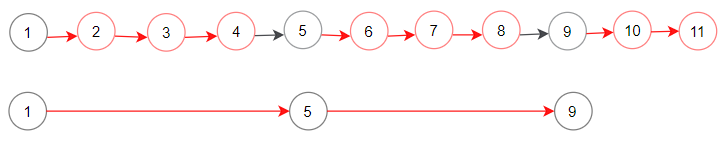
Input: head = [1,2,3,4,5,6,7,8,9,10,11], m = 1, n = 3
Output: [1,5,9]
Explanation: Head of linked list after removing nodes is returned.
Constraints:
- The number of nodes in the list is in the range
[1, 104]. 1 <= Node.val <= 1061 <= m, n <= 1000
Follow up: Could you solve this problem by modifying the list in-place?
Solutions
Solution 1: Simulation
We can simulate the entire deletion process. First, use a pointer pre to point to the head of the linked list, then traverse the linked list, moving m - 1 steps. If pre is null, it means the number of nodes from the current node is less than m, so we directly return the head. Otherwise, use a pointer cur to point to pre, then move n steps. If cur is null, it means the number of nodes from pre is less than m + n, so we directly set the next of pre to null. Otherwise, set the next of pre to the next of cur, then move pre to its next. Continue traversing the linked list until pre is null, then return the head.
The time complexity is O(n), where n is the number of nodes in the linked list. The space complexity is O(1).
# Definition for singly-linked list. # class ListNode: # def __init__(self, val=0, next=None): # self.val = val # self.next = next class Solution: def deleteNodes(self, head: ListNode, m: int, n: int) -> ListNode: pre = head while pre: for _ in range(m - 1): if pre: pre = pre.next if pre is None: return head cur = pre for _ in range(n): if cur: cur = cur.next pre.next = None if cur is None else cur.next pre = pre.next return head(code-box)
