
Description
In a binary tree, a lonely node is a node that is the only child of its parent node. The root of the tree is not lonely because it does not have a parent node.
Given the root of a binary tree, return an array containing the values of all lonely nodes in the tree. Return the list in any order.
Example 1:
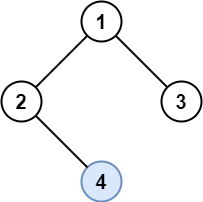
Input: root = [1,2,3,null,4]
Output: [4]
Explanation: Light blue node is the only lonely node.
Node 1 is the root and is not lonely.
Nodes 2 and 3 have the same parent and are not lonely.
Example 2:
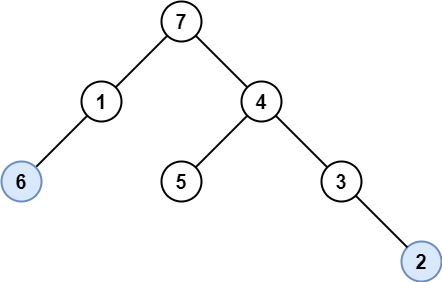
Input: root = [7,1,4,6,null,5,3,null,null,null,null,null,2]
Output: [6,2]
Explanation: Light blue nodes are lonely nodes.
Please remember that order doesn't matter, [2,6] is also an acceptable answer.
Example 3:
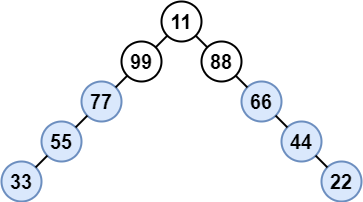
Input: root = [11,99,88,77,null,null,66,55,null,null,44,33,null,null,22]
Output: [77,55,33,66,44,22]
Explanation: Nodes 99 and 88 share the same parent. Node 11 is the root.
All other nodes are lonely.
Constraints:
- The number of nodes in the
tree is in the range [1, 1000].
1 <= Node.val <= 106
Solutions
Solution 1: DFS
We can use Depth-First Search (DFS) to traverse the entire tree. We design a function dfs, which traverses each node in the tree. If the current node is a lone child, we add its value to the answer array. The execution process of the function dfs is as follows:
- If the current node is null, or the current node is a leaf node (i.e., both the left and right children of the current node are null), then return directly.
- If the left child of the current node is null, then the right child of the current node is a lone child, and we add its value to the answer array.
- If the right child of the current node is null, then the left child of the current node is a lone child, and we add its value to the answer array.
- Recursively traverse the left and right children of the current node.
The time complexity is O(n), and the space complexity is O(n). Here, n is the number of nodes in the binary tree.
PythonJavaC++GoTypeScript
# Definition for a binary tree node.
# class TreeNode:
# def __init__(self, val=0, left=None, right=None):
# self.val = val
# self.left = left
# self.right = right
class Solution:
def getLonelyNodes(self, root: Optional[TreeNode]) -> List[int]:
def dfs(root: Optional[TreeNode]):
if root is None or root.left == root.right:
return
if root.left is None:
ans.append(root.right.val)
if root.right is None:
ans.append(root.left.val)
dfs(root.left)
dfs(root.right)
ans = []
dfs(root)
return ans(code-box)
/**
* Definition for a binary tree node.
* public class TreeNode {
* int val;
* TreeNode left;
* TreeNode right;
* TreeNode() {}
* TreeNode(int val) { this.val = val; }
* TreeNode(int val, TreeNode left, TreeNode right) {
* this.val = val;
* this.left = left;
* this.right = right;
* }
* }
*/
class Solution {
private List<Integer> ans = new ArrayList<>();
public List<Integer> getLonelyNodes(TreeNode root) {
dfs(root);
return ans;
}
private void dfs(TreeNode root) {
if (root == null || (root.left == root.right)) {
return;
}
if (root.left == null) {
ans.add(root.right.val);
}
if (root.right == null) {
ans.add(root.left.val);
}
dfs(root.left);
dfs(root.right);
}
}(code-box)
/**
* Definition for a binary tree node.
* struct TreeNode {
* int val;
* TreeNode *left;
* TreeNode *right;
* TreeNode() : val(0), left(nullptr), right(nullptr) {}
* TreeNode(int x) : val(x), left(nullptr), right(nullptr) {}
* TreeNode(int x, TreeNode *left, TreeNode *right) : val(x), left(left), right(right) {}
* };
*/
class Solution {
public:
vector<int> getLonelyNodes(TreeNode* root) {
vector<int> ans;
auto dfs = [&](this auto&& dfs, TreeNode* root) {
if (!root || (root->left == root->right)) {
return;
}
if (!root->left) {
ans.push_back(root->right->val);
}
if (!root->right) {
ans.push_back(root->left->val);
}
dfs(root->left);
dfs(root->right);
};
dfs(root);
return ans;
}
};(code-box)
/**
* Definition for a binary tree node.
* type TreeNode struct {
* Val int
* Left *TreeNode
* Right *TreeNode
* }
*/
func getLonelyNodes(root *TreeNode) (ans []int) {
var dfs func(*TreeNode)
dfs = func(root *TreeNode) {
if root == nil || (root.Left == root.Right) {
return
}
if root.Left == nil {
ans = append(ans, root.Right.Val)
}
if root.Right == nil {
ans = append(ans, root.Left.Val)
}
dfs(root.Left)
dfs(root.Right)
}
dfs(root)
return
}(code-box)
/**
* Definition for a binary tree node.
* class TreeNode {
* val: number
* left: TreeNode | null
* right: TreeNode | null
* constructor(val?: number, left?: TreeNode | null, right?: TreeNode | null) {
* this.val = (val===undefined ? 0 : val)
* this.left = (left===undefined ? null : left)
* this.right = (right===undefined ? null : right)
* }
* }
*/
function getLonelyNodes(root: TreeNode | null): number[] {
const ans: number[] = [];
const dfs = (root: TreeNode | null) => {
if (!root || root.left === root.right) {
return;
}
if (!root.left) {
ans.push(root.right.val);
}
if (!root.right) {
ans.push(root.left.val);
}
dfs(root.left);
dfs(root.right);
};
dfs(root);
return ans;
}(code-box)


