
Description
Given a binary tree where node values are digits from 1 to 9. A path in the binary tree is said to be pseudo-palindromic if at least one permutation of the node values in the path is a palindrome.
Return the number of pseudo-palindromic paths going from the root node to leaf nodes.
Example 1:
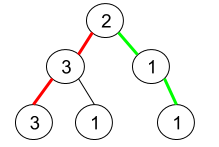
Input: root = [2,3,1,3,1,null,1]
Output: 2
Explanation: The figure above represents the given binary tree. There are three paths going from the root node to leaf nodes: the red path [2,3,3], the green path [2,1,1], and the path [2,3,1]. Among these paths only red path and green path are pseudo-palindromic paths since the red path [2,3,3] can be rearranged in [3,2,3] (palindrome) and the green path [2,1,1] can be rearranged in [1,2,1] (palindrome).
Example 2:
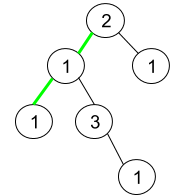
Input: root = [2,1,1,1,3,null,null,null,null,null,1]
Output: 1
Explanation: The figure above represents the given binary tree. There are three paths going from the root node to leaf nodes: the green path [2,1,1], the path [2,1,3,1], and the path [2,1]. Among these paths only the green path is pseudo-palindromic since [2,1,1] can be rearranged in [1,2,1] (palindrome).
Example 3:
Input: root = [9]
Output: 1
Constraints:
- The number of nodes in the tree is in the range
[1, 105].
1 <= Node.val <= 9
Solutions
Solution 1: DFS + Bit Manipulation
A path is a pseudo-palindromic path if and only if the number of nodes with odd occurrences in the path is 0 or 1.
Since the range of the binary tree node values is from 1 to 9, for each path from root to leaf, we can use a 10-bit binary number mask to represent the occurrence status of the node values in the current path. The ith bit of mask is 1 if the node value i appears an odd number of times in the current path, and 0 if it appears an even number of times. Therefore, a path is a pseudo-palindromic path if and only if mask &(mask - 1) = 0, where & represents the bitwise AND operation.
Based on the above analysis, we can use the depth-first search method to calculate the number of paths. We define a function dfs(root, mask), which represents the number of pseudo-palindromic paths starting from the current root node and with the current state mask. The answer is dfs(root, 0).
The execution logic of the function dfs(root, mask) is as follows:
If root is null, return 0;
Otherwise, let mask = mask \oplus 2root.val, where \oplus represents the bitwise XOR operation.
If root is a leaf node, return 1 if mask &(mask - 1) = 0, otherwise return 0;
If root is not a leaf node, return dfs(root.left, mask) + dfs(root.right, mask).
The time complexity is O(n), and the space complexity is O(n). Here, n is the number of nodes in the binary tree.
PythonJavaC++GoTypeScriptRust
# Definition for a binary tree node.
# class TreeNode:
# def __init__(self, val=0, left=None, right=None):
# self.val = val
# self.left = left
# self.right = right
class Solution:
def pseudoPalindromicPaths(self, root: Optional[TreeNode]) -> int:
def dfs(root: Optional[TreeNode], mask: int):
if root is None:
return 0
mask ^= 1 << root.val
if root.left is None and root.right is None:
return int((mask & (mask - 1)) == 0)
return dfs(root.left, mask) + dfs(root.right, mask)
return dfs(root, 0)(code-box)
/**
* Definition for a binary tree node.
* public class TreeNode {
* int val;
* TreeNode left;
* TreeNode right;
* TreeNode() {}
* TreeNode(int val) { this.val = val; }
* TreeNode(int val, TreeNode left, TreeNode right) {
* this.val = val;
* this.left = left;
* this.right = right;
* }
* }
*/
class Solution {
public int pseudoPalindromicPaths(TreeNode root) {
return dfs(root, 0);
}
private int dfs(TreeNode root, int mask) {
if (root == null) {
return 0;
}
mask ^= 1 << root.val;
if (root.left == null && root.right == null) {
return (mask & (mask - 1)) == 0 ? 1 : 0;
}
return dfs(root.left, mask) + dfs(root.right, mask);
}
}(code-box)
/**
* Definition for a binary tree node.
* struct TreeNode {
* int val;
* TreeNode *left;
* TreeNode *right;
* TreeNode() : val(0), left(nullptr), right(nullptr) {}
* TreeNode(int x) : val(x), left(nullptr), right(nullptr) {}
* TreeNode(int x, TreeNode *left, TreeNode *right) : val(x), left(left), right(right) {}
* };
*/
class Solution {
public:
int pseudoPalindromicPaths(TreeNode* root) {
function<int(TreeNode*, int)> dfs = [&](TreeNode* root, int mask) {
if (!root) {
return 0;
}
mask ^= 1 << root->val;
if (!root->left && !root->right) {
return (mask & (mask - 1)) == 0 ? 1 : 0;
}
return dfs(root->left, mask) + dfs(root->right, mask);
};
return dfs(root, 0);
}
};(code-box)
/**
* Definition for a binary tree node.
* type TreeNode struct {
* Val int
* Left *TreeNode
* Right *TreeNode
* }
*/
func pseudoPalindromicPaths(root *TreeNode) int {
var dfs func(*TreeNode, int) int
dfs = func(root *TreeNode, mask int) int {
if root == nil {
return 0
}
mask ^= 1 << root.Val
if root.Left == nil && root.Right == nil {
if mask&(mask-1) == 0 {
return 1
}
return 0
}
return dfs(root.Left, mask) + dfs(root.Right, mask)
}
return dfs(root, 0)
}(code-box)
/**
* Definition for a binary tree node.
* class TreeNode {
* val: number
* left: TreeNode | null
* right: TreeNode | null
* constructor(val?: number, left?: TreeNode | null, right?: TreeNode | null) {
* this.val = (val===undefined ? 0 : val)
* this.left = (left===undefined ? null : left)
* this.right = (right===undefined ? null : right)
* }
* }
*/
function pseudoPalindromicPaths(root: TreeNode | null): number {
const dfs = (root: TreeNode | null, mask: number): number => {
if (!root) {
return 0;
}
mask ^= 1 << root.val;
if (!root.left && !root.right) {
return (mask & (mask - 1)) === 0 ? 1 : 0;
}
return dfs(root.left, mask) + dfs(root.right, mask);
};
return dfs(root, 0);
}(code-box)
// Definition for a binary tree node.
// #[derive(Debug, PartialEq, Eq)]
// pub struct TreeNode {
// pub val: i32,
// pub left: Option<Rc<RefCell<TreeNode>>>,
// pub right: Option<Rc<RefCell<TreeNode>>>,
// }
//
// impl TreeNode {
// #[inline]
// pub fn new(val: i32) -> Self {
// TreeNode {
// val,
// left: None,
// right: None
// }
// }
// }
use std::cell::RefCell;
use std::rc::Rc;
impl Solution {
pub fn pseudo_palindromic_paths(root: Option<Rc<RefCell<TreeNode>>>) -> i32 {
fn dfs(root: Option<Rc<RefCell<TreeNode>>>, mask: i32) -> i32 {
if let Some(node) = root {
let mut mask = mask;
let val = node.borrow().val;
mask ^= 1 << val;
if node.borrow().left.is_none() && node.borrow().right.is_none() {
return if (mask & (mask - 1)) == 0 { 1 } else { 0 };
}
return (dfs(node.borrow().left.clone(), mask)
+ dfs(node.borrow().right.clone(), mask));
}
0
}
dfs(root, 0)
}
}(code-box)


