
Description
Given a 2D integer array nums, return all elements of nums in diagonal order as shown in the below images.
Example 1:
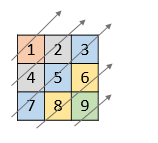
Input: nums = [[1,2,3],[4,5,6],[7,8,9]]
Output: [1,4,2,7,5,3,8,6,9]
Example 2:
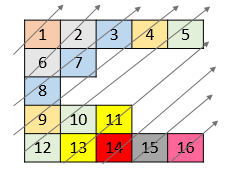
Input: nums = [[1,2,3,4,5],[6,7],[8],[9,10,11],[12,13,14,15,16]]
Output: [1,6,2,8,7,3,9,4,12,10,5,13,11,14,15,16]
Constraints:
1 <= nums.length <= 1051 <= nums[i].length <= 1051 <= sum(nums[i].length) <= 1051 <= nums[i][j] <= 105
Solutions
Solution 1: Sorting
We observe that:
- The value of i + j is the same for each diagonal;
- The value of i + j for the next diagonal is greater than that of the previous diagonal;
- Within the same diagonal, the value of i + j is the same, and the value of j increases from small to large.
Therefore, we store all numbers in the form of (i, j, nums[i][j]) into arr, and then sort according to the first two items. Finally, return the array composed of the values at index 2 of all elements in arr.
The time complexity is O(n × log n), where n is the number of elements in the array nums. The space complexity is O(n).
PythonJavaC++GoTypeScriptC#
class Solution:
def findDiagonalOrder(self, nums: List[List[int]]) -> List[int]:
arr = []
for i, row in enumerate(nums):
for j, v in enumerate(row):
arr.append((i + j, j, v))
arr.sort()
return [v[2] for v in arr](code-box)
class Solution {
public int[] findDiagonalOrder(List<List<Integer>> nums) {
List<int[]> arr = new ArrayList<>();
for (int i = 0; i < nums.size(); ++i) {
for (int j = 0; j < nums.get(i).size(); ++j) {
arr.add(new int[] {i + j, j, nums.get(i).get(j)});
}
}
arr.sort((a, b) -> a[0] == b[0] ? a[1] - b[1] : a[0] - b[0]);
int[] ans = new int[arr.size()];
for (int i = 0; i < arr.size(); ++i) {
ans[i] = arr.get(i)[2];
}
return ans;
}
}(code-box)
class Solution {
public:
vector<int> findDiagonalOrder(vector<vector<int>>& nums) {
vector<tuple<int, int, int>> arr;
for (int i = 0; i < nums.size(); ++i) {
for (int j = 0; j < nums[i].size(); ++j) {
arr.push_back({i + j, j, nums[i][j]});
}
}
sort(arr.begin(), arr.end());
vector<int> ans;
for (auto& e : arr) {
ans.push_back(get<2>(e));
}
return ans;
}
};(code-box)
func findDiagonalOrder(nums [][]int) []int {
arr := [][]int{}
for i, row := range nums {
for j, v := range row {
arr = append(arr, []int{i + j, j, v})
}
}
sort.Slice(arr, func(i, j int) bool {
if arr[i][0] == arr[j][0] {
return arr[i][1] < arr[j][1]
}
return arr[i][0] < arr[j][0]
})
ans := []int{}
for _, v := range arr {
ans = append(ans, v[2])
}
return ans
}(code-box)
function findDiagonalOrder(nums: number[][]): number[] {
const arr: number[][] = [];
for (let i = 0; i < nums.length; ++i) {
for (let j = 0; j < nums[i].length; ++j) {
arr.push([i + j, j, nums[i][j]]);
}
}
arr.sort((a, b) => (a[0] === b[0] ? a[1] - b[1] : a[0] - b[0]));
return arr.map(x => x[2]);
}(code-box)
public class Solution {
public int[] FindDiagonalOrder(IList<IList<int>> nums) {
List<int[]> arr = new List<int[]>();
for (int i = 0; i < nums.Count; ++i) {
for (int j = 0; j < nums[i].Count; ++j) {
arr.Add(new int[] { i + j, j, nums[i][j] });
}
}
arr.Sort((a, b) => a[0] == b[0] ? a[1] - b[1] : a[0] - b[0]);
int[] ans = new int[arr.Count];
for (int i = 0; i < arr.Count; ++i) {
ans[i] = arr[i][2];
}
return ans;
}
}(code-box)


