


Description
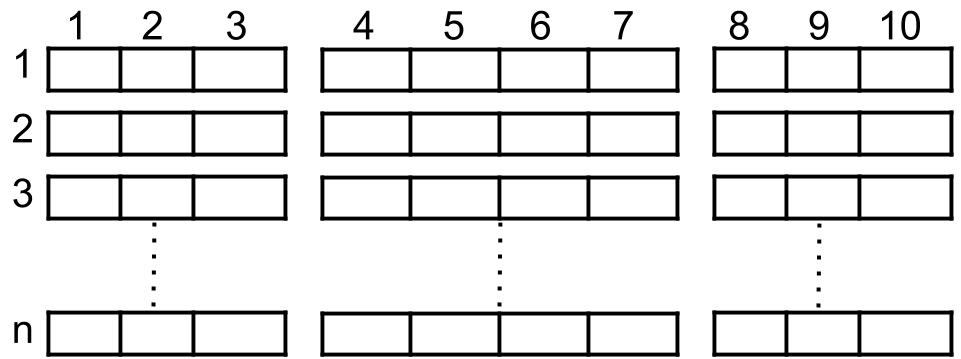
A cinema has n rows of seats, numbered from 1 to n and there are ten seats in each row, labelled from 1 to 10 as shown in the figure above.
Given the array reservedSeats containing the numbers of seats already reserved, for example, reservedSeats[i] = [3,8] means the seat located in row 3 and labelled with 8 is already reserved.
Return the maximum number of four-person groups you can assign on the cinema seats. A four-person group occupies four adjacent seats in one single row. Seats across an aisle (such as [3,3] and [3,4]) are not considered to be adjacent, but there is an exceptional case on which an aisle split a four-person group, in that case, the aisle split a four-person group in the middle, which means to have two people on each side.
Example 1:
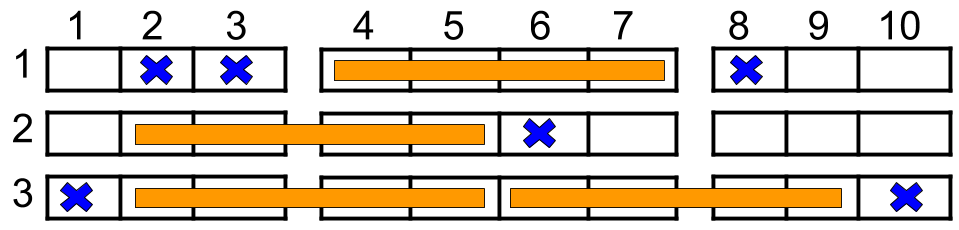
Input: n = 3, reservedSeats = [[1,2],[1,3],[1,8],[2,6],[3,1],[3,10]]
Output: 4
Explanation: The figure above shows the optimal allocation for four groups, where seats mark with blue are already reserved and contiguous seats mark with orange are for one group.
Example 2:
Input: n = 2, reservedSeats = [[2,1],[1,8],[2,6]]
Output: 2
Example 3:
Input: n = 4, reservedSeats = [[4,3],[1,4],[4,6],[1,7]]
Output: 4
Constraints:
1 <= n <= 10^91 <= reservedSeats.length <= min(10*n, 10^4)reservedSeats[i].length == 21 <= reservedSeats[i][0] <= n1 <= reservedSeats[i][1] <= 10- All
reservedSeats[i]are distinct.
Solutions
Solution 1: Hash Table + Bit Manipulation
We use a hash table d to store all the reserved seats, where the key is the row number, and the value is the state of the reserved seats in that row, i.e., a binary number. The j-th bit being 1 means the j-th seat is reserved, and 0 means the j-th seat is not reserved.
We traverse reservedSeats, for each seat (i, j), we add the state of the j-th seat (corresponding to the 10-j bit in the lower bits) to d[i].
For rows that do not appear in the hash table d, we can arrange 2 families arbitrarily, so the initial answer is (n - len(d)) × 2.
Next, we traverse the state of each row in the hash table. For each row, we try to arrange the situations 1234, 5678, 3456 in turn. If a situation can be arranged, we add 1 to the answer.
After the traversal, we get the final answer.
The time complexity is O(m), and the space complexity is O(m). Where m is the length of reservedSeats.
class Solution: def maxNumberOfFamilies(self, n: int, reservedSeats: List[List[int]]) -> int: d = defaultdict(int) for i, j in reservedSeats: d[i] |= 1 << (10 - j) masks = (0b0111100000, 0b0000011110, 0b0001111000) ans = (n - len(d)) * 2 for x in d.values(): for mask in masks: if (x & mask) == 0: x |= mask ans += 1 return ans(code-box)
