


Description
Given a binary tree root, return the maximum sum of all keys of any sub-tree which is also a Binary Search Tree (BST).
Assume a BST is defined as follows:
- The left subtree of a node contains only nodes with keys less than the node's key.
- The right subtree of a node contains only nodes with keys greater than the node's key.
- Both the left and right subtrees must also be binary search trees.
Example 1:
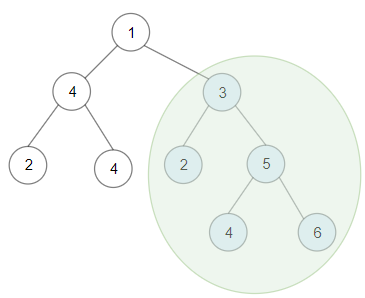
Input: root = [1,4,3,2,4,2,5,null,null,null,null,null,null,4,6]
Output: 20
Explanation: Maximum sum in a valid Binary search tree is obtained in root node with key equal to 3.
Example 2:
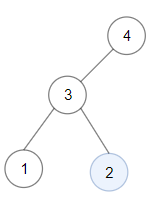
Input: root = [4,3,null,1,2]
Output: 2
Explanation: Maximum sum in a valid Binary search tree is obtained in a single root node with key equal to 2.
Example 3:
Input: root = [-4,-2,-5]
Output: 0
Explanation: All values are negatives. Return an empty BST.
Constraints:
- The number of nodes in the tree is in the range
[1, 4 * 104]. -4 * 104 <= Node.val <= 4 * 104
Solutions
Solution 1: DFS
To determine whether a tree is a binary search tree, it needs to meet the following four conditions:
- The left subtree is a binary search tree;
- The right subtree is a binary search tree;
- The maximum value of the left subtree is less than the value of the root node;
- The minimum value of the right subtree is greater than the value of the root node.
Therefore, we design a function dfs(root), the return value of the function is a quadruple (bst, mi, mx, s), where:
- The number bst indicates whether the tree with root as the root is a binary search tree. If it is a binary search tree, then bst = 1; otherwise bst = 0;
- The number mi represents the minimum value of the tree with root as the root;
- The number mx represents the maximum value of the tree with root as the root;
- The number s represents the sum of all nodes of the tree with root as the root.
The execution logic of the function dfs(root) is as follows:
If root is an empty node, return (1, +∞, -∞, 0), indicating that the empty tree is a binary search tree, the minimum value and maximum value are positive infinity and negative infinity respectively, and the sum of nodes is 0.
Otherwise, recursively calculate the left subtree and right subtree of root, and get (lbst, lmi, lmx, ls) and (rbst, rmi, rmx, rs) respectively, then judge whether the root node meets the conditions of the binary search tree.
If lbst = 1 and rbst = 1 and lmx < root.val < rmi, then the tree with root as the root is a binary search tree, and the sum of nodes s= ls + rs + root.val. We update the answer ans = max(ans, s), and return (1, min(lmi, root.val), max(rmx, root.val), s).
Otherwise, the tree with root as the root is not a binary search tree, we return (0, 0, 0, 0).
We call dfs(root) in the main function. After execution, the answer is ans.
The time complexity is O(n), and the space complexity is O(n). Where n is the number of nodes in the binary tree.
# Definition for a binary tree node. # class TreeNode: # def __init__(self, val=0, left=None, right=None): # self.val = val # self.left = left # self.right = right class Solution: def maxSumBST(self, root: Optional[TreeNode]) -> int: def dfs(root: Optional[TreeNode]) -> tuple: if root is None: return 1, inf, -inf, 0 lbst, lmi, lmx, ls = dfs(root.left) rbst, rmi, rmx, rs = dfs(root.right) if lbst and rbst and lmx < root.val < rmi: nonlocal ans s = ls + rs + root.val ans = max(ans, s) return 1, min(lmi, root.val), max(rmx, root.val), s return 0, 0, 0, 0 ans = 0 dfs(root) return ans(code-box)
