


Description
There is a one-dimensional garden on the x-axis. The garden starts at the point 0 and ends at the point n. (i.e., the length of the garden is n).
There are n + 1 taps located at points [0, 1, ..., n] in the garden.
Given an integer n and an integer array ranges of length n + 1 where ranges[i] (0-indexed) means the i-th tap can water the area [i - ranges[i], i + ranges[i]] if it was open.
Return the minimum number of taps that should be open to water the whole garden, If the garden cannot be watered return -1.
Example 1:
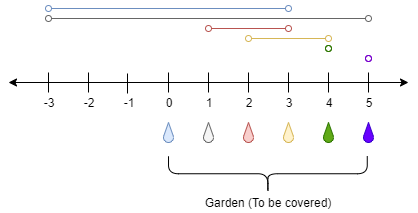
Input: n = 5, ranges = [3,4,1,1,0,0]
Output: 1
Explanation: The tap at point 0 can cover the interval [-3,3]
The tap at point 1 can cover the interval [-3,5]
The tap at point 2 can cover the interval [1,3]
The tap at point 3 can cover the interval [2,4]
The tap at point 4 can cover the interval [4,4]
The tap at point 5 can cover the interval [5,5]
Opening Only the second tap will water the whole garden [0,5]
Example 2:
Input: n = 3, ranges = [0,0,0,0]
Output: -1
Explanation: Even if you activate all the four taps you cannot water the whole garden.
Constraints:
1 <= n <= 104ranges.length == n + 10 <= ranges[i] <= 100
Solutions
Solution 1: Greedy
We note that for all taps that can cover a certain left endpoint, choosing the tap that can cover the farthest right endpoint is optimal.
Therefore, we can preprocess the array ranges. For the i-th tap, it can cover the left endpoint l = max(0, i - ranges[i]) and the right endpoint r = i + ranges[i]. We calculate the position of the tap that can cover the left endpoint l with the farthest right endpoint and record it in the array last[i].
Then we define the following three variables:
- Variable ans represents the final answer, i.e., the minimum number of taps;
- Variable mx represents the farthest right endpoint that can currently be covered;
- Variable pre represents the farthest right endpoint covered by the previous tap.
We traverse all positions in the range [0, …, n-1]. For the current position i, we use last[i] to update mx, i.e., mx = max(mx, last[i]).
- If mx ≤ i, it means the next position cannot be covered, so we return -1.
- If pre = i, it means a new subinterval needs to be used, so we increment ans by 1 and update pre = mx.
After the traversal, we return ans.
The time complexity is O(n), and the space complexity is O(n). Here, n is the length of the garden.
Similar problems:
class Solution: def minTaps(self, n: int, ranges: List[int]) -> int: last = [0] * (n + 1) for i, x in enumerate(ranges): l, r = max(0, i - x), i + x last[l] = max(last[l], r) ans = mx = pre = 0 for i in range(n): mx = max(mx, last[i]) if mx <= i: return -1 if pre == i: ans += 1 pre = mx return ans(code-box)
