


Description
Given 3 positives numbers a, b and c. Return the minimum flips required in some bits of a and b to make ( a OR b == c ). (bitwise OR operation).
Flip operation consists of change any single bit 1 to 0 or change the bit 0 to 1 in their binary representation.
Example 1:
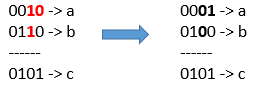
Input: a = 2, b = 6, c = 5 Output: 3 Explanation: After flips a = 1 , b = 4 , c = 5 such that (aORb==c)
Example 2:
Input: a = 4, b = 2, c = 7

Output: 1
Example 3:
Input: a = 1, b = 2, c = 3

Output: 0
Constraints:
<li><code>1 <= a <= 10^9</code></li>
<li><code>1 <= b <= 10^9</code></li>
<li><code>1 <= c <= 10^9</code></li>
Solutions
Solution 1: Bit Manipulation
We can enumerate each bit of the binary representation of a, b, and c, denoted as x, y, and z respectively. If the bitwise OR operation result of x and y is different from z, we then check if both x and y are 1. If so, we need to flip twice, otherwise, we only need to flip once. We accumulate all the required flip times.
The time complexity is O(log M), where M is the maximum value of the numbers in the problem. The space complexity is O(1).
PythonJavaC++GoTypeScript
class Solution: def minFlips(self, a: int, b: int, c: int) -> int: ans = 0 for i in range(32): x, y, z = a >> i & 1, b >> i & 1, c >> i & 1 ans += x + y if z == 0 else int(x == 0 and y == 0) return ans(code-box)
