


Description
You are given an even number of people numPeople that stand around a circle and each person shakes hands with someone else so that there are numPeople / 2 handshakes total.
Return the number of ways these handshakes could occur such that none of the handshakes cross.
Since the answer could be very large, return it modulo 109 + 7.
Example 1:

Input: numPeople = 4
Output: 2
Explanation: There are two ways to do it, the first way is [(1,2),(3,4)] and the second one is [(2,3),(4,1)].
Example 2:
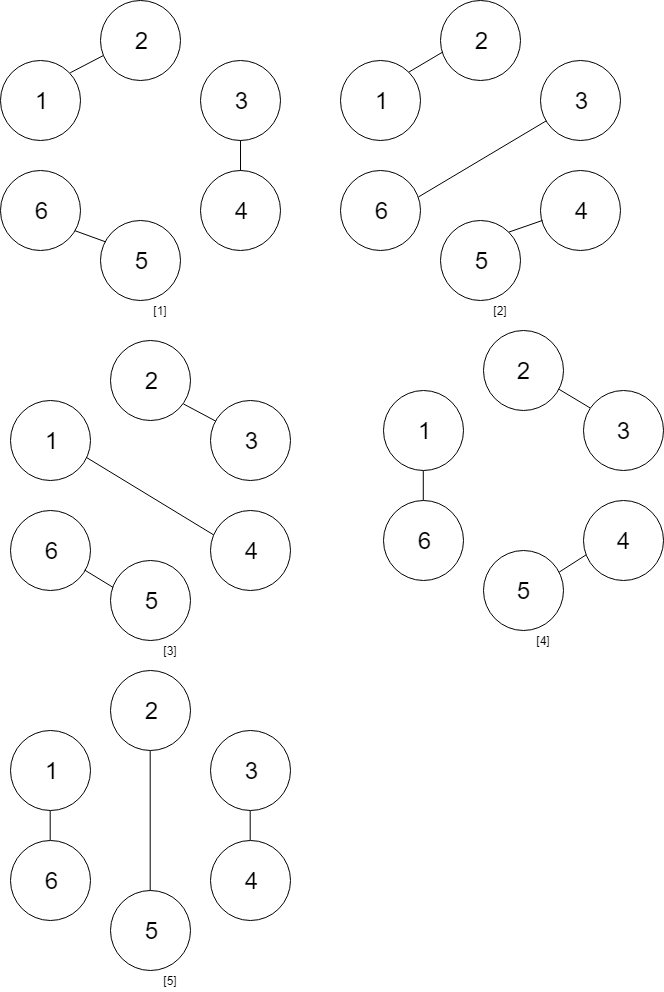
Input: numPeople = 6
Output: 5
Constraints:
2 <= numPeople <= 1000numPeopleis even.
Solutions
Solution 1: Memoization Search
We design a function dfs(i), which represents the number of handshake schemes for i people. The answer is dfs(n).
The execution logic of the function dfs(i) is as follows:
- If i \lt 2, then there is only one handshake scheme, which is not to shake hands, so return 1.
- Otherwise, we can enumerate who the first person shakes hands with. Let the number of remaining people on the left be l, and the number of people on the right be r=i-l-2. Then we have dfs(i)= ∑_{l=0}i-1 dfs(l) × dfs(r).
To avoid repeated calculations, we use the method of memoization search.
The time complexity is O(n2), and the space complexity is O(n). Where n is the size of numPeople.
PythonJavaC++GoTypeScript
class Solution: def numberOfWays(self, numPeople: int) -> int: @cache def dfs(i: int) -> int: if i < 2: return 1 ans = 0 for l in range(0, i, 2): r = i - l - 2 ans += dfs(l) * dfs(r) ans %= mod return ans mod = 10**9 + 7 return dfs(numPeople)(code-box)
