
Description
We have n jobs, where every job is scheduled to be done from startTime[i] to endTime[i], obtaining a profit of profit[i].
You're given the startTime, endTime and profit arrays, return the maximum profit you can take such that there are no two jobs in the subset with overlapping time range.
If you choose a job that ends at time X you will be able to start another job that starts at time X.
Example 1:
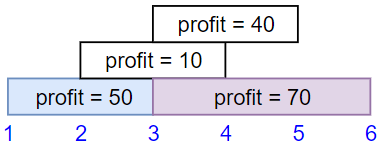
Input: startTime = [1,2,3,3], endTime = [3,4,5,6], profit = [50,10,40,70]
Output: 120
Explanation: The subset chosen is the first and fourth job.
Time range [1-3]+[3-6] , we get profit of 120 = 50 + 70.
Example 2:
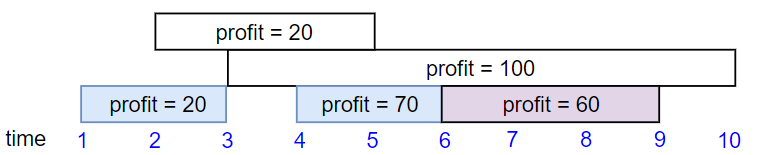
Input: startTime = [1,2,3,4,6], endTime = [3,5,10,6,9], profit = [20,20,100,70,60]
Output: 150
Explanation: The subset chosen is the first, fourth and fifth job.
Profit obtained 150 = 20 + 70 + 60.
Example 3:
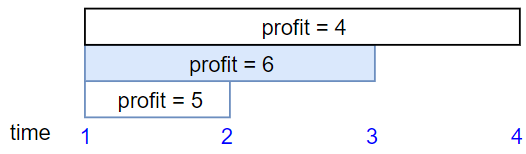
Input: startTime = [1,1,1], endTime = [2,3,4], profit = [5,6,4]
Output: 6
Constraints:
1 <= startTime.length == endTime.length == profit.length <= 5 * 1041 <= startTime[i] < endTime[i] <= 1091 <= profit[i] <= 104
Solutions
Solution 1: Memoization Search + Binary Search
First, we sort the jobs by start time in ascending order, then design a function dfs(i) to represent the maximum profit that can be obtained starting from the i-th job. The answer is dfs(0).
The calculation process of function dfs(i) is as follows:
For the i-th job, we can choose to do it or not. If we don't do it, the maximum profit is dfs(i + 1); if we do it, we can use binary search to find the first job that starts after the end time of the i-th job, denoted as j, then the maximum profit is profit[i] + dfs(j). We take the larger of the two. That is:
dfs(i)=max(dfs(i+1),profit[i]+dfs(j))
Where j is the smallest index that satisfies startTime[j] \ge endTime[i].
In this process, we can use memoization search to save the answer of each state to avoid repeated calculations.
The time complexity is O(n × log n), where n is the number of jobs.
PythonJavaC++GoTypeScript
class Solution:
def jobScheduling(
self, startTime: List[int], endTime: List[int], profit: List[int]
) -> int:
@cache
def dfs(i):
if i >= n:
return 0
_, e, p = jobs[i]
j = bisect_left(jobs, e, lo=i + 1, key=lambda x: x[0])
return max(dfs(i + 1), p + dfs(j))
jobs = sorted(zip(startTime, endTime, profit))
n = len(profit)
return dfs(0)(code-box)
class Solution {
private int[][] jobs;
private int[] f;
private int n;
public int jobScheduling(int[] startTime, int[] endTime, int[] profit) {
n = profit.length;
jobs = new int[n][3];
for (int i = 0; i < n; ++i) {
jobs[i] = new int[] {startTime[i], endTime[i], profit[i]};
}
Arrays.sort(jobs, (a, b) -> a[0] - b[0]);
f = new int[n];
return dfs(0);
}
private int dfs(int i) {
if (i >= n) {
return 0;
}
if (f[i] != 0) {
return f[i];
}
int e = jobs[i][1], p = jobs[i][2];
int j = search(jobs, e, i + 1);
int ans = Math.max(dfs(i + 1), p + dfs(j));
f[i] = ans;
return ans;
}
private int search(int[][] jobs, int x, int i) {
int left = i, right = n;
while (left < right) {
int mid = (left + right) >> 1;
if (jobs[mid][0] >= x) {
right = mid;
} else {
left = mid + 1;
}
}
return left;
}
}(code-box)
class Solution {
public:
int jobScheduling(vector<int>& startTime, vector<int>& endTime, vector<int>& profit) {
int n = profit.size();
vector<tuple<int, int, int>> jobs(n);
for (int i = 0; i < n; ++i) jobs[i] = {startTime[i], endTime[i], profit[i]};
sort(jobs.begin(), jobs.end());
vector<int> f(n);
function<int(int)> dfs = [&](int i) -> int {
if (i >= n) return 0;
if (f[i]) return f[i];
auto [_, e, p] = jobs[i];
tuple<int, int, int> t{e, 0, 0};
int j = lower_bound(jobs.begin() + i + 1, jobs.end(), t, [&](auto& l, auto& r) -> bool { return get<0>(l) < get<0>(r); }) - jobs.begin();
int ans = max(dfs(i + 1), p + dfs(j));
f[i] = ans;
return ans;
};
return dfs(0);
}
};(code-box)
func jobScheduling(startTime []int, endTime []int, profit []int) int {
n := len(profit)
type tuple struct{ s, e, p int }
jobs := make([]tuple, n)
for i, p := range profit {
jobs[i] = tuple{startTime[i], endTime[i], p}
}
sort.Slice(jobs, func(i, j int) bool { return jobs[i].s < jobs[j].s })
f := make([]int, n)
var dfs func(int) int
dfs = func(i int) int {
if i >= n {
return 0
}
if f[i] != 0 {
return f[i]
}
j := sort.Search(n, func(j int) bool { return jobs[j].s >= jobs[i].e })
ans := max(dfs(i+1), jobs[i].p+dfs(j))
f[i] = ans
return ans
}
return dfs(0)
}(code-box)
function jobScheduling(startTime: number[], endTime: number[], profit: number[]): number {
const n = startTime.length;
const f = new Array(n).fill(0);
const idx = new Array(n).fill(0).map((_, i) => i);
idx.sort((i, j) => startTime[i] - startTime[j]);
const search = (x: number) => {
let l = 0;
let r = n;
while (l < r) {
const mid = (l + r) >> 1;
if (startTime[idx[mid]] >= x) {
r = mid;
} else {
l = mid + 1;
}
}
return l;
};
const dfs = (i: number): number => {
if (i >= n) {
return 0;
}
if (f[i] !== 0) {
return f[i];
}
const j = search(endTime[idx[i]]);
return (f[i] = Math.max(dfs(i + 1), dfs(j) + profit[idx[i]]));
};
return dfs(0);
}(code-box)
Solution 2: Dynamic Programming + Binary Search
We can also change the memoization search in Solution 1 to dynamic programming.
First, sort the jobs, this time we sort by end time in ascending order, then define dp[i], which represents the maximum profit that can be obtained from the first i jobs. The answer is dp[n]. Initialize dp[0]=0.
For the i-th job, we can choose to do it or not. If we don't do it, the maximum profit is dp[i]; if we do it, we can use binary search to find the last job that ends before the start time of the i-th job, denoted as j, then the maximum profit is profit[i] + dp[j]. We take the larger of the two. That is:
dp[i+1] = max(dp[i], profit[i] + dp[j])
Where j is the largest index that satisfies endTime[j] ≤ startTime[i].
The time complexity is O(n × log n), where n is the number of jobs.
Similar problems:
PythonJavaC++GoTypeScriptSwift
class Solution:
def jobScheduling(
self, startTime: List[int], endTime: List[int], profit: List[int]
) -> int:
jobs = sorted(zip(endTime, startTime, profit))
n = len(profit)
dp = [0] * (n + 1)
for i, (_, s, p) in enumerate(jobs):
j = bisect_right(jobs, s, hi=i, key=lambda x: x[0])
dp[i + 1] = max(dp[i], dp[j] + p)
return dp[n](code-box)
class Solution {
public int jobScheduling(int[] startTime, int[] endTime, int[] profit) {
int n = profit.length;
int[][] jobs = new int[n][3];
for (int i = 0; i < n; ++i) {
jobs[i] = new int[] {startTime[i], endTime[i], profit[i]};
}
Arrays.sort(jobs, (a, b) -> a[1] - b[1]);
int[] dp = new int[n + 1];
for (int i = 0; i < n; ++i) {
int j = search(jobs, jobs[i][0], i);
dp[i + 1] = Math.max(dp[i], dp[j] + jobs[i][2]);
}
return dp[n];
}
private int search(int[][] jobs, int x, int n) {
int left = 0, right = n;
while (left < right) {
int mid = (left + right) >> 1;
if (jobs[mid][1] > x) {
right = mid;
} else {
left = mid + 1;
}
}
return left;
}
}(code-box)
class Solution {
public:
int jobScheduling(vector<int>& startTime, vector<int>& endTime, vector<int>& profit) {
int n = profit.size();
vector<tuple<int, int, int>> jobs(n);
for (int i = 0; i < n; ++i) jobs[i] = {endTime[i], startTime[i], profit[i]};
sort(jobs.begin(), jobs.end());
vector<int> dp(n + 1);
for (int i = 0; i < n; ++i) {
auto [_, s, p] = jobs[i];
int j = upper_bound(jobs.begin(), jobs.begin() + i, s, [&](int x, auto& job) -> bool { return x < get<0>(job); }) - jobs.begin();
dp[i + 1] = max(dp[i], dp[j] + p);
}
return dp[n];
}
};(code-box)
func jobScheduling(startTime []int, endTime []int, profit []int) int {
n := len(profit)
type tuple struct{ s, e, p int }
jobs := make([]tuple, n)
for i, p := range profit {
jobs[i] = tuple{startTime[i], endTime[i], p}
}
sort.Slice(jobs, func(i, j int) bool { return jobs[i].e < jobs[j].e })
dp := make([]int, n+1)
for i, job := range jobs {
j := sort.Search(i, func(k int) bool { return jobs[k].e > job.s })
dp[i+1] = max(dp[i], dp[j]+job.p)
}
return dp[n]
}(code-box)
function jobScheduling(startTime: number[], endTime: number[], profit: number[]): number {
const n = profit.length;
const jobs: [number, number, number][] = Array.from({ length: n }, (_, i) => [
startTime[i],
endTime[i],
profit[i],
]);
jobs.sort((a, b) => a[1] - b[1]);
const dp: number[] = Array.from({ length: n + 1 }, () => 0);
const search = (x: number, right: number): number => {
let left = 0;
while (left < right) {
const mid = (left + right) >> 1;
if (jobs[mid][1] > x) {
right = mid;
} else {
left = mid + 1;
}
}
return left;
};
for (let i = 0; i < n; ++i) {
const j = search(jobs[i][0], i);
dp[i + 1] = Math.max(dp[i], dp[j] + jobs[i][2]);
}
return dp[n];
}(code-box)
class Solution {
func binarySearch<T: Comparable>(inputArr: [T], searchItem: T) -> Int? {
var lowerIndex = 0
var upperIndex = inputArr.count - 1
while lowerIndex < upperIndex {
let currentIndex = (lowerIndex + upperIndex) / 2
if inputArr[currentIndex] <= searchItem {
lowerIndex = currentIndex + 1
} else {
upperIndex = currentIndex
}
}
if inputArr[upperIndex] <= searchItem {
return upperIndex + 1
}
return lowerIndex
}
func jobScheduling(_ startTime: [Int], _ endTime: [Int], _ profit: [Int]) -> Int {
let zipList = zip(zip(startTime, endTime), profit)
var table: [(startTime: Int, endTime: Int, profit: Int, cumsum: Int)] = []
for ((x, y), z) in zipList {
table.append((x, y, z, 0))
}
table.sort(by: { $0.endTime < $1.endTime })
let sortedEndTime = endTime.sorted()
var profits: [Int] = [0]
for iJob in table {
let index: Int! = binarySearch(inputArr: sortedEndTime, searchItem: iJob.startTime)
if profits.last! < profits[index] + iJob.profit {
profits.append(profits[index] + iJob.profit)
} else {
profits.append(profits.last!)
}
}
return profits.last!
}
}(code-box)


