


Description
A confusing number is a number that when rotated 180 degrees becomes a different number with each digit valid.
We can rotate digits of a number by 180 degrees to form new digits.
- When
0,1,6,8, and9are rotated180degrees, they become0,1,9,8, and6respectively. - When
2,3,4,5, and7are rotated180degrees, they become invalid.
Note that after rotating a number, we can ignore leading zeros.
- For example, after rotating
8000, we have0008which is considered as just8.
Given an integer n, return true if it is a confusing number, or false otherwise.
Example 1:
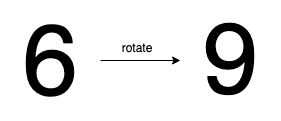
Input: n = 6
Output: true
Explanation: We get 9 after rotating 6, 9 is a valid number, and 9 != 6.
Example 2:

Input: n = 89
Output: true
Explanation: We get 68 after rotating 89, 68 is a valid number and 68 != 89.
Example 3:

Input: n = 11
Output: false
Explanation: We get 11 after rotating 11, 11 is a valid number but the value remains the same, thus 11 is not a confusing number
Constraints:
0 <= n <= 109
Solutions
Solution 1
PythonJavaC++GoPHP
class Solution: def confusingNumber(self, n: int) -> bool: x, y = n, 0 d = [0, 1, -1, -1, -1, -1, 9, -1, 8, 6] while x: x, v = divmod(x, 10) if d[v] < 0: return False y = y * 10 + d[v] return y != n(code-box)
