
Description
Given the root of a Binary Search Tree (BST), convert it to a Greater Tree such that every key of the original BST is changed to the original key plus the sum of all keys greater than the original key in BST.
As a reminder, a binary search tree is a tree that satisfies these constraints:
- The left subtree of a node contains only nodes with keys less than the node's key.
- The right subtree of a node contains only nodes with keys greater than the node's key.
- Both the left and right subtrees must also be binary search trees.
Example 1:
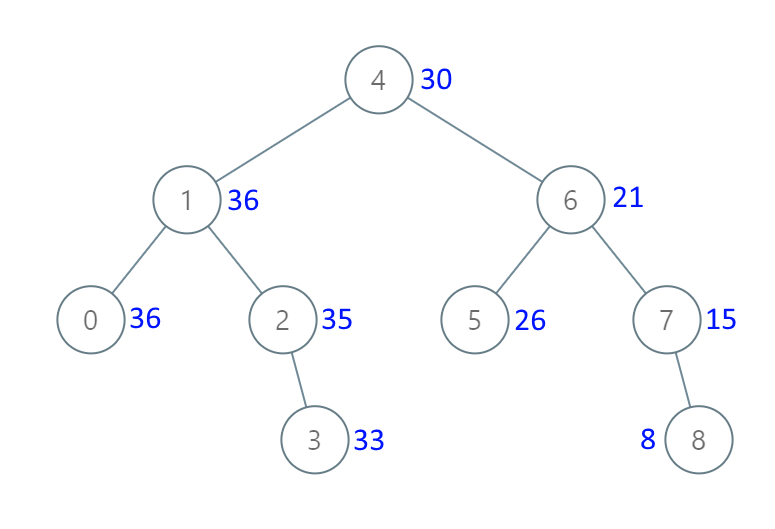
Input: root = [4,1,6,0,2,5,7,null,null,null,3,null,null,null,8]
Output: [30,36,21,36,35,26,15,null,null,null,33,null,null,null,8]
Example 2:
Input: root = [0,null,1]
Output: [1,null,1]
Constraints:
- The number of nodes in the tree is in the range
[1, 100].
0 <= Node.val <= 100- All the values in the tree are unique.
Note: This question is the same as 538: https://leetcode.com/problems/convert-bst-to-greater-tree/
Solutions
Solution 1: Recursion
Traverse the binary search tree in the order of "right-root-left". Accumulate all the node values encountered into s, and assign the accumulated value to the corresponding node.
Time complexity is O(n), and space complexity is O(n), where n is the number of nodes in the binary search tree.
PythonJavaC++GoTypeScriptRustJavaScriptC
# Definition for a binary tree node.
# class TreeNode:
# def __init__(self, val=0, left=None, right=None):
# self.val = val
# self.left = left
# self.right = right
class Solution:
def bstToGst(self, root: Optional[TreeNode]) -> Optional[TreeNode]:
def dfs(root: Optional[TreeNode]):
if root is None:
return
dfs(root.right)
nonlocal s
s += root.val
root.val = s
dfs(root.left)
s = 0
dfs(root)
return root(code-box)
/**
* Definition for a binary tree node.
* public class TreeNode {
* int val;
* TreeNode left;
* TreeNode right;
* TreeNode() {}
* TreeNode(int val) { this.val = val; }
* TreeNode(int val, TreeNode left, TreeNode right) {
* this.val = val;
* this.left = left;
* this.right = right;
* }
* }
*/
class Solution {
private int s;
public TreeNode bstToGst(TreeNode root) {
dfs(root);
return root;
}
private void dfs(TreeNode root) {
if (root == null) {
return;
}
dfs(root.right);
s += root.val;
root.val = s;
dfs(root.left);
}
}(code-box)
/**
* Definition for a binary tree node.
* struct TreeNode {
* int val;
* TreeNode *left;
* TreeNode *right;
* TreeNode() : val(0), left(nullptr), right(nullptr) {}
* TreeNode(int x) : val(x), left(nullptr), right(nullptr) {}
* TreeNode(int x, TreeNode *left, TreeNode *right) : val(x), left(left), right(right) {}
* };
*/
class Solution {
public:
TreeNode* bstToGst(TreeNode* root) {
int s = 0;
auto dfs = [&](this auto&& dfs, TreeNode* root) {
if (!root) {
return;
}
dfs(root->right);
s += root->val;
root->val = s;
dfs(root->left);
};
dfs(root);
return root;
}
};(code-box)
/**
* Definition for a binary tree node.
* type TreeNode struct {
* Val int
* Left *TreeNode
* Right *TreeNode
* }
*/
func bstToGst(root *TreeNode) *TreeNode {
s := 0
var dfs func(*TreeNode)
dfs = func(root *TreeNode) {
if root == nil {
return
}
dfs(root.Right)
s += root.Val
root.Val = s
dfs(root.Left)
}
dfs(root)
return root
}(code-box)
/**
* Definition for a binary tree node.
* class TreeNode {
* val: number
* left: TreeNode | null
* right: TreeNode | null
* constructor(val?: number, left?: TreeNode | null, right?: TreeNode | null) {
* this.val = (val===undefined ? 0 : val)
* this.left = (left===undefined ? null : left)
* this.right = (right===undefined ? null : right)
* }
* }
*/
function bstToGst(root: TreeNode | null): TreeNode | null {
let s = 0;
const dfs = (root: TreeNode | null) => {
if (!root) {
return;
}
dfs(root.right);
s += root.val;
root.val = s;
dfs(root.left);
};
dfs(root);
return root;
}(code-box)
// Definition for a binary tree node.
// #[derive(Debug, PartialEq, Eq)]
// pub struct TreeNode {
// pub val: i32,
// pub left: Option<Rc<RefCell<TreeNode>>>,
// pub right: Option<Rc<RefCell<TreeNode>>>,
// }
//
// impl TreeNode {
// #[inline]
// pub fn new(val: i32) -> Self {
// TreeNode {
// val,
// left: None,
// right: None
// }
// }
// }
use std::rc::Rc;
use std::cell::RefCell;
impl Solution {
pub fn bst_to_gst(root: Option<Rc<RefCell<TreeNode>>>) -> Option<Rc<RefCell<TreeNode>>> {
let mut s = 0;
Self::dfs(&root, &mut s);
root
}
fn dfs(root: &Option<Rc<RefCell<TreeNode>>>, s: &mut i32) {
if let Some(node) = root {
let mut node = node.borrow_mut();
Self::dfs(&node.right, s);
*s += node.val;
node.val = *s;
Self::dfs(&node.left, s);
}
}
}(code-box)
/**
* Definition for a binary tree node.
* function TreeNode(val, left, right) {
* this.val = (val===undefined ? 0 : val)
* this.left = (left===undefined ? null : left)
* this.right = (right===undefined ? null : right)
* }
*/
/**
* @param {TreeNode} root
* @return {TreeNode}
*/
var bstToGst = function (root) {
let s = 0;
function dfs(root) {
if (!root) {
return;
}
dfs(root.right);
s += root.val;
root.val = s;
dfs(root.left);
}
dfs(root);
return root;
};(code-box)
/**
* Definition for a binary tree node.
* struct TreeNode {
* int val;
* struct TreeNode *left;
* struct TreeNode *right;
* };
*/
int dfs(struct TreeNode* root, int sum) {
if (root) {
sum = dfs(root->right, sum) + root->val;
root->val = sum;
sum = dfs(root->left, sum);
}
return sum;
}
struct TreeNode* bstToGst(struct TreeNode* root) {
dfs(root, 0);
return root;
}(code-box)
Solution 2: Morris Traversal
Morris traversal does not require a stack, with a time complexity of O(n) and a space complexity of O(1). The core idea is as follows:
Define s as the cumulative sum of the node values in the binary search tree. Traverse the binary tree nodes:
- If the right subtree of the current node
root is null, add the current node value to s, update the current node value to s, and move the current node to root.left.
- If the right subtree of the current node
root is not null, find the leftmost node next in the right subtree (i.e., the successor node of root in an in-order traversal):
- If the left subtree of the successor node
next is null, set the left subtree of next to point to the current node root, and move the current node to root.right.
- If the left subtree of the successor node
next is not null, add the current node value to s, update the current node value to s, then set the left subtree of next to null (i.e., remove the link between next and root), and move the current node to root.left.
- Repeat the above steps until the binary tree nodes are null, at which point the traversal is complete.
- Finally, return the root node of the binary search tree.
Morris reverse in-order traversal follows the same idea as Morris in-order traversal, except that the traversal order changes from "left-root-right" to "right-root-left".
PythonJavaC++GoTypeScriptC
# Definition for a binary tree node.
# class TreeNode:
# def __init__(self, val=0, left=None, right=None):
# self.val = val
# self.left = left
# self.right = right
class Solution:
def bstToGst(self, root: TreeNode) -> TreeNode:
s = 0
node = root
while root:
if root.right is None:
s += root.val
root.val = s
root = root.left
else:
next = root.right
while next.left and next.left != root:
next = next.left
if next.left is None:
next.left = root
root = root.right
else:
s += root.val
root.val = s
next.left = None
root = root.left
return node(code-box)
/**
* Definition for a binary tree node.
* public class TreeNode {
* int val;
* TreeNode left;
* TreeNode right;
* TreeNode() {}
* TreeNode(int val) { this.val = val; }
* TreeNode(int val, TreeNode left, TreeNode right) {
* this.val = val;
* this.left = left;
* this.right = right;
* }
* }
*/
class Solution {
public TreeNode bstToGst(TreeNode root) {
int s = 0;
TreeNode node = root;
while (root != null) {
if (root.right == null) {
s += root.val;
root.val = s;
root = root.left;
} else {
TreeNode next = root.right;
while (next.left != null && next.left != root) {
next = next.left;
}
if (next.left == null) {
next.left = root;
root = root.right;
} else {
s += root.val;
root.val = s;
next.left = null;
root = root.left;
}
}
}
return node;
}
}(code-box)
/**
* Definition for a binary tree node.
* struct TreeNode {
* int val;
* TreeNode *left;
* TreeNode *right;
* TreeNode() : val(0), left(nullptr), right(nullptr) {}
* TreeNode(int x) : val(x), left(nullptr), right(nullptr) {}
* TreeNode(int x, TreeNode *left, TreeNode *right) : val(x), left(left), right(right) {}
* };
*/
class Solution {
public:
TreeNode* bstToGst(TreeNode* root) {
int s = 0;
TreeNode* node = root;
while (root) {
if (root->right == nullptr) {
s += root->val;
root->val = s;
root = root->left;
} else {
TreeNode* next = root->right;
while (next->left && next->left != root) {
next = next->left;
}
if (next->left == nullptr) {
next->left = root;
root = root->right;
} else {
s += root->val;
root->val = s;
next->left = nullptr;
root = root->left;
}
}
}
return node;
}
};(code-box)
/**
* Definition for a binary tree node.
* type TreeNode struct {
* Val int
* Left *TreeNode
* Right *TreeNode
* }
*/
func bstToGst(root *TreeNode) *TreeNode {
s := 0
node := root
for root != nil {
if root.Right == nil {
s += root.Val
root.Val = s
root = root.Left
} else {
next := root.Right
for next.Left != nil && next.Left != root {
next = next.Left
}
if next.Left == nil {
next.Left = root
root = root.Right
} else {
s += root.Val
root.Val = s
next.Left = nil
root = root.Left
}
}
}
return node
}(code-box)
/**
* Definition for a binary tree node.
* class TreeNode {
* val: number
* left: TreeNode | null
* right: TreeNode | null
* constructor(val?: number, left?: TreeNode | null, right?: TreeNode | null) {
* this.val = (val===undefined ? 0 : val)
* this.left = (left===undefined ? null : left)
* this.right = (right===undefined ? null : right)
* }
* }
*/
function bstToGst(root: TreeNode | null): TreeNode | null {
let cur = root;
let sum = 0;
while (cur != null) {
const { val, left, right } = cur;
if (right == null) {
sum += val;
cur.val = sum;
cur = left;
} else {
let next = right;
while (next.left != null && next.left != cur) {
next = next.left;
}
if (next.left == null) {
next.left = cur;
cur = right;
} else {
next.left = null;
sum += val;
cur.val = sum;
cur = left;
}
}
}
return root;
}(code-box)
/**
* Definition for a binary tree node.
* struct TreeNode {
* int val;
* struct TreeNode *left;
* struct TreeNode *right;
* };
*/
struct TreeNode* bstToGst(struct TreeNode* root) {
struct TreeNode* cur = root;
int sum = 0;
while (cur) {
if (!cur->right) {
sum += cur->val;
cur->val = sum;
cur = cur->left;
} else {
struct TreeNode* next = cur->right;
while (next->left && next->left != cur) {
next = next->left;
}
if (!next->left) {
next->left = cur;
cur = cur->right;
} else {
next->left = NULL;
sum += cur->val;
cur->val = sum;
cur = cur->left;
}
}
}
return root;
}(code-box)


