


Description
In a row of dominoes, tops[i] and bottoms[i] represent the top and bottom halves of the ith domino. (A domino is a tile with two numbers from 1 to 6 - one on each half of the tile.)
We may rotate the ith domino, so that tops[i] and bottoms[i] swap values.
Return the minimum number of rotations so that all the values in tops are the same, or all the values in bottoms are the same.
If it cannot be done, return -1.
Example 1:
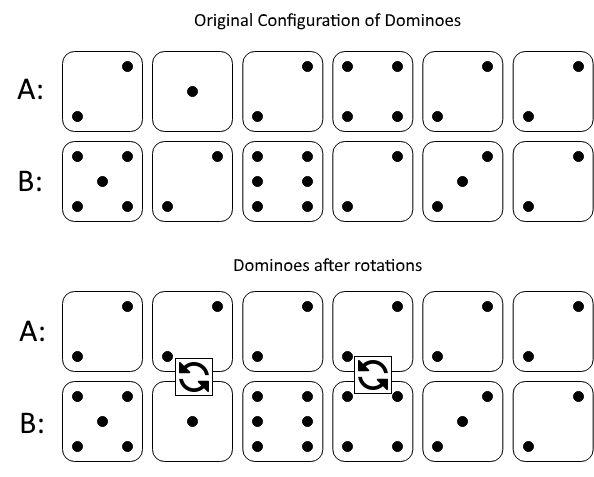
Input: tops = [2,1,2,4,2,2], bottoms = [5,2,6,2,3,2]
Output: 2
Explanation:
The first figure represents the dominoes as given by tops and bottoms: before we do any rotations.
If we rotate the second and fourth dominoes, we can make every value in the top row equal to 2, as indicated by the second figure.
Example 2:
Input: tops = [3,5,1,2,3], bottoms = [3,6,3,3,4]
Output: -1
Explanation:
In this case, it is not possible to rotate the dominoes to make one row of values equal.
Constraints:
2 <= tops.length <= 2 * 104bottoms.length == tops.length1 <= tops[i], bottoms[i] <= 6
Solutions
Solution 1: Greedy
According to the problem description, we know that in order to make all values in tops or all values in bottoms the same, the value must be one of tops[0] or bottoms[0].
Therefore, we design a function f(x) to represent the minimum number of rotations required to make all values equal to x. Then the answer is min{f(tops[0]), f(bottoms[0])}.
The calculation method of function f(x) is as follows:
We use two variables cnt1 and cnt2 to count the number of occurrences of x in tops and bottoms, respectively. We subtract the maximum value of cnt1 and cnt2 from n, which is the minimum number of rotations required to make all values equal to x. Note that if there are no values equal to x in tops and bottoms, the value of f(x) is a very large number, which we represent as n+1.
The time complexity is O(n), where n is the length of the array. The space complexity is O(1).
class Solution: def minDominoRotations(self, tops: List[int], bottoms: List[int]) -> int: def f(x: int) -> int: cnt1 = cnt2 = 0 for a, b in zip(tops, bottoms): if x not in (a, b): return inf cnt1 += a == x cnt2 += b == x return len(tops) - max(cnt1, cnt2) ans = min(f(tops[0]), f(bottoms[0])) return -1 if ans == inf else ans(code-box)
