
Description
You are given an array of points in the X-Y plane points where points[i] = [xi, yi].
Return the minimum area of any rectangle formed from these points, with sides not necessarily parallel to the X and Y axes. If there is not any such rectangle, return 0.
Answers within 10-5 of the actual answer will be accepted.
Example 1:
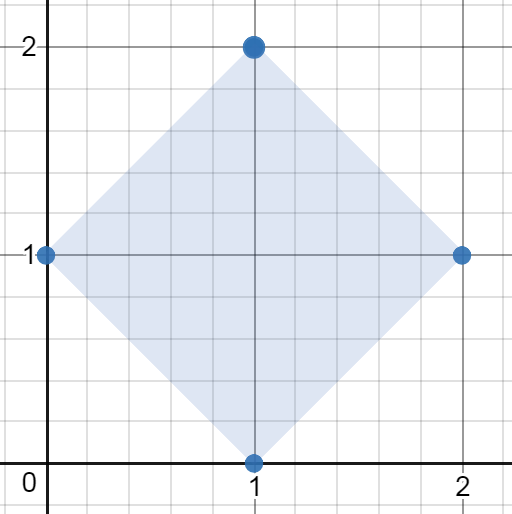
Input: points = [[1,2],[2,1],[1,0],[0,1]]
Output: 2.00000
Explanation: The minimum area rectangle occurs at [1,2],[2,1],[1,0],[0,1], with an area of 2.
Example 2:
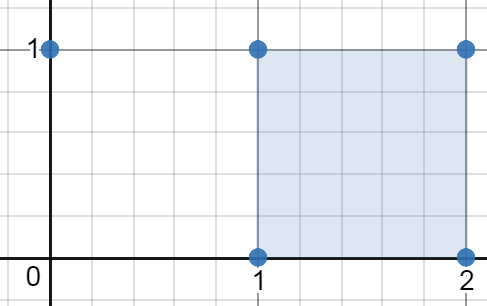
Input: points = [[0,1],[2,1],[1,1],[1,0],[2,0]]
Output: 1.00000
Explanation: The minimum area rectangle occurs at [1,0],[1,1],[2,1],[2,0], with an area of 1.
Example 3:
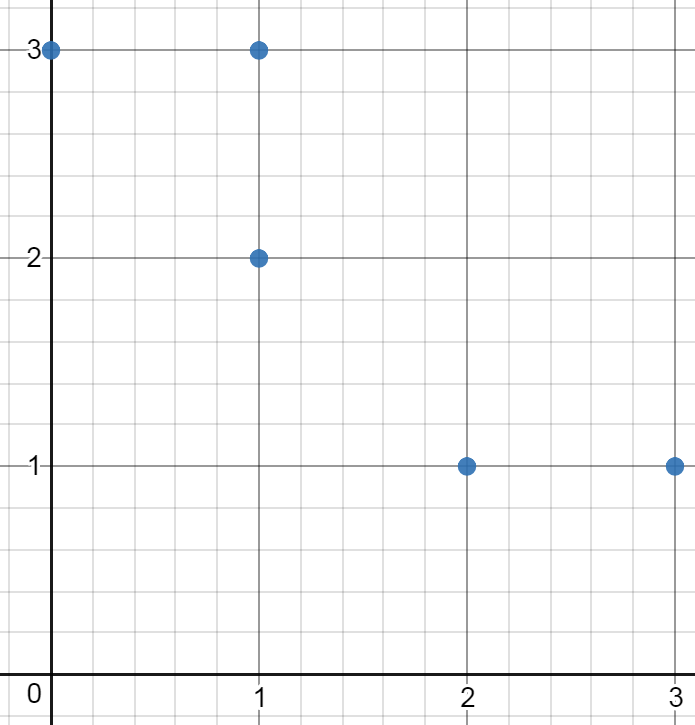
Input: points = [[0,3],[1,2],[3,1],[1,3],[2,1]]
Output: 0
Explanation: There is no possible rectangle to form from these points.
Constraints:
1 <= points.length <= 50points[i].length == 20 <= xi, yi <= 4 * 104- All the given points are unique.
Solutions
Solution 1: Hash Table + Enumeration
We use a hash table to store all the points, then enumerate three points p1 = (x1, y1), p2 = (x2, y2), p3 = (x3, y3), where p2 and p3 are the two endpoints of the diagonal of the rectangle. If the line formed by p1 and p2 and the line formed by p1 and p3 are perpendicular, and the fourth point (x4, y4)=(x2 - x1 + x3, y2 - y1 + y3) exists in the hash table, then we have found a rectangle. At this point, we can calculate the area of the rectangle and update the answer.
Finally, if a rectangle that satisfies the conditions is found, return the minimum area among them. Otherwise, return 0.
The time complexity is O(n3) and the space complexity is O(n), where n is the length of the array points.
PythonJavaC++GoTypeScript
class Solution:
def minAreaFreeRect(self, points: List[List[int]]) -> float:
s = {(x, y) for x, y in points}
n = len(points)
ans = inf
for i in range(n):
x1, y1 = points[i]
for j in range(n):
if j != i:
x2, y2 = points[j]
for k in range(j + 1, n):
if k != i:
x3, y3 = points[k]
x4 = x2 - x1 + x3
y4 = y2 - y1 + y3
if (x4, y4) in s:
v21 = (x2 - x1, y2 - y1)
v31 = (x3 - x1, y3 - y1)
if v21[0] * v31[0] + v21[1] * v31[1] == 0:
w = sqrt(v21[0] ** 2 + v21[1] ** 2)
h = sqrt(v31[0] ** 2 + v31[1] ** 2)
ans = min(ans, w * h)
return 0 if ans == inf else ans(code-box)
class Solution {
public double minAreaFreeRect(int[][] points) {
int n = points.length;
Set<Integer> s = new HashSet<>(n);
for (int[] p : points) {
s.add(f(p[0], p[1]));
}
double ans = Double.MAX_VALUE;
for (int i = 0; i < n; ++i) {
int x1 = points[i][0], y1 = points[i][1];
for (int j = 0; j < n; ++j) {
if (j != i) {
int x2 = points[j][0], y2 = points[j][1];
for (int k = j + 1; k < n; ++k) {
if (k != i) {
int x3 = points[k][0], y3 = points[k][1];
int x4 = x2 - x1 + x3, y4 = y2 - y1 + y3;
if (s.contains(f(x4, y4))) {
if ((x2 - x1) * (x3 - x1) + (y2 - y1) * (y3 - y1) == 0) {
int ww = (x2 - x1) * (x2 - x1) + (y2 - y1) * (y2 - y1);
int hh = (x3 - x1) * (x3 - x1) + (y3 - y1) * (y3 - y1);
ans = Math.min(ans, Math.sqrt(1L * ww * hh));
}
}
}
}
}
}
}
return ans == Double.MAX_VALUE ? 0 : ans;
}
private int f(int x, int y) {
return x * 40001 + y;
}
}(code-box)
class Solution {
public:
double minAreaFreeRect(vector<vector<int>>& points) {
auto f = [](int x, int y) {
return x * 40001 + y;
};
int n = points.size();
unordered_set<int> s;
for (auto& p : points) {
s.insert(f(p[0], p[1]));
}
double ans = 1e20;
for (int i = 0; i < n; ++i) {
int x1 = points[i][0], y1 = points[i][1];
for (int j = 0; j < n; ++j) {
if (j != i) {
int x2 = points[j][0], y2 = points[j][1];
for (int k = j + 1; k < n; ++k) {
if (k != i) {
int x3 = points[k][0], y3 = points[k][1];
int x4 = x2 - x1 + x3, y4 = y2 - y1 + y3;
if (x4 >= 0 && x4 < 40000 && y4 >= 0 && y4 <= 40000 && s.count(f(x4, y4))) {
if ((x2 - x1) * (x3 - x1) + (y2 - y1) * (y3 - y1) == 0) {
int ww = (x2 - x1) * (x2 - x1) + (y2 - y1) * (y2 - y1);
int hh = (x3 - x1) * (x3 - x1) + (y3 - y1) * (y3 - y1);
ans = min(ans, sqrt(1LL * ww * hh));
}
}
}
}
}
}
}
return ans == 1e20 ? 0 : ans;
}
};(code-box)
func minAreaFreeRect(points [][]int) float64 {
n := len(points)
f := func(x, y int) int {
return x*40001 + y
}
s := map[int]bool{}
for _, p := range points {
s[f(p[0], p[1])] = true
}
ans := 1e20
for i := 0; i < n; i++ {
x1, y1 := points[i][0], points[i][1]
for j := 0; j < n; j++ {
if j != i {
x2, y2 := points[j][0], points[j][1]
for k := j + 1; k < n; k++ {
if k != i {
x3, y3 := points[k][0], points[k][1]
x4, y4 := x2-x1+x3, y2-y1+y3
if s[f(x4, y4)] {
if (x2-x1)*(x3-x1)+(y2-y1)*(y3-y1) == 0 {
ww := (x2-x1)*(x2-x1) + (y2-y1)*(y2-y1)
hh := (x3-x1)*(x3-x1) + (y3-y1)*(y3-y1)
ans = math.Min(ans, math.Sqrt(float64(ww*hh)))
}
}
}
}
}
}
}
if ans == 1e20 {
return 0
}
return ans
}(code-box)
function minAreaFreeRect(points: number[][]): number {
const n = points.length;
const f = (x: number, y: number): number => x * 40001 + y;
const s: Set<number> = new Set();
for (const [x, y] of points) {
s.add(f(x, y));
}
let ans = Number.MAX_VALUE;
for (let i = 0; i < n; ++i) {
const [x1, y1] = points[i];
for (let j = 0; j < n; ++j) {
if (j !== i) {
const [x2, y2] = points[j];
for (let k = j + 1; k < n; ++k) {
if (k !== i) {
const [x3, y3] = points[k];
const x4 = x2 - x1 + x3;
const y4 = y2 - y1 + y3;
if (s.has(f(x4, y4))) {
if ((x2 - x1) * (x3 - x1) + (y2 - y1) * (y3 - y1) === 0) {
const ww = (x2 - x1) * (x2 - x1) + (y2 - y1) * (y2 - y1);
const hh = (x3 - x1) * (x3 - x1) + (y3 - y1) * (y3 - y1);
ans = Math.min(ans, Math.sqrt(ww * hh));
}
}
}
}
}
}
}
return ans === Number.MAX_VALUE ? 0 : ans;
}(code-box)


