Description
Given the root node of a binary tree, your task is to create a string representation of the tree following a specific set of formatting rules. The representation should be based on a preorder traversal of the binary tree and must adhere to the following guidelines:
-
Node Representation: Each node in the tree should be represented by its integer value.
-
Parentheses for Children: If a node has at least one child (either left or right), its children should be represented inside parentheses. Specifically:
<ul>
<li>If a node has a left child, the value of the left child should be enclosed in parentheses immediately following the node's value.</li>
<li>If a node has a right child, the value of the right child should also be enclosed in parentheses. The parentheses for the right child should follow those of the left child.</li>
</ul>
</li>
<li>
<p><strong>Omitting Empty Parentheses</strong>: Any empty parentheses pairs (i.e., <code>()</code>) should be omitted from the final string representation of the tree, with one specific exception: when a node has a right child but no left child. In such cases, you must include an empty pair of parentheses to indicate the absence of the left child. This ensures that the one-to-one mapping between the string representation and the original binary tree structure is maintained.</p>
<p>In summary, empty parentheses pairs should be omitted when a node has only a left child or no children. However, when a node has a right child but no left child, an empty pair of parentheses must precede the representation of the right child to reflect the tree's structure accurately.</p>
</li>
Example 1:
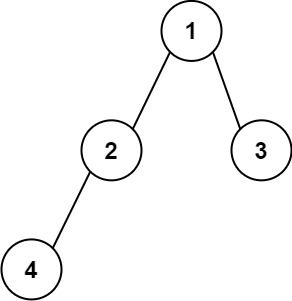
Input: root = [1,2,3,4]
Output: "1(2(4))(3)"
Explanation: Originally, it needs to be "1(2(4)())(3()())", but you need to omit all the empty parenthesis pairs. And it will be "1(2(4))(3)".
Example 2:
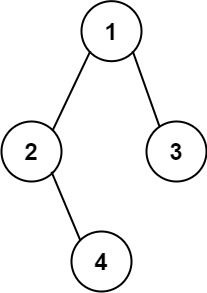
Input: root = [1,2,3,null,4]
Output: "1(2()(4))(3)"
Explanation: Almost the same as the first example, except the () after 2 is necessary to indicate the absence of a left child for 2 and the presence of a right child.
Constraints:
- The number of nodes in the tree is in the range
[1, 104].
-1000 <= Node.val <= 1000
Solutions
Solution 1
PythonJavaC++GoTypeScriptRust
# Definition for a binary tree node.
# class TreeNode:
# def __init__(self, val=0, left=None, right=None):
# self.val = val
# self.left = left
# self.right = right
class Solution:
def tree2str(self, root: Optional[TreeNode]) -> str:
def dfs(root):
if root is None:
return ''
if root.left is None and root.right is None:
return str(root.val)
if root.right is None:
return f'{root.val}({dfs(root.left)})'
return f'{root.val}({dfs(root.left)})({dfs(root.right)})'
return dfs(root)(code-box)
/**
* Definition for a binary tree node.
* public class TreeNode {
* int val;
* TreeNode left;
* TreeNode right;
* TreeNode() {}
* TreeNode(int val) { this.val = val; }
* TreeNode(int val, TreeNode left, TreeNode right) {
* this.val = val;
* this.left = left;
* this.right = right;
* }
* }
*/
class Solution {
public String tree2str(TreeNode root) {
if (root == null) {
return "";
}
if (root.left == null && root.right == null) {
return root.val + "";
}
if (root.right == null) {
return root.val + "(" + tree2str(root.left) + ")";
}
return root.val + "(" + tree2str(root.left) + ")(" + tree2str(root.right) + ")";
}
}(code-box)
/**
* Definition for a binary tree node.
* struct TreeNode {
* int val;
* TreeNode *left;
* TreeNode *right;
* TreeNode() : val(0), left(nullptr), right(nullptr) {}
* TreeNode(int x) : val(x), left(nullptr), right(nullptr) {}
* TreeNode(int x, TreeNode *left, TreeNode *right) : val(x), left(left), right(right) {}
* };
*/
class Solution {
public:
string tree2str(TreeNode* root) {
if (!root) return "";
if (!root->left && !root->right) return to_string(root->val);
if (!root->right) return to_string(root->val) + "(" + tree2str(root->left) + ")";
return to_string(root->val) + "(" + tree2str(root->left) + ")(" + tree2str(root->right) + ")";
}
};(code-box)
/**
* Definition for a binary tree node.
* type TreeNode struct {
* Val int
* Left *TreeNode
* Right *TreeNode
* }
*/
func tree2str(root *TreeNode) string {
if root == nil {
return ""
}
if root.Left == nil && root.Right == nil {
return strconv.Itoa(root.Val)
}
if root.Right == nil {
return strconv.Itoa(root.Val) + "(" + tree2str(root.Left) + ")"
}
return strconv.Itoa(root.Val) + "(" + tree2str(root.Left) + ")(" + tree2str(root.Right) + ")"
}(code-box)
/**
* Definition for a binary tree node.
* class TreeNode {
* val: number
* left: TreeNode | null
* right: TreeNode | null
* constructor(val?: number, left?: TreeNode | null, right?: TreeNode | null) {
* this.val = (val===undefined ? 0 : val)
* this.left = (left===undefined ? null : left)
* this.right = (right===undefined ? null : right)
* }
* }
*/
function tree2str(root: TreeNode | null): string {
if (root == null) {
return '';
}
if (root.left == null && root.right == null) {
return `${root.val}`;
}
return `${root.val}(${root.left ? tree2str(root.left) : ''})${
root.right ? `(${tree2str(root.right)})` : ''
}`;
}(code-box)
// Definition for a binary tree node.
// #[derive(Debug, PartialEq, Eq)]
// pub struct TreeNode {
// pub val: i32,
// pub left: Option<Rc<RefCell<TreeNode>>>,
// pub right: Option<Rc<RefCell<TreeNode>>>,
// }
//
// impl TreeNode {
// #[inline]
// pub fn new(val: i32) -> Self {
// TreeNode {
// val,
// left: None,
// right: None
// }
// }
// }
use std::cell::RefCell;
use std::rc::Rc;
impl Solution {
fn dfs(root: &Option<Rc<RefCell<TreeNode>>>, res: &mut String) {
if let Some(node) = root {
let node = node.borrow();
res.push_str(node.val.to_string().as_str());
if node.left.is_none() && node.right.is_none() {
return;
}
res.push('(');
if node.left.is_some() {
Self::dfs(&node.left, res);
}
res.push(')');
if node.right.is_some() {
res.push('(');
Self::dfs(&node.right, res);
res.push(')');
}
}
}
pub fn tree2str(root: Option<Rc<RefCell<TreeNode>>>) -> String {
let mut res = String::new();
Self::dfs(&root, &mut res);
res
}
}(code-box)


