


Description
Given the root of a binary tree, return the sum of every tree node's tilt.
The tilt of a tree node is the absolute difference between the sum of all left subtree node values and all right subtree node values. If a node does not have a left child, then the sum of the left subtree node values is treated as 0. The rule is similar if the node does not have a right child.
Example 1:
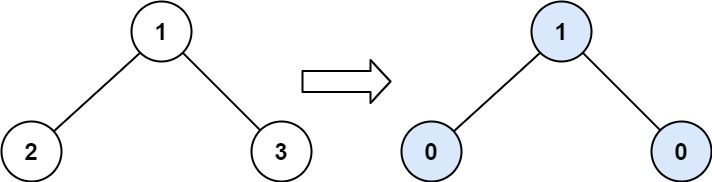
Input: root = [1,2,3]
Output: 1
Explanation:
Tilt of node 2 : |0-0| = 0 (no children)
Tilt of node 3 : |0-0| = 0 (no children)
Tilt of node 1 : |2-3| = 1 (left subtree is just left child, so sum is 2; right subtree is just right child, so sum is 3)
Sum of every tilt : 0 + 0 + 1 = 1
Example 2:
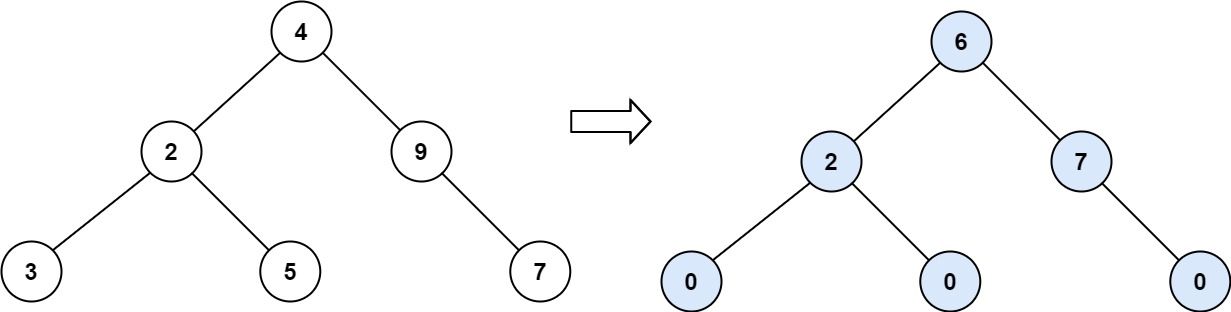
Input: root = [4,2,9,3,5,null,7]
Output: 15
Explanation:
Tilt of node 3 : |0-0| = 0 (no children)
Tilt of node 5 : |0-0| = 0 (no children)
Tilt of node 7 : |0-0| = 0 (no children)
Tilt of node 2 : |3-5| = 2 (left subtree is just left child, so sum is 3; right subtree is just right child, so sum is 5)
Tilt of node 9 : |0-7| = 7 (no left child, so sum is 0; right subtree is just right child, so sum is 7)
Tilt of node 4 : |(3+5+2)-(9+7)| = |10-16| = 6 (left subtree values are 3, 5, and 2, which sums to 10; right subtree values are 9 and 7, which sums to 16)
Sum of every tilt : 0 + 0 + 0 + 2 + 7 + 6 = 15
Example 3:
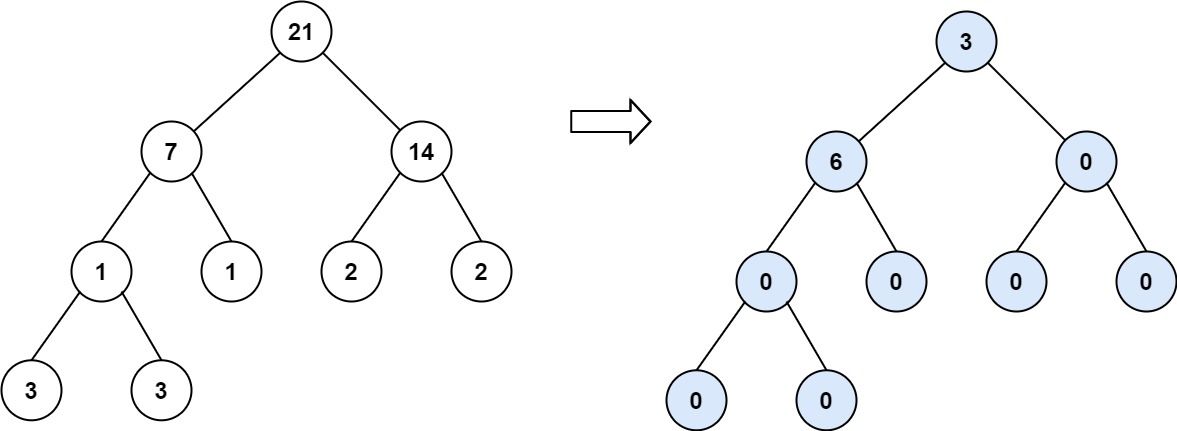
Input: root = [21,7,14,1,1,2,2,3,3]
Output: 9
Constraints:
- The number of nodes in the tree is in the range
[0, 104]. -1000 <= Node.val <= 1000
Solutions
Solution 1: Recursion
We design a function dfs to calculate the sum of nodes in the subtree rooted at the current node. In the dfs function, we first check if the current node is null. If it is, we return 0. Then we recursively call the dfs function to calculate the sum of nodes in the left subtree l and the sum of nodes in the right subtree r. Next, we calculate the tilt of the current node, which is |l - r|, and add it to the answer. Finally, we return the sum of nodes of the current node, which is l + r + root.val.
In the main function, we initialize the answer to 0, then call the dfs function to calculate the tilt of the entire tree and return the answer.
The time complexity is O(n), and the space complexity is O(n), where n is the number of nodes.
# Definition for a binary tree node. # class TreeNode: # def __init__(self, val=0, left=None, right=None): # self.val = val # self.left = left # self.right = right class Solution: def findTilt(self, root: Optional[TreeNode]) -> int: def dfs(root: Optional[TreeNode]) -> int: if root is None: return 0 l, r = dfs(root.left), dfs(root.right) nonlocal ans ans += abs(l - r) return l + r + root.val ans = 0 dfs(root) return ans(code-box)
