
Description
Given a n-ary tree, find its maximum depth.
The maximum depth is the number of nodes along the longest path from the root node down to the farthest leaf node.
Nary-Tree input serialization is represented in their level order traversal, each group of children is separated by the null value (See examples).
Example 1:
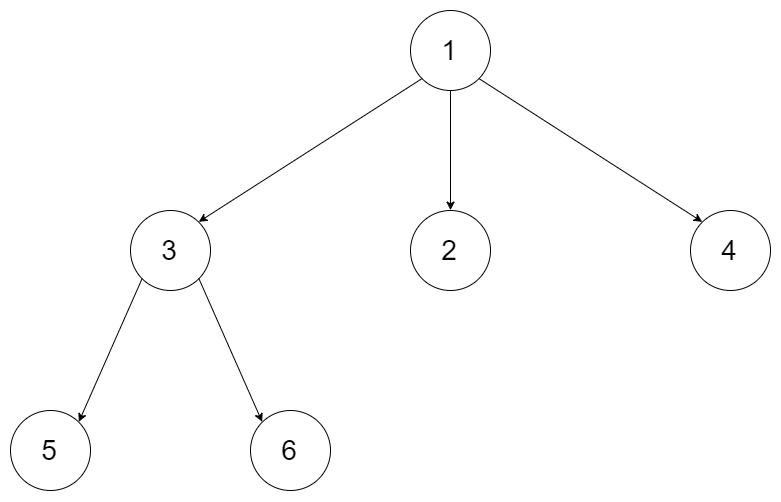
Input: root = [1,null,3,2,4,null,5,6]
Output: 3
Example 2:
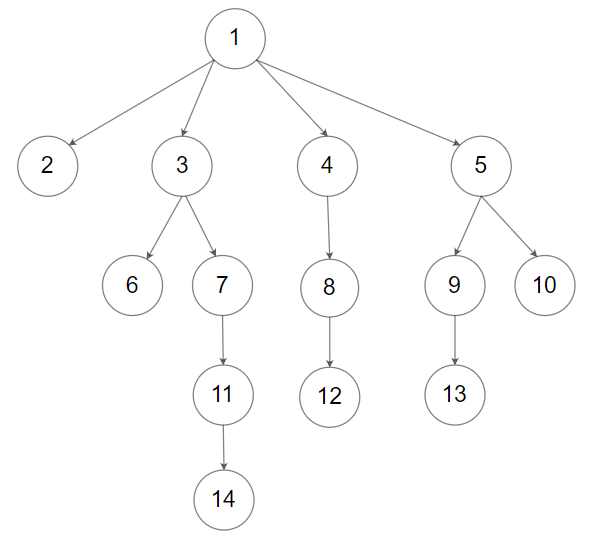
Input: root = [1,null,2,3,4,5,null,null,6,7,null,8,null,9,10,null,null,11,null,12,null,13,null,null,14]
Output: 5
Constraints:
- The total number of nodes is in the range
[0, 104].
- The depth of the n-ary tree is less than or equal to
1000.
Solutions
Solution 1: Recursion
First, we check if root is null. If it is, we return 0. Otherwise, we initialize a variable mx to record the maximum depth of the child nodes, then traverse all the child nodes of root, recursively call the maxDepth function, and update the value of mx. Finally, we return mx + 1.
The time complexity is O(n), and the space complexity is O(n), where n is the number of nodes.
PythonJavaC++GoTypeScript
"""
# Definition for a Node.
class Node:
def __init__(self, val: Optional[int] = None, children: Optional[List['Node']] = None):
self.val = val
self.children = children
"""
class Solution:
def maxDepth(self, root: "Node") -> int:
if root is None:
return 0
mx = 0
for child in root.children:
mx = max(mx, self.maxDepth(child))
return 1 + mx(code-box)
/*
// Definition for a Node.
class Node {
public int val;
public List<Node> children;
public Node() {}
public Node(int _val) {
val = _val;
}
public Node(int _val, List<Node> _children) {
val = _val;
children = _children;
}
};
*/
class Solution {
public int maxDepth(Node root) {
if (root == null) {
return 0;
}
int mx = 0;
for (Node child : root.children) {
mx = Math.max(mx, maxDepth(child));
}
return 1 + mx;
}
}(code-box)
/*
// Definition for a Node.
class Node {
public:
int val;
vector<Node*> children;
Node() {}
Node(int _val) {
val = _val;
}
Node(int _val, vector<Node*> _children) {
val = _val;
children = _children;
}
};
*/
class Solution {
public:
int maxDepth(Node* root) {
if (!root) {
return 0;
}
int mx = 0;
for (Node* child : root->children) {
mx = max(mx, maxDepth(child));
}
return mx + 1;
}
};(code-box)
/**
* Definition for a Node.
* type Node struct {
* Val int
* Children []*Node
* }
*/
func maxDepth(root *Node) int {
if root == nil {
return 0
}
mx := 0
for _, child := range root.Children {
mx = max(mx, maxDepth(child))
}
return 1 + mx
}(code-box)
/**
* Definition for _Node.
* class _Node {
* val: number
* children: _Node[]
*
* constructor(val?: number, children?: _Node[]) {
* this.val = (val===undefined ? 0 : val)
* this.children = (children===undefined ? [] : children)
* }
* }
*/
function maxDepth(root: _Node | null): number {
if (!root) {
return 0;
}
return 1 + Math.max(...root.children.map(child => maxDepth(child)), 0);
}(code-box)


