
Description
Given the root of a binary tree, return the most frequent subtree sum. If there is a tie, return all the values with the highest frequency in any order.
The subtree sum of a node is defined as the sum of all the node values formed by the subtree rooted at that node (including the node itself).
Example 1:
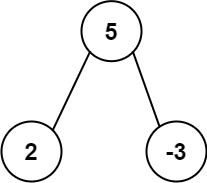
Input: root = [5,2,-3]
Output: [2,-3,4]
Example 2:
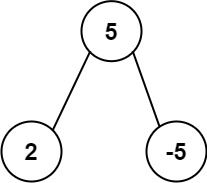
Input: root = [5,2,-5]
Output: [2]
Constraints:
- The number of nodes in the tree is in the range
[1, 104].
-105 <= Node.val <= 105
Solutions
Solution 1: Hash Table + DFS
We can use a hash table cnt to record the frequency of each subtree sum. Then, we use depth-first search (DFS) to traverse the entire tree, calculate the sum of elements for each subtree, and update cnt.
Finally, we traverse cnt to find all subtree sums that appear most frequently.
The time complexity is O(n), and the space complexity is O(n). Here, n is the number of nodes in the binary tree.
PythonJavaC++GoTypeScriptRust
# Definition for a binary tree node.
# class TreeNode:
# def __init__(self, val=0, left=None, right=None):
# self.val = val
# self.left = left
# self.right = right
class Solution:
def findFrequentTreeSum(self, root: Optional[TreeNode]) -> List[int]:
def dfs(root: Optional[TreeNode]) -> int:
if root is None:
return 0
l, r = dfs(root.left), dfs(root.right)
s = l + r + root.val
cnt[s] += 1
return s
cnt = Counter()
dfs(root)
mx = max(cnt.values())
return [k for k, v in cnt.items() if v == mx](code-box)
/**
* Definition for a binary tree node.
* public class TreeNode {
* int val;
* TreeNode left;
* TreeNode right;
* TreeNode() {}
* TreeNode(int val) { this.val = val; }
* TreeNode(int val, TreeNode left, TreeNode right) {
* this.val = val;
* this.left = left;
* this.right = right;
* }
* }
*/
class Solution {
private Map<Integer, Integer> cnt = new HashMap<>();
private int mx;
public int[] findFrequentTreeSum(TreeNode root) {
dfs(root);
List<Integer> ans = new ArrayList<>();
for (var e : cnt.entrySet()) {
if (e.getValue() == mx) {
ans.add(e.getKey());
}
}
return ans.stream().mapToInt(i -> i).toArray();
}
private int dfs(TreeNode root) {
if (root == null) {
return 0;
}
int s = root.val + dfs(root.left) + dfs(root.right);
mx = Math.max(mx, cnt.merge(s, 1, Integer::sum));
return s;
}
}(code-box)
/**
* Definition for a binary tree node.
* struct TreeNode {
* int val;
* TreeNode *left;
* TreeNode *right;
* TreeNode() : val(0), left(nullptr), right(nullptr) {}
* TreeNode(int x) : val(x), left(nullptr), right(nullptr) {}
* TreeNode(int x, TreeNode *left, TreeNode *right) : val(x), left(left), right(right) {}
* };
*/
class Solution {
public:
vector<int> findFrequentTreeSum(TreeNode* root) {
unordered_map<int, int> cnt;
int mx = 0;
function<int(TreeNode*)> dfs = [&](TreeNode* root) -> int {
if (!root) {
return 0;
}
int s = root->val + dfs(root->left) + dfs(root->right);
mx = max(mx, ++cnt[s]);
return s;
};
dfs(root);
vector<int> ans;
for (const auto& [k, v] : cnt) {
if (v == mx) {
ans.push_back(k);
}
}
return ans;
}
};(code-box)
/**
* Definition for a binary tree node.
* type TreeNode struct {
* Val int
* Left *TreeNode
* Right *TreeNode
* }
*/
func findFrequentTreeSum(root *TreeNode) (ans []int) {
cnt := map[int]int{}
var mx int
var dfs func(*TreeNode) int
dfs = func(root *TreeNode) int {
if root == nil {
return 0
}
s := root.Val + dfs(root.Left) + dfs(root.Right)
cnt[s]++
mx = max(mx, cnt[s])
return s
}
dfs(root)
for k, v := range cnt {
if v == mx {
ans = append(ans, k)
}
}
return
}(code-box)
/**
* Definition for a binary tree node.
* class TreeNode {
* val: number
* left: TreeNode | null
* right: TreeNode | null
* constructor(val?: number, left?: TreeNode | null, right?: TreeNode | null) {
* this.val = (val===undefined ? 0 : val)
* this.left = (left===undefined ? null : left)
* this.right = (right===undefined ? null : right)
* }
* }
*/
function findFrequentTreeSum(root: TreeNode | null): number[] {
const cnt = new Map<number, number>();
let mx = 0;
const dfs = (root: TreeNode | null): number => {
if (!root) {
return 0;
}
const { val, left, right } = root;
const s = val + dfs(left) + dfs(right);
cnt.set(s, (cnt.get(s) ?? 0) + 1);
mx = Math.max(mx, cnt.get(s)!);
return s;
};
dfs(root);
return Array.from(cnt.entries())
.filter(([_, c]) => c === mx)
.map(([s, _]) => s);
}(code-box)
// Definition for a binary tree node.
// #[derive(Debug, PartialEq, Eq)]
// pub struct TreeNode {
// pub val: i32,
// pub left: Option<Rc<RefCell<TreeNode>>>,
// pub right: Option<Rc<RefCell<TreeNode>>>,
// }
//
// impl TreeNode {
// #[inline]
// pub fn new(val: i32) -> Self {
// TreeNode {
// val,
// left: None,
// right: None
// }
// }
// }
use std::cell::RefCell;
use std::collections::HashMap;
use std::rc::Rc;
impl Solution {
pub fn find_frequent_tree_sum(root: Option<Rc<RefCell<TreeNode>>>) -> Vec<i32> {
fn dfs(root: Option<Rc<RefCell<TreeNode>>>, cnt: &mut HashMap<i32, i32>) -> i32 {
if let Some(node) = root {
let l = dfs(node.borrow().left.clone(), cnt);
let r = dfs(node.borrow().right.clone(), cnt);
let s = l + r + node.borrow().val;
*cnt.entry(s).or_insert(0) += 1;
s
} else {
0
}
}
let mut cnt = HashMap::new();
dfs(root, &mut cnt);
let mx = cnt.values().cloned().max().unwrap_or(0);
cnt.into_iter()
.filter(|&(_, v)| v == mx)
.map(|(k, _)| k)
.collect()
}
}(code-box)


