
Description
Given an m x n matrix mat, return an array of all the elements of the array in a diagonal order.
Example 1:
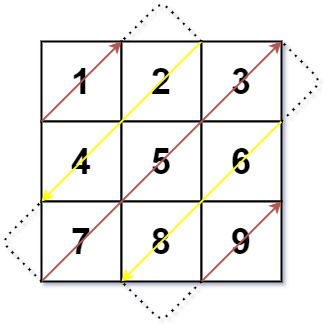
Input: mat = [[1,2,3],[4,5,6],[7,8,9]]
Output: [1,2,4,7,5,3,6,8,9]
Example 2:
Input: mat = [[1,2],[3,4]]
Output: [1,2,3,4]
Constraints:
m == mat.lengthn == mat[i].length1 <= m, n <= 1041 <= m * n <= 104-105 <= mat[i][j] <= 105
Solutions
Solution 1: Fixed Point Traversal
For each round k, we fix the starting point from the top-right and traverse diagonally to the bottom-left to get t. If k is even, we reverse t.
The time complexity is O(m × n), and the space complexity is O(1). Ignoring the space used for the answer.
PythonJavaC++GoTypeScriptRustC#
class Solution:
def findDiagonalOrder(self, mat: List[List[int]]) -> List[int]:
m, n = len(mat), len(mat[0])
ans = []
for k in range(m + n - 1):
t = []
i = 0 if k < n else k - n + 1
j = k if k < n else n - 1
while i < m and j >= 0:
t.append(mat[i][j])
i += 1
j -= 1
if k % 2 == 0:
t = t[::-1]
ans.extend(t)
return ans(code-box)
class Solution {
public int[] findDiagonalOrder(int[][] mat) {
int m = mat.length, n = mat[0].length;
int[] ans = new int[m * n];
int idx = 0;
List<Integer> t = new ArrayList<>();
for (int k = 0; k < m + n - 1; ++k) {
int i = k < n ? 0 : k - n + 1;
int j = k < n ? k : n - 1;
while (i < m && j >= 0) {
t.add(mat[i][j]);
++i;
--j;
}
if (k % 2 == 0) {
Collections.reverse(t);
}
for (int v : t) {
ans[idx++] = v;
}
t.clear();
}
return ans;
}
}(code-box)
class Solution {
public:
vector<int> findDiagonalOrder(vector<vector<int>>& mat) {
int m = mat.size();
int n = mat[0].size();
vector<int> ans;
vector<int> t;
for (int k = 0; k < m + n - 1; ++k) {
int i = (k < n) ? 0 : k - n + 1;
int j = (k < n) ? k : n - 1;
while (i < m && j >= 0) {
t.push_back(mat[i][j]);
++i;
--j;
}
if (k % 2 == 0) {
ranges::reverse(t);
}
ans.insert(ans.end(), t.begin(), t.end());
t.clear();
}
return ans;
}
};(code-box)
func findDiagonalOrder(mat [][]int) []int {
m := len(mat)
n := len(mat[0])
ans := make([]int, 0, m*n)
for k := 0; k < m+n-1; k++ {
t := make([]int, 0)
var i, j int
if k < n {
i = 0
j = k
} else {
i = k - n + 1
j = n - 1
}
for i < m && j >= 0 {
t = append(t, mat[i][j])
i++
j--
}
if k%2 == 0 {
slices.Reverse(t)
}
ans = append(ans, t...)
}
return ans
}(code-box)
function findDiagonalOrder(mat: number[][]): number[] {
const m = mat.length;
const n = mat[0].length;
const ans: number[] = [];
for (let k = 0; k < m + n - 1; k++) {
const t: number[] = [];
let i = k < n ? 0 : k - n + 1;
let j = k < n ? k : n - 1;
while (i < m && j >= 0) {
t.push(mat[i][j]);
i++;
j--;
}
if (k % 2 === 0) {
t.reverse();
}
ans.push(...t);
}
return ans;
}(code-box)
impl Solution {
pub fn find_diagonal_order(mat: Vec<Vec<i32>>) -> Vec<i32> {
let m = mat.len();
let n = mat[0].len();
let mut ans = Vec::with_capacity(m * n);
for k in 0..(m + n - 1) {
let mut t = Vec::new();
let (mut i, mut j) = if k < n {
(0, k)
} else {
(k - n + 1, n - 1)
};
while i < m && j < n {
t.push(mat[i][j]);
i += 1;
if j == 0 { break; }
j -= 1;
}
if k % 2 == 0 {
t.reverse();
}
ans.extend(t);
}
ans
}
}(code-box)
public class Solution {
public int[] FindDiagonalOrder(int[][] mat) {
int m = mat.Length;
int n = mat[0].Length;
List<int> ans = new List<int>();
for (int k = 0; k < m + n - 1; k++) {
List<int> t = new List<int>();
int i = k < n ? 0 : k - n + 1;
int j = k < n ? k : n - 1;
while (i < m && j >= 0) {
t.Add(mat[i][j]);
i++;
j--;
}
if (k % 2 == 0) {
t.Reverse();
}
ans.AddRange(t);
}
return ans.ToArray();
}
}(code-box)


