
Description
Given the root of a binary tree and an integer targetSum, return the number of paths where the sum of the values along the path equals targetSum.
The path does not need to start or end at the root or a leaf, but it must go downwards (i.e., traveling only from parent nodes to child nodes).
Example 1:
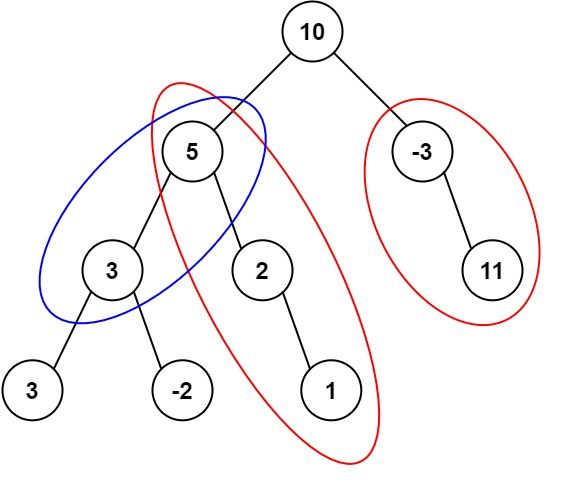
Input: root = [10,5,-3,3,2,null,11,3,-2,null,1], targetSum = 8
Output: 3
Explanation: The paths that sum to 8 are shown.
Example 2:
Input: root = [5,4,8,11,null,13,4,7,2,null,null,5,1], targetSum = 22
Output: 3
Constraints:
- The number of nodes in the tree is in the range
[0, 1000].
-109 <= Node.val <= 109-1000 <= targetSum <= 1000
Solutions
Solution 1: Hash Table + Prefix Sum + Recursion
We can use the idea of prefix sums to recursively traverse the binary tree while using a hash table cnt to count the occurrences of each prefix sum along the path from the root to the current node.
We design a recursive function dfs(node, s), where node represents the current node being traversed, and s represents the prefix sum along the path from the root to the current node. The return value of the function is the number of paths ending at node or its subtree nodes with a sum equal to targetSum. The final answer is dfs(root, 0).
The recursive process of dfs(node, s) is as follows:
- If the current node node is null, return 0.
- Calculate the prefix sum s along the path from the root to the current node.
- Use cnt[s - targetSum] to represent the number of paths ending at the current node with a sum equal to targetSum. Here, cnt[s - targetSum] is the count of prefix sums equal to s - targetSum in cnt.
- Increment the count of the prefix sum s by 1, i.e., cnt[s] = cnt[s] + 1.
- Recursively traverse the left and right child nodes of the current node by calling dfs(node.left, s) and dfs(node.right, s), and add their return values.
- After the return value is calculated, decrement the count of the prefix sum s by 1, i.e., cnt[s] = cnt[s] - 1.
- Finally, return the result.
The time complexity is O(n), and the space complexity is O(n), where n is the number of nodes in the binary tree.
PythonJavaC++GoTypeScriptRustJavaScriptC#
# Definition for a binary tree node.
# class TreeNode:
# def __init__(self, val=0, left=None, right=None):
# self.val = val
# self.left = left
# self.right = right
class Solution:
def pathSum(self, root: Optional[TreeNode], targetSum: int) -> int:
def dfs(node, s):
if node is None:
return 0
s += node.val
ans = cnt[s - targetSum]
cnt[s] += 1
ans += dfs(node.left, s)
ans += dfs(node.right, s)
cnt[s] -= 1
return ans
cnt = Counter({0: 1})
return dfs(root, 0)(code-box)
/**
* Definition for a binary tree node.
* public class TreeNode {
* int val;
* TreeNode left;
* TreeNode right;
* TreeNode() {}
* TreeNode(int val) { this.val = val; }
* TreeNode(int val, TreeNode left, TreeNode right) {
* this.val = val;
* this.left = left;
* this.right = right;
* }
* }
*/
class Solution {
private Map<Long, Integer> cnt = new HashMap<>();
private int targetSum;
public int pathSum(TreeNode root, int targetSum) {
cnt.put(0L, 1);
this.targetSum = targetSum;
return dfs(root, 0);
}
private int dfs(TreeNode node, long s) {
if (node == null) {
return 0;
}
s += node.val;
int ans = cnt.getOrDefault(s - targetSum, 0);
cnt.merge(s, 1, Integer::sum);
ans += dfs(node.left, s);
ans += dfs(node.right, s);
cnt.merge(s, -1, Integer::sum);
return ans;
}
}(code-box)
/**
* Definition for a binary tree node.
* struct TreeNode {
* int val;
* TreeNode *left;
* TreeNode *right;
* TreeNode() : val(0), left(nullptr), right(nullptr) {}
* TreeNode(int x) : val(x), left(nullptr), right(nullptr) {}
* TreeNode(int x, TreeNode *left, TreeNode *right) : val(x), left(left), right(right) {}
* };
*/
class Solution {
public:
int pathSum(TreeNode* root, int targetSum) {
unordered_map<long long, int> cnt;
cnt[0] = 1;
auto dfs = [&](this auto&& dfs, TreeNode* node, long long s) -> int {
if (!node) {
return 0;
}
s += node->val;
int ans = cnt[s - targetSum];
++cnt[s];
ans += dfs(node->left, s) + dfs(node->right, s);
--cnt[s];
return ans;
};
return dfs(root, 0);
}
};(code-box)
/**
* Definition for a binary tree node.
* type TreeNode struct {
* Val int
* Left *TreeNode
* Right *TreeNode
* }
*/
func pathSum(root *TreeNode, targetSum int) int {
cnt := map[int]int{0: 1}
var dfs func(*TreeNode, int) int
dfs = func(node *TreeNode, s int) int {
if node == nil {
return 0
}
s += node.Val
ans := cnt[s-targetSum]
cnt[s]++
ans += dfs(node.Left, s) + dfs(node.Right, s)
cnt[s]--
return ans
}
return dfs(root, 0)
}(code-box)
/**
* Definition for a binary tree node.
* class TreeNode {
* val: number
* left: TreeNode | null
* right: TreeNode | null
* constructor(val?: number, left?: TreeNode | null, right?: TreeNode | null) {
* this.val = (val===undefined ? 0 : val)
* this.left = (left===undefined ? null : left)
* this.right = (right===undefined ? null : right)
* }
* }
*/
function pathSum(root: TreeNode | null, targetSum: number): number {
const cnt: Map<number, number> = new Map();
const dfs = (node: TreeNode | null, s: number): number => {
if (!node) {
return 0;
}
s += node.val;
let ans = cnt.get(s - targetSum) ?? 0;
cnt.set(s, (cnt.get(s) ?? 0) + 1);
ans += dfs(node.left, s);
ans += dfs(node.right, s);
cnt.set(s, (cnt.get(s) ?? 0) - 1);
return ans;
};
cnt.set(0, 1);
return dfs(root, 0);
}(code-box)
// Definition for a binary tree node.
// #[derive(Debug, PartialEq, Eq)]
// pub struct TreeNode {
// pub val: i32,
// pub left: Option<Rc<RefCell<TreeNode>>>,
// pub right: Option<Rc<RefCell<TreeNode>>>,
// }
//
// impl TreeNode {
// #[inline]
// pub fn new(val: i32) -> Self {
// TreeNode {
// val,
// left: None,
// right: None
// }
// }
// }
use std::rc::Rc;
use std::cell::RefCell;
use std::collections::HashMap;
impl Solution {
pub fn path_sum(root: Option<Rc<RefCell<TreeNode>>>, target_sum: i32) -> i32 {
let mut cnt = HashMap::new();
cnt.insert(0, 1);
fn dfs(node: Option<Rc<RefCell<TreeNode>>>, s: i64, target: i64, cnt: &mut HashMap<i64, i32>) -> i32 {
if let Some(n) = node {
let n = n.borrow();
let s = s + n.val as i64;
let ans = cnt.get(&(s - target)).copied().unwrap_or(0);
*cnt.entry(s).or_insert(0) += 1;
let ans = ans + dfs(n.left.clone(), s, target, cnt) + dfs(n.right.clone(), s, target, cnt);
*cnt.get_mut(&s).unwrap() -= 1;
ans
} else {
0
}
}
dfs(root, 0, target_sum as i64, &mut cnt)
}
}(code-box)
/**
* Definition for a binary tree node.
* function TreeNode(val, left, right) {
* this.val = (val===undefined ? 0 : val)
* this.left = (left===undefined ? null : left)
* this.right = (right===undefined ? null : right)
* }
*/
/**
* @param {TreeNode} root
* @param {number} targetSum
* @return {number}
*/
var pathSum = function (root, targetSum) {
const cnt = new Map();
const dfs = (node, s) => {
if (!node) {
return 0;
}
s += node.val;
let ans = cnt.get(s - targetSum) || 0;
cnt.set(s, (cnt.get(s) || 0) + 1);
ans += dfs(node.left, s);
ans += dfs(node.right, s);
cnt.set(s, cnt.get(s) - 1);
return ans;
};
cnt.set(0, 1);
return dfs(root, 0);
};(code-box)
/**
* Definition for a binary tree node.
* public class TreeNode {
* public int val;
* public TreeNode left;
* public TreeNode right;
* public TreeNode(int val=0, TreeNode left=null, TreeNode right=null) {
* this.val = val;
* this.left = left;
* this.right = right;
* }
* }
*/
public class Solution {
public int PathSum(TreeNode root, int targetSum) {
Dictionary<long, int> cnt = new Dictionary<long, int>();
int Dfs(TreeNode node, long s) {
if (node == null) {
return 0;
}
s += node.val;
int ans = cnt.GetValueOrDefault(s - targetSum, 0);
cnt[s] = cnt.GetValueOrDefault(s, 0) + 1;
ans += Dfs(node.left, s);
ans += Dfs(node.right, s);
cnt[s]--;
return ans;
}
cnt[0] = 1;
return Dfs(root, 0);
}
}(code-box)


