
Description
A binary watch has 4 LEDs on the top to represent the hours (0-11), and 6 LEDs on the bottom to represent the minutes (0-59). Each LED represents a zero or one, with the least significant bit on the right.
- For example, the below binary watch reads
"4:51".
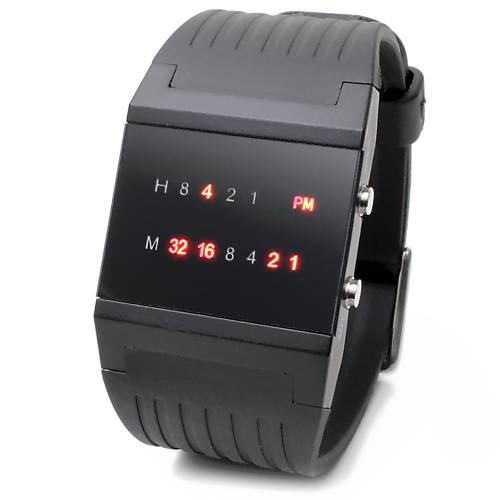
Given an integer turnedOn which represents the number of LEDs that are currently on (ignoring the PM), return all possible times the watch could represent. You may return the answer in any order.
The hour must not contain a leading zero.
- For example,
"01:00" is not valid. It should be "1:00".
The minute must consist of two digits and may contain a leading zero.
- For example,
"10:2" is not valid. It should be "10:02".
Example 1:
Input: turnedOn = 1
Output: ["0:01","0:02","0:04","0:08","0:16","0:32","1:00","2:00","4:00","8:00"]
Example 2:
Input: turnedOn = 9
Output: []
Constraints:
Solutions
Solution 1: Enumerate Combinations
The problem can be converted to finding all possible combinations of i ∈ [0, 12) and j ∈ [0, 60).
A valid combination must satisfy the condition that the number of 1s in the binary representation of i plus the number of 1s in the binary representation of j equals turnedOn.
The time complexity is O(1), and the space complexity is O(1).
PythonJavaC++GoTypeScriptRust
class Solution:
def readBinaryWatch(self, turnedOn: int) -> List[str]:
return [
'{:d}:{:02d}'.format(i, j)
for i in range(12)
for j in range(60)
if (bin(i) + bin(j)).count('1') == turnedOn
](code-box)
class Solution {
public List<String> readBinaryWatch(int turnedOn) {
List<String> ans = new ArrayList<>();
for (int i = 0; i < 12; ++i) {
for (int j = 0; j < 60; ++j) {
if (Integer.bitCount(i) + Integer.bitCount(j) == turnedOn) {
ans.add(String.format("%d:%02d", i, j));
}
}
}
return ans;
}
}(code-box)
class Solution {
public:
vector<string> readBinaryWatch(int turnedOn) {
vector<string> ans;
for (int i = 0; i < 12; ++i) {
for (int j = 0; j < 60; ++j) {
if (__builtin_popcount(i) + __builtin_popcount(j) == turnedOn) {
ans.push_back(to_string(i) + ":" + (j < 10 ? "0" : "") + to_string(j));
}
}
}
return ans;
}
};(code-box)
func readBinaryWatch(turnedOn int) []string {
var ans []string
for i := 0; i < 12; i++ {
for j := 0; j < 60; j++ {
if bits.OnesCount(uint(i))+bits.OnesCount(uint(j)) == turnedOn {
ans = append(ans, fmt.Sprintf("%d:%02d", i, j))
}
}
}
return ans
}(code-box)
function readBinaryWatch(turnedOn: number): string[] {
const ans: string[] = [];
for (let i = 0; i < 12; ++i) {
for (let j = 0; j < 60; ++j) {
if (bitCount(i) + bitCount(j) === turnedOn) {
ans.push(`${i}:${j.toString().padStart(2, '0')}`);
}
}
}
return ans;
}
function bitCount(i: number): number {
i = i - ((i >>> 1) & 0x55555555);
i = (i & 0x33333333) + ((i >>> 2) & 0x33333333);
i = (i + (i >>> 4)) & 0x0f0f0f0f;
i = i + (i >>> 8);
i = i + (i >>> 16);
return i & 0x3f;
}(code-box)
impl Solution {
pub fn read_binary_watch(turned_on: i32) -> Vec<String> {
let mut ans: Vec<String> = Vec::new();
for i in 0u32..12 {
for j in 0u32..60 {
if (i.count_ones() + j.count_ones()) as i32 == turned_on {
ans.push(format!("{}:{:02}", i, j));
}
}
}
ans
}
}(code-box)
Solution 2: Binary Enumeration
We can use 10 binary bits to represent the watch, where the first 4 bits represent hours and the last 6 bits represent minutes. Enumerate each number in [0, 2^{10}), check if the number of 1s in its binary representation equals turnedOn, and if so, convert it to time format and add it to the answer.
The time complexity is O(1), and the space complexity is O(1).
PythonJavaC++GoTypeScriptRust
class Solution:
def readBinaryWatch(self, turnedOn: int) -> List[str]:
ans = []
for i in range(1 << 10):
h, m = i >> 6, i & 0b111111
if h < 12 and m < 60 and i.bit_count() == turnedOn:
ans.append('{:d}:{:02d}'.format(h, m))
return ans(code-box)
class Solution {
public List<String> readBinaryWatch(int turnedOn) {
List<String> ans = new ArrayList<>();
for (int i = 0; i < 1 << 10; ++i) {
int h = i >> 6, m = i & 0b111111;
if (h < 12 && m < 60 && Integer.bitCount(i) == turnedOn) {
ans.add(String.format("%d:%02d", h, m));
}
}
return ans;
}
}(code-box)
class Solution {
public:
vector<string> readBinaryWatch(int turnedOn) {
vector<string> ans;
for (int i = 0; i < 1 << 10; ++i) {
int h = i >> 6, m = i & 0b111111;
if (h < 12 && m < 60 && __builtin_popcount(i) == turnedOn) {
ans.push_back(to_string(h) + ":" + (m < 10 ? "0" : "") + to_string(m));
}
}
return ans;
}
};(code-box)
func readBinaryWatch(turnedOn int) []string {
var ans []string
for i := 0; i < 1<<10; i++ {
h, m := i>>6, i&0b111111
if h < 12 && m < 60 && bits.OnesCount(uint(i)) == turnedOn {
ans = append(ans, fmt.Sprintf("%d:%02d", h, m))
}
}
return ans
}(code-box)
function readBinaryWatch(turnedOn: number): string[] {
const ans: string[] = [];
for (let i = 0; i < 1 << 10; ++i) {
const h = i >> 6;
const m = i & 0b111111;
if (h < 12 && m < 60 && bitCount(i) === turnedOn) {
ans.push(`${h}:${m < 10 ? '0' : ''}${m}`);
}
}
return ans;
}
function bitCount(i: number): number {
i = i - ((i >>> 1) & 0x55555555);
i = (i & 0x33333333) + ((i >>> 2) & 0x33333333);
i = (i + (i >>> 4)) & 0x0f0f0f0f;
i = i + (i >>> 8);
i = i + (i >>> 16);
return i & 0x3f;
}(code-box)
impl Solution {
pub fn read_binary_watch(turned_on: i32) -> Vec<String> {
let mut ans: Vec<String> = Vec::new();
for i in 0u32..(1 << 10) {
let h = i >> 6;
let m = i & 0b111111;
if h < 12 && m < 60 && i.count_ones() as i32 == turned_on {
ans.push(format!("{}:{:02}", h, m));
}
}
ans
}
}(code-box)


