
Description
Given the root of a binary tree, find the largest subtree, which is also a Binary Search Tree (BST), where the largest means subtree has the largest number of nodes.
A Binary Search Tree (BST) is a tree in which all the nodes follow the below-mentioned properties:
- The left subtree values are less than the value of their parent (root) node's value.
- The right subtree values are greater than the value of their parent (root) node's value.
Note: A subtree must include all of its descendants.
Example 1:
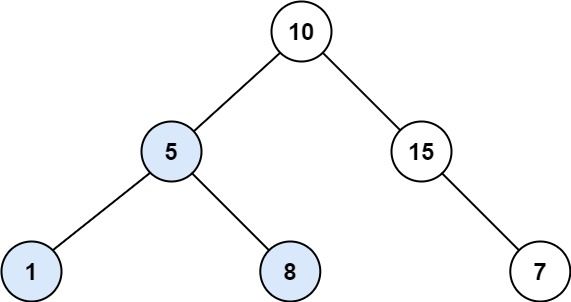
Input: root = [10,5,15,1,8,null,7]
Output: 3
Explanation: The Largest BST Subtree in this case is the highlighted one. The return value is the subtree's size, which is 3.
Example 2:
Input: root = [4,2,7,2,3,5,null,2,null,null,null,null,null,1]
Output: 2
Constraints:
- The number of nodes in the tree is in the range
[0, 104].
-104 <= Node.val <= 104
Follow up: Can you figure out ways to solve it with O(n) time complexity?
Solutions
Solution 1
PythonJavaC++Go
# Definition for a binary tree node.
# class TreeNode:
# def __init__(self, val=0, left=None, right=None):
# self.val = val
# self.left = left
# self.right = right
class Solution:
def largestBSTSubtree(self, root: Optional[TreeNode]) -> int:
def dfs(root):
if root is None:
return inf, -inf, 0
lmi, lmx, ln = dfs(root.left)
rmi, rmx, rn = dfs(root.right)
nonlocal ans
if lmx < root.val < rmi:
ans = max(ans, ln + rn + 1)
return min(lmi, root.val), max(rmx, root.val), ln + rn + 1
return -inf, inf, 0
ans = 0
dfs(root)
return ans(code-box)
/**
* Definition for a binary tree node.
* public class TreeNode {
* int val;
* TreeNode left;
* TreeNode right;
* TreeNode() {}
* TreeNode(int val) { this.val = val; }
* TreeNode(int val, TreeNode left, TreeNode right) {
* this.val = val;
* this.left = left;
* this.right = right;
* }
* }
*/
class Solution {
private int ans;
public int largestBSTSubtree(TreeNode root) {
ans = 0;
dfs(root);
return ans;
}
private int[] dfs(TreeNode root) {
if (root == null) {
return new int[] {Integer.MAX_VALUE, Integer.MIN_VALUE, 0};
}
int[] left = dfs(root.left);
int[] right = dfs(root.right);
if (left[1] < root.val && root.val < right[0]) {
ans = Math.max(ans, left[2] + right[2] + 1);
return new int[] {
Math.min(root.val, left[0]), Math.max(root.val, right[1]), left[2] + right[2] + 1};
}
return new int[] {Integer.MIN_VALUE, Integer.MAX_VALUE, 0};
}
}(code-box)
/**
* Definition for a binary tree node.
* struct TreeNode {
* int val;
* TreeNode *left;
* TreeNode *right;
* TreeNode() : val(0), left(nullptr), right(nullptr) {}
* TreeNode(int x) : val(x), left(nullptr), right(nullptr) {}
* TreeNode(int x, TreeNode *left, TreeNode *right) : val(x), left(left), right(right) {}
* };
*/
class Solution {
public:
int ans;
int largestBSTSubtree(TreeNode* root) {
ans = 0;
dfs(root);
return ans;
}
vector<int> dfs(TreeNode* root) {
if (!root) return {INT_MAX, INT_MIN, 0};
auto left = dfs(root->left);
auto right = dfs(root->right);
if (left[1] < root->val && root->val < right[0]) {
ans = max(ans, left[2] + right[2] + 1);
return {min(root->val, left[0]), max(root->val, right[1]), left[2] + right[2] + 1};
}
return {INT_MIN, INT_MAX, 0};
}
};(code-box)
/**
* Definition for a binary tree node.
* type TreeNode struct {
* Val int
* Left *TreeNode
* Right *TreeNode
* }
*/
func largestBSTSubtree(root *TreeNode) int {
ans := 0
var dfs func(root *TreeNode) []int
dfs = func(root *TreeNode) []int {
if root == nil {
return []int{math.MaxInt32, math.MinInt32, 0}
}
left := dfs(root.Left)
right := dfs(root.Right)
if left[1] < root.Val && root.Val < right[0] {
ans = max(ans, left[2]+right[2]+1)
return []int{min(root.Val, left[0]), max(root.Val, right[1]), left[2] + right[2] + 1}
}
return []int{math.MinInt32, math.MaxInt32, 0}
}
dfs(root)
return ans
}(code-box)


