


Description
You are painting a fence of n posts with k different colors. You must paint the posts following these rules:
- Every post must be painted exactly one color.
- There cannot be three or more consecutive posts with the same color.
Given the two integers n and k, return the number of ways you can paint the fence.
Example 1:
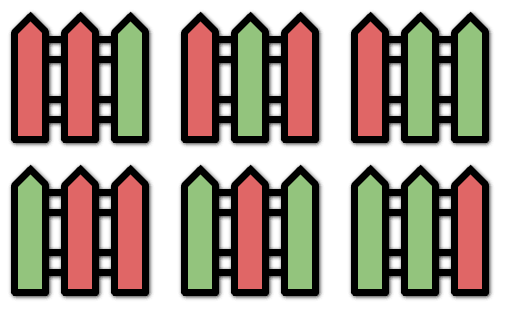
Input: n = 3, k = 2
Output: 6
Explanation: All the possibilities are shown.
Note that painting all the posts red or all the posts green is invalid because there cannot be three posts in a row with the same color.
Example 2:
Input: n = 1, k = 1
Output: 1
Example 3:
Input: n = 7, k = 2
Output: 42
Constraints:
1 <= n <= 501 <= k <= 105- The testcases are generated such that the answer is in the range
[0, 231 - 1]for the givennandk.
Solutions
Solution 1: Dynamic Programming
We define f[i] to represent the number of ways to paint the fence posts from [0..i] such that the last two posts have different colors, and g[i] to represent the number of ways to paint the fence posts from [0..i] such that the last two posts have the same color. Initially, f[0] = k and g[0] = 0.
When i > 0, we have the following state transition equations:
$$ \begin{aligned} f[i] & = (f[i - 1] + g[i - 1]) \times (k - 1) \ g[i] & = f[i - 1] \end{aligned} $$
The final answer is f[n - 1] + g[n - 1].
The time complexity is O(n) and the space complexity is O(n), where n is the number of fence posts.
class Solution: def numWays(self, n: int, k: int) -> int: f = [0] * n g = [0] * n f[0] = k for i in range(1, n): f[i] = (f[i - 1] + g[i - 1]) * (k - 1) g[i] = f[i - 1] return f[-1] + g[-1](code-box)
Solution 2: Dynamic Programming (Space Optimization)
We notice that f[i] and g[i] are only related to f[i - 1] and g[i - 1]. Therefore, we can use two variables f and g to record the values of f[i - 1] and g[i - 1] respectively, thus optimizing the space complexity to O(1).
class Solution: def numWays(self, n: int, k: int) -> int: f, g = k, 0 for _ in range(n - 1): ff = (f + g) * (k - 1) g = f f = ff return f + g(code-box)
