
Description
Given head, the head of a linked list, determine if the linked list has a cycle in it.
There is a cycle in a linked list if there is some node in the list that can be reached again by continuously following the next pointer. Internally, pos is used to denote the index of the node that tail's next pointer is connected to. Note that pos is not passed as a parameter.
Return true if there is a cycle in the linked list. Otherwise, return false.
Example 1:
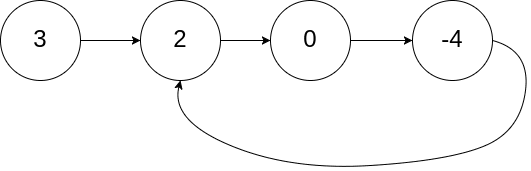
Input: head = [3,2,0,-4], pos = 1
Output: true
Explanation: There is a cycle in the linked list, where the tail connects to the 1st node (0-indexed).
Example 2:
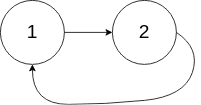
Input: head = [1,2], pos = 0
Output: true
Explanation: There is a cycle in the linked list, where the tail connects to the 0th node.
Example 3:

Input: head = [1], pos = -1
Output: false
Explanation: There is no cycle in the linked list.
Constraints:
- The number of the nodes in the list is in the range
[0, 104].
-105 <= Node.val <= 105pos is -1 or a valid index in the linked-list.
Follow up: Can you solve it using O(1) (i.e. constant) memory?
Solutions
Solution 1: Hash Table
We can traverse the linked list and use a hash table s to record each node. When a node appears for the second time, it indicates that there is a cycle, and we directly return true. Otherwise, when the linked list traversal ends, we return false.
The time complexity is O(n), and the space complexity is O(n), where n is the number of nodes in the linked list.
PythonJavaC++GoTypeScript
# Definition for singly-linked list.
# class ListNode:
# def __init__(self, x):
# self.val = x
# self.next = None
class Solution:
def hasCycle(self, head: Optional[ListNode]) -> bool:
s = set()
while head:
if head in s:
return True
s.add(head)
head = head.next
return False(code-box)
/**
* Definition for singly-linked list.
* class ListNode {
* int val;
* ListNode next;
* ListNode(int x) {
* val = x;
* next = null;
* }
* }
*/
public class Solution {
public boolean hasCycle(ListNode head) {
Set<ListNode> s = new HashSet<>();
for (; head != null; head = head.next) {
if (!s.add(head)) {
return true;
}
}
return false;
}
}(code-box)
/**
* Definition for singly-linked list.
* struct ListNode {
* int val;
* ListNode *next;
* ListNode(int x) : val(x), next(NULL) {}
* };
*/
class Solution {
public:
bool hasCycle(ListNode* head) {
unordered_set<ListNode*> s;
for (; head; head = head->next) {
if (s.contains(head)) {
return true;
}
s.insert(head);
}
return false;
}
};(code-box)
/**
* Definition for singly-linked list.
* type ListNode struct {
* Val int
* Next *ListNode
* }
*/
func hasCycle(head *ListNode) bool {
s := map[*ListNode]bool{}
for ; head != nil; head = head.Next {
if s[head] {
return true
}
s[head] = true
}
return false
}(code-box)
/**
* Definition for singly-linked list.
* class ListNode {
* val: number
* next: ListNode | null
* constructor(val?: number, next?: ListNode | null) {
* this.val = (val===undefined ? 0 : val)
* this.next = (next===undefined ? null : next)
* }
* }
*/
function hasCycle(head: ListNode | null): boolean {
const s: Set<ListNode> = new Set();
for (; head; head = head.next) {
if (s.has(head)) {
return true;
}
s.add(head);
}
return false;
}(code-box)
Solution 2: Fast and Slow Pointers
We define two pointers, fast and slow, both initially pointing to head.
The fast pointer moves two steps at a time, and the slow pointer moves one step at a time, in a continuous loop. When the fast and slow pointers meet, it indicates that there is a cycle in the linked list. If the loop ends without the pointers meeting, it indicates that there is no cycle in the linked list.
The time complexity is O(n), and the space complexity is O(1), where n is the number of nodes in the linked list.
PythonJavaC++GoTypeScriptJavaScriptC#
# Definition for singly-linked list.
# class ListNode:
# def __init__(self, x):
# self.val = x
# self.next = None
class Solution:
def hasCycle(self, head: ListNode) -> bool:
slow = fast = head
while fast and fast.next:
slow, fast = slow.next, fast.next.next
if slow == fast:
return True
return False(code-box)
/**
* Definition for singly-linked list.
* class ListNode {
* int val;
* ListNode next;
* ListNode(int x) {
* val = x;
* next = null;
* }
* }
*/
public class Solution {
public boolean hasCycle(ListNode head) {
ListNode slow = head;
ListNode fast = head;
while (fast != null && fast.next != null) {
slow = slow.next;
fast = fast.next.next;
if (slow == fast) {
return true;
}
}
return false;
}
}(code-box)
/**
* Definition for singly-linked list.
* struct ListNode {
* int val;
* ListNode *next;
* ListNode(int x) : val(x), next(NULL) {}
* };
*/
class Solution {
public:
bool hasCycle(ListNode* head) {
ListNode* slow = head;
ListNode* fast = head;
while (fast && fast->next) {
slow = slow->next;
fast = fast->next->next;
if (slow == fast) {
return true;
}
}
return false;
}
};(code-box)
/**
* Definition for singly-linked list.
* type ListNode struct {
* Val int
* Next *ListNode
* }
*/
func hasCycle(head *ListNode) bool {
slow, fast := head, head
for fast != nil && fast.Next != nil {
slow, fast = slow.Next, fast.Next.Next
if slow == fast {
return true
}
}
return false
}(code-box)
/**
* Definition for singly-linked list.
* class ListNode {
* val: number
* next: ListNode | null
* constructor(val?: number, next?: ListNode | null) {
* this.val = (val===undefined ? 0 : val)
* this.next = (next===undefined ? null : next)
* }
* }
*/
function hasCycle(head: ListNode | null): boolean {
let slow = head;
let fast = head;
while (fast !== null && fast.next !== null) {
slow = slow.next;
fast = fast.next.next;
if (slow === fast) {
return true;
}
}
return false;
}(code-box)
/**
* Definition for singly-linked list.
* function ListNode(val) {
* this.val = val;
* this.next = null;
* }
*/
/**
* @param {ListNode} head
* @return {boolean}
*/
var hasCycle = function (head) {
let slow = head;
let fast = head;
while (fast && fast.next) {
slow = slow.next;
fast = fast.next.next;
if (slow === fast) {
return true;
}
}
return false;
};(code-box)
/**
* Definition for singly-linked list.
* public class ListNode {
* public int val;
* public ListNode next;
* public ListNode(int x) {
* val = x;
* next = null;
* }
* }
*/
public class Solution {
public bool HasCycle(ListNode head) {
var fast = head;
var slow = head;
while (fast != null && fast.next != null) {
fast = fast.next.next;
slow = slow.next;
if (fast == slow) {
return true;
}
}
return false;
}
}(code-box)


