
Description
You are given an m x n matrix board containing letters 'X' and 'O', capture regions that are surrounded:
- Connect: A cell is connected to adjacent cells horizontally or vertically.
- Region: To form a region connect every
'O' cell.
- Surround: A region is surrounded if none of the
'O' cells in that region are on the edge of the board. Such regions are completely enclosed by 'X' cells.
To capture a surrounded region, replace all 'O's with 'X's in-place within the original board. You do not need to return anything.
Example 1:
Input: board = [["X","X","X","X"],["X","O","O","X"],["X","X","O","X"],["X","O","X","X"]]
Output: [["X","X","X","X"],["X","X","X","X"],["X","X","X","X"],["X","O","X","X"]]
Explanation:
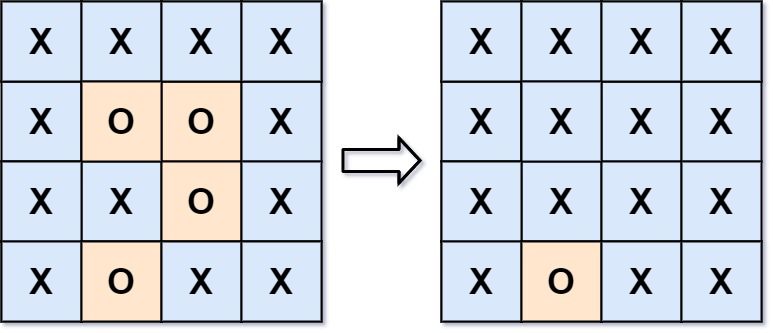
In the above diagram, the bottom region is not captured because it is on the edge of the board and cannot be surrounded.
Example 2:
Input: board = [["X"]]
Output: [["X"]]
Constraints:
m == board.lengthn == board[i].length1 <= m, n <= 200board[i][j] is 'X' or 'O'.
Solutions
Solution 1: Depth-First Search (DFS)
We can start from the boundary of the matrix, taking each 'O' on the matrix boundary as a starting point, and perform depth-first search. All 'O's found in the search are replaced with '.'.
Then we traverse the matrix again, for each position:
- If it is '.', replace it with 'O';
- Otherwise, if it is 'O', replace it with 'X'.
The time complexity is O(m × n), and the space complexity is O(m × n). Here, m and n are the number of rows and columns in the matrix, respectively.
PythonJavaC++GoTypeScriptRustC#
class Solution:
def solve(self, board: List[List[str]]) -> None:
def dfs(i: int, j: int):
if not (0 <= i < m and 0 <= j < n and board[i][j] == "O"):
return
board[i][j] = "."
for a, b in pairwise((-1, 0, 1, 0, -1)):
dfs(i + a, j + b)
m, n = len(board), len(board[0])
for i in range(m):
dfs(i, 0)
dfs(i, n - 1)
for j in range(n):
dfs(0, j)
dfs(m - 1, j)
for i in range(m):
for j in range(n):
if board[i][j] == ".":
board[i][j] = "O"
elif board[i][j] == "O":
board[i][j] = "X"(code-box)
class Solution {
private final int[] dirs = {-1, 0, 1, 0, -1};
private char[][] board;
private int m;
private int n;
public void solve(char[][] board) {
m = board.length;
n = board[0].length;
this.board = board;
for (int i = 0; i < m; ++i) {
dfs(i, 0);
dfs(i, n - 1);
}
for (int j = 0; j < n; ++j) {
dfs(0, j);
dfs(m - 1, j);
}
for (int i = 0; i < m; ++i) {
for (int j = 0; j < n; ++j) {
if (board[i][j] == '.') {
board[i][j] = 'O';
} else if (board[i][j] == 'O') {
board[i][j] = 'X';
}
}
}
}
private void dfs(int i, int j) {
if (i < 0 || i >= m || j < 0 || j >= n || board[i][j] != 'O') {
return;
}
board[i][j] = '.';
for (int k = 0; k < 4; ++k) {
dfs(i + dirs[k], j + dirs[k + 1]);
}
}
}(code-box)
class Solution {
public:
void solve(vector<vector<char>>& board) {
int m = board.size(), n = board[0].size();
int dirs[5] = {-1, 0, 1, 0, -1};
function<void(int, int)> dfs = [&](int i, int j) {
if (i < 0 || i >= m || j < 0 || j >= n || board[i][j] != 'O') {
return;
}
board[i][j] = '.';
for (int k = 0; k < 4; ++k) {
dfs(i + dirs[k], j + dirs[k + 1]);
}
};
for (int i = 0; i < m; ++i) {
dfs(i, 0);
dfs(i, n - 1);
}
for (int j = 1; j < n - 1; ++j) {
dfs(0, j);
dfs(m - 1, j);
}
for (auto& row : board) {
for (auto& c : row) {
if (c == '.') {
c = 'O';
} else if (c == 'O') {
c = 'X';
}
}
}
}
};(code-box)
func solve(board [][]byte) {
m, n := len(board), len(board[0])
dirs := [5]int{-1, 0, 1, 0, -1}
var dfs func(i, j int)
dfs = func(i, j int) {
if i < 0 || i >= m || j < 0 || j >= n || board[i][j] != 'O' {
return
}
board[i][j] = '.'
for k := 0; k < 4; k++ {
dfs(i+dirs[k], j+dirs[k+1])
}
}
for i := 0; i < m; i++ {
dfs(i, 0)
dfs(i, n-1)
}
for j := 0; j < n; j++ {
dfs(0, j)
dfs(m-1, j)
}
for i, row := range board {
for j, c := range row {
if c == '.' {
board[i][j] = 'O'
} else if c == 'O' {
board[i][j] = 'X'
}
}
}
}(code-box)
function solve(board: string[][]): void {
const m = board.length;
const n = board[0].length;
const dirs: number[] = [-1, 0, 1, 0, -1];
const dfs = (i: number, j: number): void => {
if (i < 0 || i >= m || j < 0 || j >= n || board[i][j] !== 'O') {
return;
}
board[i][j] = '.';
for (let k = 0; k < 4; ++k) {
dfs(i + dirs[k], j + dirs[k + 1]);
}
};
for (let i = 0; i < m; ++i) {
dfs(i, 0);
dfs(i, n - 1);
}
for (let j = 0; j < n; ++j) {
dfs(0, j);
dfs(m - 1, j);
}
for (let i = 0; i < m; ++i) {
for (let j = 0; j < n; ++j) {
if (board[i][j] === '.') {
board[i][j] = 'O';
} else if (board[i][j] === 'O') {
board[i][j] = 'X';
}
}
}
}(code-box)
impl Solution {
pub fn solve(board: &mut Vec<Vec<char>>) {
let m = board.len();
let n = board[0].len();
let dirs = vec![-1, 0, 1, 0, -1];
fn dfs(
board: &mut Vec<Vec<char>>,
i: usize,
j: usize,
dirs: &Vec<i32>,
m: usize,
n: usize,
) {
if i >= 0 && i < m && j >= 0 && j < n && board[i][j] == 'O' {
board[i][j] = '.';
for k in 0..4 {
dfs(
board,
((i as i32) + dirs[k]) as usize,
((j as i32) + dirs[k + 1]) as usize,
dirs,
m,
n,
);
}
}
}
for i in 0..m {
dfs(board, i, 0, &dirs, m, n);
dfs(board, i, n - 1, &dirs, m, n);
}
for j in 0..n {
dfs(board, 0, j, &dirs, m, n);
dfs(board, m - 1, j, &dirs, m, n);
}
for i in 0..m {
for j in 0..n {
if board[i][j] == '.' {
board[i][j] = 'O';
} else if board[i][j] == 'O' {
board[i][j] = 'X';
}
}
}
}
}(code-box)
public class Solution {
private readonly int[] dirs = {-1, 0, 1, 0, -1};
private char[][] board;
private int m;
private int n;
public void Solve(char[][] board) {
m = board.Length;
n = board[0].Length;
this.board = board;
for (int i = 0; i < m; ++i) {
Dfs(i, 0);
Dfs(i, n - 1);
}
for (int j = 0; j < n; ++j) {
Dfs(0, j);
Dfs(m - 1, j);
}
for (int i = 0; i < m; ++i) {
for (int j = 0; j < n; ++j) {
if (board[i][j] == '.') {
board[i][j] = 'O';
} else if (board[i][j] == 'O') {
board[i][j] = 'X';
}
}
}
}
private void Dfs(int i, int j) {
if (i < 0 || i >= m || j < 0 || j >= n || board[i][j] != 'O') {
return;
}
board[i][j] = '.';
for (int k = 0; k < 4; ++k) {
Dfs(i + dirs[k], j + dirs[k + 1]);
}
}
}(code-box)
Solution 2: Union-Find Set
We can also use a union-find set, connecting each 'O' on the matrix boundary with a super node m × n, and connecting each 'O' in the matrix with the 'O's above, below, left, and right of it.
Then we traverse this matrix, for each position, if it is 'O' and it is not connected to the super node, then we replace it with 'X'.
The time complexity is O(m × n × α(m × n)), and the space complexity is O(m × n). Here, m and n are the number of rows and columns in the matrix, respectively, and α is the inverse Ackermann function.
PythonJavaC++GoTypeScript
class Solution:
def solve(self, board: List[List[str]]) -> None:
def find(x: int) -> int:
if p[x] != x:
p[x] = find(p[x])
return p[x]
m, n = len(board), len(board[0])
p = list(range(m * n + 1))
for i in range(m):
for j in range(n):
if board[i][j] == "O":
if i in (0, m - 1) or j in (0, n - 1):
p[find(i * n + j)] = find(m * n)
else:
for a, b in pairwise((-1, 0, 1, 0, -1)):
x, y = i + a, j + b
if board[x][y] == "O":
p[find(x * n + y)] = find(i * n + j)
for i in range(m):
for j in range(n):
if board[i][j] == "O" and find(i * n + j) != find(m * n):
board[i][j] = "X"(code-box)
class Solution {
private int[] p;
public void solve(char[][] board) {
int m = board.length;
int n = board[0].length;
p = new int[m * n + 1];
for (int i = 0; i < p.length; ++i) {
p[i] = i;
}
int[] dirs = {-1, 0, 1, 0, -1};
for (int i = 0; i < m; ++i) {
for (int j = 0; j < n; ++j) {
if (board[i][j] == 'O') {
if (i == 0 || i == m - 1 || j == 0 || j == n - 1) {
p[find(i * n + j)] = find(m * n);
} else {
for (int k = 0; k < 4; ++k) {
int x = i + dirs[k];
int y = j + dirs[k + 1];
if (board[x][y] == 'O') {
p[find(x * n + y)] = find(i * n + j);
}
}
}
}
}
}
for (int i = 0; i < m; ++i) {
for (int j = 0; j < n; ++j) {
if (board[i][j] == 'O' && find(i * n + j) != find(m * n)) {
board[i][j] = 'X';
}
}
}
}
private int find(int x) {
if (p[x] != x) {
p[x] = find(p[x]);
}
return p[x];
}
}(code-box)
class Solution {
public:
void solve(vector<vector<char>>& board) {
int m = board.size(), n = board[0].size();
vector<int> p(m * n + 1);
iota(p.begin(), p.end(), 0);
function<int(int)> find = [&](int x) {
return p[x] == x ? x : p[x] = find(p[x]);
};
int dirs[5] = {-1, 0, 1, 0, -1};
for (int i = 0; i < m; ++i) {
for (int j = 0; j < n; ++j) {
if (board[i][j] == 'O') {
if (i == 0 || i == m - 1 || j == 0 || j == n - 1) {
p[find(i * n + j)] = find(m * n);
} else {
for (int k = 0; k < 4; ++k) {
int x = i + dirs[k];
int y = j + dirs[k + 1];
if (board[x][y] == 'O') {
p[find(x * n + y)] = find(i * n + j);
}
}
}
}
}
}
for (int i = 0; i < m; ++i) {
for (int j = 0; j < n; ++j) {
if (board[i][j] == 'O' && find(i * n + j) != find(m * n)) {
board[i][j] = 'X';
}
}
}
}
};(code-box)
func solve(board [][]byte) {
m, n := len(board), len(board[0])
p := make([]int, m*n+1)
for i := range p {
p[i] = i
}
var find func(x int) int
find = func(x int) int {
if p[x] != x {
p[x] = find(p[x])
}
return p[x]
}
dirs := [5]int{-1, 0, 1, 0, -1}
for i := 0; i < m; i++ {
for j := 0; j < n; j++ {
if board[i][j] == 'O' {
if i == 0 || i == m-1 || j == 0 || j == n-1 {
p[find(i*n+j)] = find(m * n)
} else {
for k := 0; k < 4; k++ {
x, y := i+dirs[k], j+dirs[k+1]
if board[x][y] == 'O' {
p[find(x*n+y)] = find(i*n + j)
}
}
}
}
}
}
for i := 0; i < m; i++ {
for j := 0; j < n; j++ {
if board[i][j] == 'O' && find(i*n+j) != find(m*n) {
board[i][j] = 'X'
}
}
}
}(code-box)
function solve(board: string[][]): void {
const m = board.length;
const n = board[0].length;
const p: number[] = Array(m * n + 1)
.fill(0)
.map((_, i) => i);
const dirs: number[] = [-1, 0, 1, 0, -1];
const find = (x: number): number => {
if (p[x] !== x) {
p[x] = find(p[x]);
}
return p[x];
};
for (let i = 0; i < m; ++i) {
for (let j = 0; j < n; ++j) {
if (board[i][j] === 'O') {
if (i === 0 || i === m - 1 || j === 0 || j === n - 1) {
p[find(i * n + j)] = find(m * n);
} else {
for (let k = 0; k < 4; ++k) {
const [x, y] = [i + dirs[k], j + dirs[k + 1]];
if (board[x][y] === 'O') {
p[find(x * n + y)] = find(i * n + j);
}
}
}
}
}
}
for (let i = 0; i < m; ++i) {
for (let j = 0; j < n; ++j) {
if (board[i][j] === 'O' && find(i * n + j) !== find(m * n)) {
board[i][j] = 'X';
}
}
}
}(code-box)


