
Description
Given an integer numRows, return the first numRows of Pascal's triangle.
In Pascal's triangle, each number is the sum of the two numbers directly above it as shown:
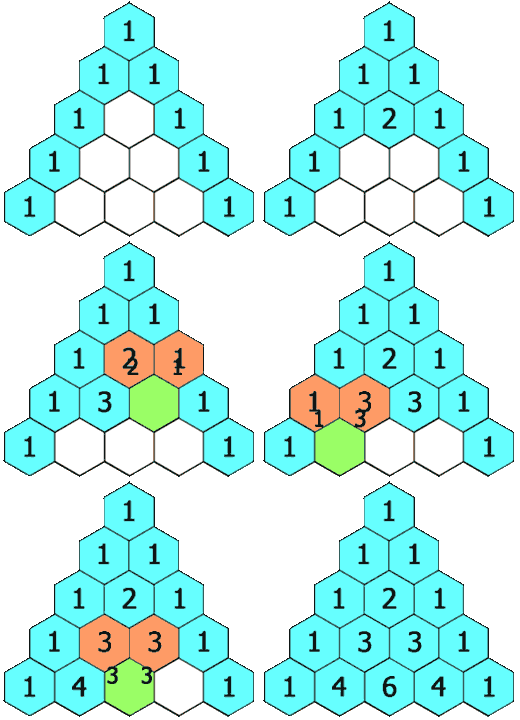
Example 1:
Input: numRows = 5
Output: [[1],[1,1],[1,2,1],[1,3,3,1],[1,4,6,4,1]]
Example 2:
Input: numRows = 1
Output: [[1]]
Constraints:
Solutions
Solution 1: Simulation
We first create an answer array f, then set the first row of f to [1]. Next, starting from the second row, the first and last elements of each row are 1, and for other elements f[i][j] = f[i - 1][j - 1] + f[i - 1][j].
The time complexity is O(n^2), where n is the given number of rows. Ignoring the space consumption of the answer, the space complexity is O(1).
PythonJavaC++GoTypeScriptRustJavaScriptC#
class Solution:
def generate(self, numRows: int) -> List[List[int]]:
f = [[1]]
for i in range(numRows - 1):
g = [1] + [a + b for a, b in pairwise(f[-1])] + [1]
f.append(g)
return f(code-box)
class Solution {
public List<List<Integer>> generate(int numRows) {
List<List<Integer>> f = new ArrayList<>();
f.add(List.of(1));
for (int i = 0; i < numRows - 1; ++i) {
List<Integer> g = new ArrayList<>();
g.add(1);
for (int j = 1; j < f.get(i).size(); ++j) {
g.add(f.get(i).get(j - 1) + f.get(i).get(j));
}
g.add(1);
f.add(g);
}
return f;
}
}(code-box)
class Solution {
public:
vector<vector<int>> generate(int numRows) {
vector<vector<int>> f;
f.push_back(vector<int>(1, 1));
for (int i = 0; i < numRows - 1; ++i) {
vector<int> g;
g.push_back(1);
for (int j = 1; j < f[i].size(); ++j) {
g.push_back(f[i][j - 1] + f[i][j]);
}
g.push_back(1);
f.push_back(g);
}
return f;
}
};(code-box)
func generate(numRows int) [][]int {
f := [][]int{[]int{1}}
for i := 0; i < numRows-1; i++ {
g := []int{1}
for j := 1; j < len(f[i]); j++ {
g = append(g, f[i][j-1]+f[i][j])
}
g = append(g, 1)
f = append(f, g)
}
return f
}(code-box)
function generate(numRows: number): number[][] {
const f: number[][] = [[1]];
for (let i = 0; i < numRows - 1; ++i) {
const g: number[] = [1];
for (let j = 1; j < f[i].length; ++j) {
g.push(f[i][j - 1] + f[i][j]);
}
g.push(1);
f.push(g);
}
return f;
}(code-box)
impl Solution {
pub fn generate(num_rows: i32) -> Vec<Vec<i32>> {
let mut f = vec![vec![1]];
for i in 1..num_rows {
let mut g = vec![1];
for j in 1..f[i as usize - 1].len() {
g.push(f[i as usize - 1][j - 1] + f[i as usize - 1][j]);
}
g.push(1);
f.push(g);
}
f
}
}(code-box)
/**
* @param {number} numRows
* @return {number[][]}
*/
var generate = function (numRows) {
const f = [[1]];
for (let i = 0; i < numRows - 1; ++i) {
const g = [1];
for (let j = 1; j < f[i].length; ++j) {
g.push(f[i][j - 1] + f[i][j]);
}
g.push(1);
f.push(g);
}
return f;
};(code-box)
public class Solution {
public IList<IList<int>> Generate(int numRows) {
var f = new List<IList<int>> { new List<int> { 1 } };
for (int i = 1; i < numRows; ++i) {
var g = new List<int> { 1 };
for (int j = 1; j < f[i - 1].Count; ++j) {
g.Add(f[i - 1][j - 1] + f[i - 1][j]);
}
g.Add(1);
f.Add(g);
}
return f;
}
}(code-box)


