
Description
Given two integer arrays inorder and postorder where inorder is the inorder traversal of a binary tree and postorder is the postorder traversal of the same tree, construct and return the binary tree.
Example 1:
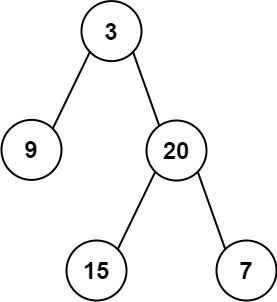
Input: inorder = [9,3,15,20,7], postorder = [9,15,7,20,3]
Output: [3,9,20,null,null,15,7]
Example 2:
Input: inorder = [-1], postorder = [-1]
Output: [-1]
Constraints:
1 <= inorder.length <= 3000postorder.length == inorder.length-3000 <= inorder[i], postorder[i] <= 3000inorder and postorder consist of unique values.- Each value of
postorder also appears in inorder.
inorder is guaranteed to be the inorder traversal of the tree.postorder is guaranteed to be the postorder traversal of the tree.
Solutions
Solution 1: Hash Table + Recursion
The last node in the post-order traversal is the root node. We can find the position of the root node in the in-order traversal, and then recursively construct the left and right subtrees.
Specifically, we first use a hash table d to store the position of each node in the in-order traversal. Then we design a recursive function dfs(i, j, n), where i and j represent the starting positions of the in-order and post-order traversals, respectively, and n represents the number of nodes in the subtree. The function logic is as follows:
- If n ≤ 0, it means the subtree is empty, return a null node.
- Otherwise, take out the last node v of the post-order traversal, and then find the position k of v in the in-order traversal using the hash table d. Then the number of nodes in the left subtree is k - i, and the number of nodes in the right subtree is n - k + i - 1.
- Recursively construct the left subtree dfs(i, j, k - i) and the right subtree dfs(k + 1, j + k - i, n - k + i - 1), connect them to the root node, and finally return the root node.
The time complexity is O(n), and the space complexity is O(n). Here, n is the number of nodes in the binary tree.
PythonJavaC++GoTypeScriptRust
# Definition for a binary tree node.
# class TreeNode:
# def __init__(self, val=0, left=None, right=None):
# self.val = val
# self.left = left
# self.right = right
class Solution:
def buildTree(self, inorder: List[int], postorder: List[int]) -> Optional[TreeNode]:
def dfs(i: int, j: int, n: int) -> Optional[TreeNode]:
if n <= 0:
return None
v = postorder[j + n - 1]
k = d[v]
l = dfs(i, j, k - i)
r = dfs(k + 1, j + k - i, n - k + i - 1)
return TreeNode(v, l, r)
d = {v: i for i, v in enumerate(inorder)}
return dfs(0, 0, len(inorder))(code-box)
/**
* Definition for a binary tree node.
* public class TreeNode {
* int val;
* TreeNode left;
* TreeNode right;
* TreeNode() {}
* TreeNode(int val) { this.val = val; }
* TreeNode(int val, TreeNode left, TreeNode right) {
* this.val = val;
* this.left = left;
* this.right = right;
* }
* }
*/
class Solution {
private Map<Integer, Integer> d = new HashMap<>();
private int[] postorder;
public TreeNode buildTree(int[] inorder, int[] postorder) {
this.postorder = postorder;
int n = inorder.length;
for (int i = 0; i < n; ++i) {
d.put(inorder[i], i);
}
return dfs(0, 0, n);
}
private TreeNode dfs(int i, int j, int n) {
if (n <= 0) {
return null;
}
int v = postorder[j + n - 1];
int k = d.get(v);
TreeNode l = dfs(i, j, k - i);
TreeNode r = dfs(k + 1, j + k - i, n - k + i - 1);
return new TreeNode(v, l, r);
}
}(code-box)
/**
* Definition for a binary tree node.
* struct TreeNode {
* int val;
* TreeNode *left;
* TreeNode *right;
* TreeNode() : val(0), left(nullptr), right(nullptr) {}
* TreeNode(int x) : val(x), left(nullptr), right(nullptr) {}
* TreeNode(int x, TreeNode *left, TreeNode *right) : val(x), left(left), right(right) {}
* };
*/
class Solution {
public:
TreeNode* buildTree(vector<int>& inorder, vector<int>& postorder) {
unordered_map<int, int> d;
int n = inorder.size();
for (int i = 0; i < n; ++i) {
d[inorder[i]] = i;
}
function<TreeNode*(int, int, int)> dfs = [&](int i, int j, int n) -> TreeNode* {
if (n <= 0) {
return nullptr;
}
int v = postorder[j + n - 1];
int k = d[v];
auto l = dfs(i, j, k - i);
auto r = dfs(k + 1, j + k - i, n - k + i - 1);
return new TreeNode(v, l, r);
};
return dfs(0, 0, n);
}
};(code-box)
/**
* Definition for a binary tree node.
* type TreeNode struct {
* Val int
* Left *TreeNode
* Right *TreeNode
* }
*/
func buildTree(inorder []int, postorder []int) *TreeNode {
d := map[int]int{}
for i, v := range inorder {
d[v] = i
}
var dfs func(i, j, n int) *TreeNode
dfs = func(i, j, n int) *TreeNode {
if n <= 0 {
return nil
}
v := postorder[j+n-1]
k := d[v]
l := dfs(i, j, k-i)
r := dfs(k+1, j+k-i, n-k+i-1)
return &TreeNode{v, l, r}
}
return dfs(0, 0, len(inorder))
}(code-box)
/**
* Definition for a binary tree node.
* class TreeNode {
* val: number
* left: TreeNode | null
* right: TreeNode | null
* constructor(val?: number, left?: TreeNode | null, right?: TreeNode | null) {
* this.val = (val===undefined ? 0 : val)
* this.left = (left===undefined ? null : left)
* this.right = (right===undefined ? null : right)
* }
* }
*/
function buildTree(inorder: number[], postorder: number[]): TreeNode | null {
const n = inorder.length;
const d: Record<number, number> = {};
for (let i = 0; i < n; i++) {
d[inorder[i]] = i;
}
const dfs = (i: number, j: number, n: number): TreeNode | null => {
if (n <= 0) {
return null;
}
const v = postorder[j + n - 1];
const k = d[v];
const l = dfs(i, j, k - i);
const r = dfs(k + 1, j + k - i, n - 1 - (k - i));
return new TreeNode(v, l, r);
};
return dfs(0, 0, n);
}(code-box)
// Definition for a binary tree node.
// #[derive(Debug, PartialEq, Eq)]
// pub struct TreeNode {
// pub val: i32,
// pub left: Option<Rc<RefCell<TreeNode>>>,
// pub right: Option<Rc<RefCell<TreeNode>>>,
// }
//
// impl TreeNode {
// #[inline]
// pub fn new(val: i32) -> Self {
// TreeNode {
// val,
// left: None,
// right: None
// }
// }
// }
use std::cell::RefCell;
use std::collections::HashMap;
use std::rc::Rc;
impl Solution {
pub fn build_tree(inorder: Vec<i32>, postorder: Vec<i32>) -> Option<Rc<RefCell<TreeNode>>> {
let n = inorder.len();
let mut d: HashMap<i32, usize> = HashMap::new();
for i in 0..n {
d.insert(inorder[i], i);
}
fn dfs(
postorder: &[i32],
d: &HashMap<i32, usize>,
i: usize,
j: usize,
n: usize,
) -> Option<Rc<RefCell<TreeNode>>> {
if n <= 0 {
return None;
}
let val = postorder[j + n - 1];
let k = *d.get(&val).unwrap();
let left = dfs(postorder, d, i, j, k - i);
let right = dfs(postorder, d, k + 1, j + k - i, n - 1 - (k - i));
Some(Rc::new(RefCell::new(TreeNode { val, left, right })))
}
dfs(&postorder, &d, 0, 0, n)
}
}(code-box)


