
Description
Given the head of a sorted linked list, delete all duplicates such that each element appears only once. Return the linked list sorted as well.
Example 1:
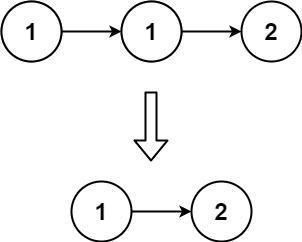
Input: head = [1,1,2]
Output: [1,2]
Example 2:
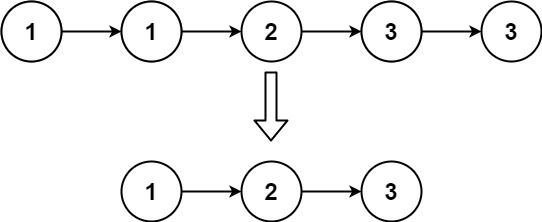
Input: head = [1,1,2,3,3]
Output: [1,2,3]
Constraints:
- The number of nodes in the list is in the range
[0, 300].
-100 <= Node.val <= 100- The list is guaranteed to be sorted in ascending order.
Solutions
Solution 1: Single Pass
We use a pointer cur to traverse the linked list. If the element corresponding to the current cur is the same as the element corresponding to cur.next, we set the next pointer of cur to point to the next node of cur.next. Otherwise, it means that the element corresponding to cur in the linked list is not duplicated, so we can move the cur pointer to the next node.
After the traversal ends, return the head node of the linked list.
The time complexity is O(n), where n is the length of the linked list. The space complexity is O(1).
PythonJavaC++GoRustJavaScriptC#
# Definition for singly-linked list.
# class ListNode:
# def __init__(self, val=0, next=None):
# self.val = val
# self.next = next
class Solution:
def deleteDuplicates(self, head: Optional[ListNode]) -> Optional[ListNode]:
cur = head
while cur and cur.next:
if cur.val == cur.next.val:
cur.next = cur.next.next
else:
cur = cur.next
return head(code-box)
/**
* Definition for singly-linked list.
* public class ListNode {
* int val;
* ListNode next;
* ListNode() {}
* ListNode(int val) { this.val = val; }
* ListNode(int val, ListNode next) { this.val = val; this.next = next; }
* }
*/
class Solution {
public ListNode deleteDuplicates(ListNode head) {
ListNode cur = head;
while (cur != null && cur.next != null) {
if (cur.val == cur.next.val) {
cur.next = cur.next.next;
} else {
cur = cur.next;
}
}
return head;
}
}(code-box)
/**
* Definition for singly-linked list.
* struct ListNode {
* int val;
* ListNode *next;
* ListNode() : val(0), next(nullptr) {}
* ListNode(int x) : val(x), next(nullptr) {}
* ListNode(int x, ListNode *next) : val(x), next(next) {}
* };
*/
class Solution {
public:
ListNode* deleteDuplicates(ListNode* head) {
ListNode* cur = head;
while (cur != nullptr && cur->next != nullptr) {
if (cur->val == cur->next->val) {
cur->next = cur->next->next;
} else {
cur = cur->next;
}
}
return head;
}
};(code-box)
/**
* Definition for singly-linked list.
* type ListNode struct {
* Val int
* Next *ListNode
* }
*/
func deleteDuplicates(head *ListNode) *ListNode {
cur := head
for cur != nil && cur.Next != nil {
if cur.Val == cur.Next.Val {
cur.Next = cur.Next.Next
} else {
cur = cur.Next
}
}
return head
}(code-box)
// Definition for singly-linked list.
// #[derive(PartialEq, Eq, Clone, Debug)]
// pub struct ListNode {
// pub val: i32,
// pub next: Option<Box<ListNode>>
// }
//
// impl ListNode {
// #[inline]
// fn new(val: i32) -> Self {
// ListNode {
// next: None,
// val
// }
// }
// }
impl Solution {
pub fn delete_duplicates(head: Option<Box<ListNode>>) -> Option<Box<ListNode>> {
let mut dummy = Some(Box::new(ListNode::new(i32::MAX)));
let mut p = &mut dummy;
let mut current = head;
while let Some(mut node) = current {
current = node.next.take();
if p.as_mut().unwrap().val != node.val {
p.as_mut().unwrap().next = Some(node);
p = &mut p.as_mut().unwrap().next;
}
}
dummy.unwrap().next
}
}(code-box)
/**
* Definition for singly-linked list.
* function ListNode(val) {
* this.val = val;
* this.next = null;
* }
*/
/**
* @param {ListNode} head
* @return {ListNode}
*/
var deleteDuplicates = function (head) {
let cur = head;
while (cur && cur.next) {
if (cur.next.val === cur.val) {
cur.next = cur.next.next;
} else {
cur = cur.next;
}
}
return head;
};(code-box)
/**
* Definition for singly-linked list.
* public class ListNode {
* public int val;
* public ListNode next;
* public ListNode(int val=0, ListNode next=null) {
* this.val = val;
* this.next = next;
* }
* }
*/
public class Solution {
public ListNode DeleteDuplicates(ListNode head) {
ListNode cur = head;
while (cur != null && cur.next != null) {
if (cur.val == cur.next.val) {
cur.next = cur.next.next;
} else {
cur = cur.next;
}
}
return head;
}
}(code-box)


