
Description
There is a robot on an m x n grid. The robot is initially located at the top-left corner (i.e., grid[0][0]). The robot tries to move to the bottom-right corner (i.e., grid[m - 1][n - 1]). The robot can only move either down or right at any point in time.
Given the two integers m and n, return the number of possible unique paths that the robot can take to reach the bottom-right corner.
The test cases are generated so that the answer will be less than or equal to 2 * 109.
Example 1:
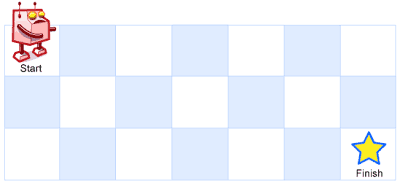
Input: m = 3, n = 7
Output: 28
Example 2:
Input: m = 3, n = 2
Output: 3
Explanation: From the top-left corner, there are a total of 3 ways to reach the bottom-right corner:
1. Right -> Down -> Down
2. Down -> Down -> Right
3. Down -> Right -> Down
Constraints:
Solutions
Solution 1: Dynamic Programming
We define f[i][j] to represent the number of paths from the top left corner to (i, j), initially f[0][0] = 1, and the answer is f[m - 1][n - 1].
Consider f[i][j]:
- If i > 0, then f[i][j] can be reached by taking one step from f[i - 1][j], so f[i][j] = f[i][j] + f[i - 1][j];
- If j > 0, then f[i][j] can be reached by taking one step from f[i][j - 1], so f[i][j] = f[i][j] + f[i][j - 1].
Therefore, we have the following state transition equation:
$$
f[i][j] = \begin{cases}
1 & i = 0, j = 0 \
f[i - 1][j] + f[i][j - 1] & \textit{otherwise}
\end{cases}
$$
The final answer is f[m - 1][n - 1].
The time complexity is O(m × n), and the space complexity is O(m × n). Here, m and n are the number of rows and columns of the grid, respectively.
We notice that f[i][j] is only related to f[i - 1][j] and f[i][j - 1], so we can optimize the first dimension space and only keep the second dimension space, resulting in a time complexity of O(m × n) and a space complexity of O(n).
PythonJavaC++GoTypeScriptRustJavaScript
class Solution:
def uniquePaths(self, m: int, n: int) -> int:
f = [[0] * n for _ in range(m)]
f[0][0] = 1
for i in range(m):
for j in range(n):
if i:
f[i][j] += f[i - 1][j]
if j:
f[i][j] += f[i][j - 1]
return f[-1][-1](code-box)
class Solution {
public int uniquePaths(int m, int n) {
var f = new int[m][n];
f[0][0] = 1;
for (int i = 0; i < m; ++i) {
for (int j = 0; j < n; ++j) {
if (i > 0) {
f[i][j] += f[i - 1][j];
}
if (j > 0) {
f[i][j] += f[i][j - 1];
}
}
}
return f[m - 1][n - 1];
}
}(code-box)
class Solution {
public:
int uniquePaths(int m, int n) {
vector<vector<int>> f(m, vector<int>(n));
f[0][0] = 1;
for (int i = 0; i < m; ++i) {
for (int j = 0; j < n; ++j) {
if (i) {
f[i][j] += f[i - 1][j];
}
if (j) {
f[i][j] += f[i][j - 1];
}
}
}
return f[m - 1][n - 1];
}
};(code-box)
func uniquePaths(m int, n int) int {
f := make([][]int, m)
for i := range f {
f[i] = make([]int, n)
}
f[0][0] = 1
for i := 0; i < m; i++ {
for j := 0; j < n; j++ {
if i > 0 {
f[i][j] += f[i-1][j]
}
if j > 0 {
f[i][j] += f[i][j-1]
}
}
}
return f[m-1][n-1]
}(code-box)
function uniquePaths(m: number, n: number): number {
const f: number[][] = Array(m)
.fill(0)
.map(() => Array(n).fill(0));
f[0][0] = 1;
for (let i = 0; i < m; ++i) {
for (let j = 0; j < n; ++j) {
if (i > 0) {
f[i][j] += f[i - 1][j];
}
if (j > 0) {
f[i][j] += f[i][j - 1];
}
}
}
return f[m - 1][n - 1];
}(code-box)
impl Solution {
pub fn unique_paths(m: i32, n: i32) -> i32 {
let (m, n) = (m as usize, n as usize);
let mut f = vec![1; n];
for i in 1..m {
for j in 1..n {
f[j] += f[j - 1];
}
}
f[n - 1]
}
}(code-box)
/**
* @param {number} m
* @param {number} n
* @return {number}
*/
var uniquePaths = function (m, n) {
const f = Array(m)
.fill(0)
.map(() => Array(n).fill(0));
f[0][0] = 1;
for (let i = 0; i < m; ++i) {
for (let j = 0; j < n; ++j) {
if (i > 0) {
f[i][j] += f[i - 1][j];
}
if (j > 0) {
f[i][j] += f[i][j - 1];
}
}
}
return f[m - 1][n - 1];
};(code-box)
Solution 2
PythonJavaC++GoTypeScriptJavaScript
class Solution:
def uniquePaths(self, m: int, n: int) -> int:
f = [[1] * n for _ in range(m)]
for i in range(1, m):
for j in range(1, n):
f[i][j] = f[i - 1][j] + f[i][j - 1]
return f[-1][-1](code-box)
class Solution {
public int uniquePaths(int m, int n) {
var f = new int[m][n];
for (var g : f) {
Arrays.fill(g, 1);
}
for (int i = 1; i < m; ++i) {
for (int j = 1; j < n; j++) {
f[i][j] = f[i - 1][j] + f[i][j - 1];
}
}
return f[m - 1][n - 1];
}
}(code-box)
class Solution {
public:
int uniquePaths(int m, int n) {
vector<vector<int>> f(m, vector<int>(n, 1));
for (int i = 1; i < m; ++i) {
for (int j = 1; j < n; ++j) {
f[i][j] = f[i - 1][j] + f[i][j - 1];
}
}
return f[m - 1][n - 1];
}
};(code-box)
func uniquePaths(m int, n int) int {
f := make([][]int, m)
for i := range f {
f[i] = make([]int, n)
for j := range f[i] {
f[i][j] = 1
}
}
for i := 1; i < m; i++ {
for j := 1; j < n; j++ {
f[i][j] = f[i-1][j] + f[i][j-1]
}
}
return f[m-1][n-1]
}(code-box)
function uniquePaths(m: number, n: number): number {
const f: number[][] = Array(m)
.fill(0)
.map(() => Array(n).fill(1));
for (let i = 1; i < m; ++i) {
for (let j = 1; j < n; ++j) {
f[i][j] = f[i - 1][j] + f[i][j - 1];
}
}
return f[m - 1][n - 1];
}(code-box)
/**
* @param {number} m
* @param {number} n
* @return {number}
*/
var uniquePaths = function (m, n) {
const f = Array(m)
.fill(0)
.map(() => Array(n).fill(1));
for (let i = 1; i < m; ++i) {
for (let j = 1; j < n; ++j) {
f[i][j] = f[i - 1][j] + f[i][j - 1];
}
}
return f[m - 1][n - 1];
};(code-box)
Solution 3
PythonJavaC++GoTypeScriptJavaScript
class Solution:
def uniquePaths(self, m: int, n: int) -> int:
f = [1] * n
for _ in range(1, m):
for j in range(1, n):
f[j] += f[j - 1]
return f[-1](code-box)
class Solution {
public int uniquePaths(int m, int n) {
int[] f = new int[n];
Arrays.fill(f, 1);
for (int i = 1; i < m; ++i) {
for (int j = 1; j < n; ++j) {
f[j] += f[j - 1];
}
}
return f[n - 1];
}
}(code-box)
class Solution {
public:
int uniquePaths(int m, int n) {
vector<int> f(n, 1);
for (int i = 1; i < m; ++i) {
for (int j = 1; j < n; ++j) {
f[j] += f[j - 1];
}
}
return f[n - 1];
}
};(code-box)
func uniquePaths(m int, n int) int {
f := make([]int, n+1)
for i := range f {
f[i] = 1
}
for i := 1; i < m; i++ {
for j := 1; j < n; j++ {
f[j] += f[j-1]
}
}
return f[n-1]
}(code-box)
function uniquePaths(m: number, n: number): number {
const f: number[] = Array(n).fill(1);
for (let i = 1; i < m; ++i) {
for (let j = 1; j < n; ++j) {
f[j] += f[j - 1];
}
}
return f[n - 1];
}(code-box)
/**
* @param {number} m
* @param {number} n
* @return {number}
*/
var uniquePaths = function (m, n) {
const f = Array(n).fill(1);
for (let i = 1; i < m; ++i) {
for (let j = 1; j < n; ++j) {
f[j] += f[j - 1];
}
}
return f[n - 1];
};(code-box)


