
Description
The n-queens puzzle is the problem of placing n queens on an n x n chessboard such that no two queens attack each other.
Given an integer n, return the number of distinct solutions to the n-queens puzzle.
Example 1:
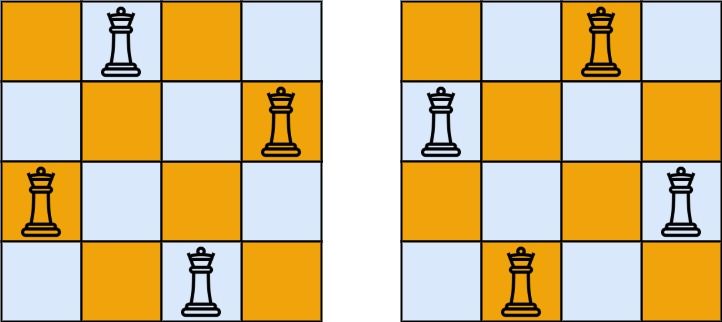
Input: n = 4
Output: 2
Explanation: There are two distinct solutions to the 4-queens puzzle as shown.
Example 2:
Input: n = 1
Output: 1
Constraints:
Solutions
Solution 1: Backtracking
We design a function dfs(i), which represents starting the search from the ith row, and the results of the search are added to the answer.
In the ith row, we enumerate each column of the ith row. If the current column does not conflict with the queens placed before, then we can place a queen, and then continue to search the next row, that is, call dfs(i + 1).
If a conflict occurs, then we skip the current column and continue to enumerate the next column.
To determine whether a conflict occurs, we need to use three arrays to record whether a queen has been placed in each column, each positive diagonal, and each negative diagonal, respectively.
Specifically, we use the cols array to record whether a queen has been placed in each column, the dg array to record whether a queen has been placed in each positive diagonal, and the udg array to record whether a queen has been placed in each negative diagonal.
The time complexity is O(n!), and the space complexity is O(n). Here, n is the number of queens.
PythonJavaC++GoTypeScriptJavaScriptC#
class Solution:
def totalNQueens(self, n: int) -> int:
def dfs(i: int):
if i == n:
nonlocal ans
ans += 1
return
for j in range(n):
a, b = i + j, i - j + n
if cols[j] or dg[a] or udg[b]:
continue
cols[j] = dg[a] = udg[b] = True
dfs(i + 1)
cols[j] = dg[a] = udg[b] = False
cols = [False] * 10
dg = [False] * 20
udg = [False] * 20
ans = 0
dfs(0)
return ans(code-box)
class Solution {
private int n;
private int ans;
private boolean[] cols = new boolean[10];
private boolean[] dg = new boolean[20];
private boolean[] udg = new boolean[20];
public int totalNQueens(int n) {
this.n = n;
dfs(0);
return ans;
}
private void dfs(int i) {
if (i == n) {
++ans;
return;
}
for (int j = 0; j < n; ++j) {
int a = i + j, b = i - j + n;
if (cols[j] || dg[a] || udg[b]) {
continue;
}
cols[j] = true;
dg[a] = true;
udg[b] = true;
dfs(i + 1);
cols[j] = false;
dg[a] = false;
udg[b] = false;
}
}
}(code-box)
class Solution {
public:
int totalNQueens(int n) {
bitset<10> cols;
bitset<20> dg;
bitset<20> udg;
int ans = 0;
function<void(int)> dfs = [&](int i) {
if (i == n) {
++ans;
return;
}
for (int j = 0; j < n; ++j) {
int a = i + j, b = i - j + n;
if (cols[j] || dg[a] || udg[b]) continue;
cols[j] = dg[a] = udg[b] = 1;
dfs(i + 1);
cols[j] = dg[a] = udg[b] = 0;
}
};
dfs(0);
return ans;
}
};(code-box)
func totalNQueens(n int) (ans int) {
cols := [10]bool{}
dg := [20]bool{}
udg := [20]bool{}
var dfs func(int)
dfs = func(i int) {
if i == n {
ans++
return
}
for j := 0; j < n; j++ {
a, b := i+j, i-j+n
if cols[j] || dg[a] || udg[b] {
continue
}
cols[j], dg[a], udg[b] = true, true, true
dfs(i + 1)
cols[j], dg[a], udg[b] = false, false, false
}
}
dfs(0)
return
}(code-box)
function totalNQueens(n: number): number {
const cols: boolean[] = Array(10).fill(false);
const dg: boolean[] = Array(20).fill(false);
const udg: boolean[] = Array(20).fill(false);
let ans = 0;
const dfs = (i: number) => {
if (i === n) {
++ans;
return;
}
for (let j = 0; j < n; ++j) {
let [a, b] = [i + j, i - j + n];
if (cols[j] || dg[a] || udg[b]) {
continue;
}
cols[j] = dg[a] = udg[b] = true;
dfs(i + 1);
cols[j] = dg[a] = udg[b] = false;
}
};
dfs(0);
return ans;
}(code-box)
function totalNQueens(n) {
const cols = Array(10).fill(false);
const dg = Array(20).fill(false);
const udg = Array(20).fill(false);
let ans = 0;
const dfs = i => {
if (i === n) {
++ans;
return;
}
for (let j = 0; j < n; ++j) {
let [a, b] = [i + j, i - j + n];
if (cols[j] || dg[a] || udg[b]) {
continue;
}
cols[j] = dg[a] = udg[b] = true;
dfs(i + 1);
cols[j] = dg[a] = udg[b] = false;
}
};
dfs(0);
return ans;
}(code-box)
public class Solution {
public int TotalNQueens(int n) {
bool[] cols = new bool[10];
bool[] dg = new bool[20];
bool[] udg = new bool[20];
int ans = 0;
void dfs(int i) {
if (i == n) {
ans++;
return;
}
for (int j = 0; j < n; j++) {
int a = i + j, b = i - j + n;
if (cols[j] || dg[a] || udg[b]) {
continue;
}
cols[j] = dg[a] = udg[b] = true;
dfs(i + 1);
cols[j] = dg[a] = udg[b] = false;
}
}
dfs(0);
return ans;
}
}(code-box)


