
Description
You are given the heads of two sorted linked lists list1 and list2.
Merge the two lists into one sorted list. The list should be made by splicing together the nodes of the first two lists.
Return the head of the merged linked list.
Example 1:
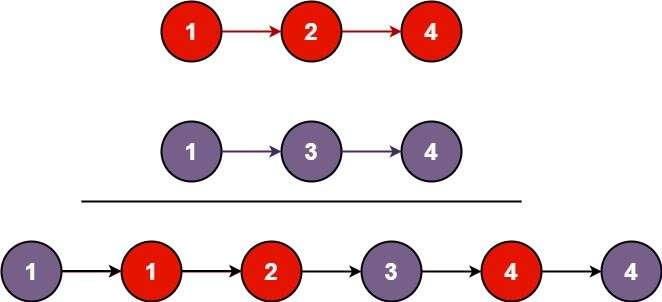
Input: list1 = [1,2,4], list2 = [1,3,4]
Output: [1,1,2,3,4,4]
Example 2:
Input: list1 = [], list2 = []
Output: []
Example 3:
Input: list1 = [], list2 = [0]
Output: [0]
Constraints:
- The number of nodes in both lists is in the range
[0, 50].
-100 <= Node.val <= 100- Both
list1 and list2 are sorted in non-decreasing order.
Solutions
Solution 1: Recursion
First, we judge whether the linked lists l_1 and l_2 are empty. If one of them is empty, we return the other linked list. Otherwise, we compare the head nodes of l_1 and l_2:
- If the value of the head node of l_1 is less than or equal to the value of the head node of l_2, we recursively call the function mergeTwoLists(l_1.next, l_2), and connect the head node of l_1 with the returned linked list head node, and return the head node of l_1.
- Otherwise, we recursively call the function mergeTwoLists(l_1, l_2.next), and connect the head node of l_2 with the returned linked list head node, and return the head node of l_2.
The time complexity is O(m + n), and the space complexity is O(m + n). Here, m and n are the lengths of the two linked lists respectively.
PythonJavaC++GoTypeScriptRustJavaScriptC#RubyPHP
# Definition for singly-linked list.
# class ListNode:
# def __init__(self, val=0, next=None):
# self.val = val
# self.next = next
class Solution:
def mergeTwoLists(
self, list1: Optional[ListNode], list2: Optional[ListNode]
) -> Optional[ListNode]:
if list1 is None or list2 is None:
return list1 or list2
if list1.val <= list2.val:
list1.next = self.mergeTwoLists(list1.next, list2)
return list1
else:
list2.next = self.mergeTwoLists(list1, list2.next)
return list2(code-box)
/**
* Definition for singly-linked list.
* public class ListNode {
* int val;
* ListNode next;
* ListNode() {}
* ListNode(int val) { this.val = val; }
* ListNode(int val, ListNode next) { this.val = val; this.next = next; }
* }
*/
class Solution {
public ListNode mergeTwoLists(ListNode list1, ListNode list2) {
if (list1 == null) {
return list2;
}
if (list2 == null) {
return list1;
}
if (list1.val <= list2.val) {
list1.next = mergeTwoLists(list1.next, list2);
return list1;
} else {
list2.next = mergeTwoLists(list1, list2.next);
return list2;
}
}
}(code-box)
/**
* Definition for singly-linked list.
* struct ListNode {
* int val;
* ListNode *next;
* ListNode() : val(0), next(nullptr) {}
* ListNode(int x) : val(x), next(nullptr) {}
* ListNode(int x, ListNode *next) : val(x), next(next) {}
* };
*/
class Solution {
public:
ListNode* mergeTwoLists(ListNode* list1, ListNode* list2) {
if (!list1) return list2;
if (!list2) return list1;
if (list1->val <= list2->val) {
list1->next = mergeTwoLists(list1->next, list2);
return list1;
} else {
list2->next = mergeTwoLists(list1, list2->next);
return list2;
}
}
};(code-box)
/**
* Definition for singly-linked list.
* type ListNode struct {
* Val int
* Next *ListNode
* }
*/
func mergeTwoLists(list1 *ListNode, list2 *ListNode) *ListNode {
if list1 == nil {
return list2
}
if list2 == nil {
return list1
}
if list1.Val <= list2.Val {
list1.Next = mergeTwoLists(list1.Next, list2)
return list1
} else {
list2.Next = mergeTwoLists(list1, list2.Next)
return list2
}
}(code-box)
/**
* Definition for singly-linked list.
* class ListNode {
* val: number
* next: ListNode | null
* constructor(val?: number, next?: ListNode | null) {
* this.val = (val===undefined ? 0 : val)
* this.next = (next===undefined ? null : next)
* }
* }
*/
function mergeTwoLists(list1: ListNode | null, list2: ListNode | null): ListNode | null {
if (list1 == null || list2 == null) {
return list1 || list2;
}
if (list1.val < list2.val) {
list1.next = mergeTwoLists(list1.next, list2);
return list1;
} else {
list2.next = mergeTwoLists(list1, list2.next);
return list2;
}
}(code-box)
// Definition for singly-linked list.
// #[derive(PartialEq, Eq, Clone, Debug)]
// pub struct ListNode {
// pub val: i32,
// pub next: Option<Box<ListNode>>
// }
//
// impl ListNode {
// #[inline]
// fn new(val: i32) -> Self {
// ListNode {
// next: None,
// val
// }
// }
// }
impl Solution {
pub fn merge_two_lists(
list1: Option<Box<ListNode>>,
list2: Option<Box<ListNode>>,
) -> Option<Box<ListNode>> {
match (list1, list2) {
(None, None) => None,
(Some(list), None) => Some(list),
(None, Some(list)) => Some(list),
(Some(mut list1), Some(mut list2)) => {
if list1.val < list2.val {
list1.next = Self::merge_two_lists(list1.next, Some(list2));
Some(list1)
} else {
list2.next = Self::merge_two_lists(Some(list1), list2.next);
Some(list2)
}
}
}
}
}(code-box)
/**
* Definition for singly-linked list.
* function ListNode(val, next) {
* this.val = (val===undefined ? 0 : val)
* this.next = (next===undefined ? null : next)
* }
*/
/**
* @param {ListNode} list1
* @param {ListNode} list2
* @return {ListNode}
*/
var mergeTwoLists = function (list1, list2) {
if (!list1 || !list2) {
return list1 || list2;
}
if (list1.val <= list2.val) {
list1.next = mergeTwoLists(list1.next, list2);
return list1;
} else {
list2.next = mergeTwoLists(list1, list2.next);
return list2;
}
};(code-box)
/**
* Definition for singly-linked list.
* public class ListNode {
* public int val;
* public ListNode next;
* public ListNode(int val=0, ListNode next=null) {
* this.val = val;
* this.next = next;
* }
* }
*/
public class Solution {
public ListNode MergeTwoLists(ListNode list1, ListNode list2) {
if (list1 == null) {
return list2;
}
if (list2 == null) {
return list1;
}
if (list1.val <= list2.val) {
list1.next = MergeTwoLists(list1.next, list2);
return list1;
} else {
list2.next = MergeTwoLists(list1, list2.next);
return list2;
}
}
}(code-box)
# Definition for singly-linked list.
# class ListNode
# attr_accessor :val, :next
# def initialize(val = 0, _next = nil)
# @val = val
# @next = _next
# end
# end
# @param {ListNode} list1
# @param {ListNode} list2
# @return {ListNode}
def merge_two_lists(list1, list2)
if list1.nil?
return list2
end
if list2.nil?
return list1
end
if list1.val <= list2.val
list1.next = merge_two_lists(list1.next, list2)
return list1
else
list2.next = merge_two_lists(list1, list2.next)
return list2
end
end(code-box)
/**
* Definition for a singly-linked list.
* class ListNode {
* public $val = 0;
* public $next = null;
* function __construct($val = 0, $next = null) {
* $this->val = $val;
* $this->next = $next;
* }
* }
*/
class Solution {
/**
* @param ListNode $list1
* @param ListNode $list2
* @return ListNode
*/
function mergeTwoLists($list1, $list2) {
if (is_null($list1)) {
return $list2;
}
if (is_null($list2)) {
return $list1;
}
if ($list1->val <= $list2->val) {
$list1->next = $this->mergeTwoLists($list1->next, $list2);
return $list1;
} else {
$list2->next = $this->mergeTwoLists($list1, $list2->next);
return $list2;
}
}
}(code-box)
Solution 2: Iteration
We can also use iteration to implement the merging of two sorted linked lists.
First, we define a dummy head node dummy, then loop through the two linked lists, compare the head nodes of the two linked lists, add the smaller node to the end of dummy, until one of the linked lists is empty, then add the remaining part of the other linked list to the end of dummy.
Finally, return dummy.next.
The time complexity is O(m + n), where m and n are the lengths of the two linked lists respectively. Ignoring the space consumption of the answer linked list, the space complexity is O(1).
PythonJavaC++GoTypeScriptRustJavaScriptC#RubyPHP
# Definition for singly-linked list.
# class ListNode:
# def __init__(self, val=0, next=None):
# self.val = val
# self.next = next
class Solution:
def mergeTwoLists(
self, list1: Optional[ListNode], list2: Optional[ListNode]
) -> Optional[ListNode]:
dummy = ListNode()
curr = dummy
while list1 and list2:
if list1.val <= list2.val:
curr.next = list1
list1 = list1.next
else:
curr.next = list2
list2 = list2.next
curr = curr.next
curr.next = list1 or list2
return dummy.next(code-box)
/**
* Definition for singly-linked list.
* public class ListNode {
* int val;
* ListNode next;
* ListNode() {}
* ListNode(int val) { this.val = val; }
* ListNode(int val, ListNode next) { this.val = val; this.next = next; }
* }
*/
class Solution {
public ListNode mergeTwoLists(ListNode list1, ListNode list2) {
ListNode dummy = new ListNode();
ListNode curr = dummy;
while (list1 != null && list2 != null) {
if (list1.val <= list2.val) {
curr.next = list1;
list1 = list1.next;
} else {
curr.next = list2;
list2 = list2.next;
}
curr = curr.next;
}
curr.next = list1 == null ? list2 : list1;
return dummy.next;
}
}(code-box)
/**
* Definition for singly-linked list.
* struct ListNode {
* int val;
* ListNode *next;
* ListNode() : val(0), next(nullptr) {}
* ListNode(int x) : val(x), next(nullptr) {}
* ListNode(int x, ListNode *next) : val(x), next(next) {}
* };
*/
class Solution {
public:
ListNode* mergeTwoLists(ListNode* list1, ListNode* list2) {
ListNode* dummy = new ListNode();
ListNode* curr = dummy;
while (list1 && list2) {
if (list1->val <= list2->val) {
curr->next = list1;
list1 = list1->next;
} else {
curr->next = list2;
list2 = list2->next;
}
curr = curr->next;
}
curr->next = list1 ? list1 : list2;
return dummy->next;
}
};(code-box)
/**
* Definition for singly-linked list.
* type ListNode struct {
* Val int
* Next *ListNode
* }
*/
func mergeTwoLists(list1 *ListNode, list2 *ListNode) *ListNode {
dummy := &ListNode{}
curr := dummy
for list1 != nil && list2 != nil {
if list1.Val <= list2.Val {
curr.Next = list1
list1 = list1.Next
} else {
curr.Next = list2
list2 = list2.Next
}
curr = curr.Next
}
if list1 != nil {
curr.Next = list1
} else {
curr.Next = list2
}
return dummy.Next
}(code-box)
/**
* Definition for singly-linked list.
* class ListNode {
* val: number
* next: ListNode | null
* constructor(val?: number, next?: ListNode | null) {
* this.val = (val===undefined ? 0 : val)
* this.next = (next===undefined ? null : next)
* }
* }
*/
function mergeTwoLists(list1: ListNode | null, list2: ListNode | null): ListNode | null {
const dummy = new ListNode(0);
let cur = dummy;
while (list1 != null && list2 != null) {
if (list1.val < list2.val) {
cur.next = list1;
list1 = list1.next;
} else {
cur.next = list2;
list2 = list2.next;
}
cur = cur.next;
}
cur.next = list1 || list2;
return dummy.next;
}(code-box)
// Definition for singly-linked list.
// #[derive(PartialEq, Eq, Clone, Debug)]
// pub struct ListNode {
// pub val: i32,
// pub next: Option<Box<ListNode>>
// }
//
// impl ListNode {
// #[inline]
// fn new(val: i32) -> Self {
// ListNode {
// next: None,
// val
// }
// }
// }
impl Solution {
pub fn merge_two_lists(
mut list1: Option<Box<ListNode>>,
mut list2: Option<Box<ListNode>>,
) -> Option<Box<ListNode>> {
let mut new_list = ListNode::new(0);
let mut cur = &mut new_list;
while list1.is_some() && list2.is_some() {
let (l1, l2) = (list1.as_deref_mut().unwrap(), list2.as_deref_mut().unwrap());
if l1.val < l2.val {
let next = l1.next.take();
cur.next = list1.take();
list1 = next;
} else {
let next = l2.next.take();
cur.next = list2.take();
list2 = next;
}
cur = cur.next.as_deref_mut().unwrap();
}
cur.next = list1.or(list2);
new_list.next
}
}(code-box)
/**
* Definition for singly-linked list.
* function ListNode(val, next) {
* this.val = (val===undefined ? 0 : val)
* this.next = (next===undefined ? null : next)
* }
*/
/**
* @param {ListNode} list1
* @param {ListNode} list2
* @return {ListNode}
*/
var mergeTwoLists = function (list1, list2) {
const dummy = new ListNode();
let curr = dummy;
while (list1 && list2) {
if (list1.val <= list2.val) {
curr.next = list1;
list1 = list1.next;
} else {
curr.next = list2;
list2 = list2.next;
}
curr = curr.next;
}
curr.next = list1 || list2;
return dummy.next;
};(code-box)
/**
* Definition for singly-linked list.
* public class ListNode {
* public int val;
* public ListNode next;
* public ListNode(int val=0, ListNode next=null) {
* this.val = val;
* this.next = next;
* }
* }
*/
public class Solution {
public ListNode MergeTwoLists(ListNode list1, ListNode list2) {
ListNode dummy = new ListNode();
ListNode curr = dummy;
while (list1 != null && list2 != null) {
if (list1.val <= list2.val) {
curr.next = list1;
list1 = list1.next;
} else {
curr.next = list2;
list2 = list2.next;
}
curr = curr.next;
}
curr.next = list1 == null ? list2 : list1;
return dummy.next;
}
}(code-box)
# Definition for singly-linked list.
# class ListNode
# attr_accessor :val, :next
# def initialize(val = 0, _next = nil)
# @val = val
# @next = _next
# end
# end
# @param {ListNode} list1
# @param {ListNode} list2
# @return {ListNode}
def merge_two_lists(list1, list2)
dummy = ListNode.new()
cur = dummy
while list1 && list2
if list1.val <= list2.val
cur.next = list1
list1 = list1.next
else
cur.next = list2
list2 = list2.next
end
cur = cur.next
end
cur.next = list1 || list2
dummy.next
end(code-box)
# Definition for singly-linked list.
# class ListNode {
# public $val;
# public $next;
# public function __construct($val = 0, $next = null)
# {
# $this->val = $val;
# $this->next = $next;
# }
# }
class Solution {
/**
* @param ListNode $list1
* @param ListNode $list2
* @return ListNode
*/
function mergeTwoLists($list1, $list2) {
$dummy = new ListNode(0);
$current = $dummy;
while ($list1 != null && $list2 != null) {
if ($list1->val <= $list2->val) {
$current->next = $list1;
$list1 = $list1->next;
} else {
$current->next = $list2;
$list2 = $list2->next;
}
$current = $current->next;
}
if ($list1 != null) {
$current->next = $list1;
} elseif ($list2 != null) {
$current->next = $list2;
}
return $dummy->next;
}
}(code-box)


