
Description
You are given a tree (i.e. a connected, undirected graph that has no cycles) rooted at node 0 consisting of n nodes numbered from 0 to n - 1. The tree is represented by a 0-indexed array parent of size n, where parent[i] is the parent of node i. Since node 0 is the root, parent[0] == -1.
You are also given a string s of length n, where s[i] is the character assigned to the edge between i and parent[i]. s[0] can be ignored.
Return the number of pairs of nodes (u, v) such that u < v and the characters assigned to edges on the path from u to v can be rearranged to form a palindrome.
A string is a palindrome when it reads the same backwards as forwards.
Example 1:
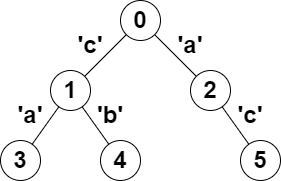
Input: parent = [-1,0,0,1,1,2], s = "acaabc"
Output: 8
Explanation: The valid pairs are:
- All the pairs (0,1), (0,2), (1,3), (1,4) and (2,5) result in one character which is always a palindrome.
- The pair (2,3) result in the string "aca" which is a palindrome.
- The pair (1,5) result in the string "cac" which is a palindrome.
- The pair (3,5) result in the string "acac" which can be rearranged into the palindrome "acca".
Example 2:
Input: parent = [-1,0,0,0,0], s = "aaaaa"
Output: 10
Explanation: Any pair of nodes (u,v) where u < v is valid.
Constraints:
n == parent.length == s.length1 <= n <= 1050 <= parent[i] <= n - 1 for all i >= 1parent[0] == -1parent represents a valid tree.s consists of only lowercase English letters.
Solutions
Solution 1
PythonJavaC++GoTypeScript
class Solution:
def countPalindromePaths(self, parent: List[int], s: str) -> int:
def dfs(i: int, xor: int):
nonlocal ans
for j, v in g[i]:
x = xor ^ v
ans += cnt[x]
for k in range(26):
ans += cnt[x ^ (1 << k)]
cnt[x] += 1
dfs(j, x)
n = len(parent)
g = defaultdict(list)
for i in range(1, n):
p = parent[i]
g[p].append((i, 1 << (ord(s[i]) - ord('a'))))
ans = 0
cnt = Counter({0: 1})
dfs(0, 0)
return ans(code-box)
class Solution {
private List<int[]>[] g;
private Map<Integer, Integer> cnt = new HashMap<>();
private long ans;
public long countPalindromePaths(List<Integer> parent, String s) {
int n = parent.size();
g = new List[n];
cnt.put(0, 1);
Arrays.setAll(g, k -> new ArrayList<>());
for (int i = 1; i < n; ++i) {
int p = parent.get(i);
g[p].add(new int[] {i, 1 << (s.charAt(i) - 'a')});
}
dfs(0, 0);
return ans;
}
private void dfs(int i, int xor) {
for (int[] e : g[i]) {
int j = e[0], v = e[1];
int x = xor ^ v;
ans += cnt.getOrDefault(x, 0);
for (int k = 0; k < 26; ++k) {
ans += cnt.getOrDefault(x ^ (1 << k), 0);
}
cnt.merge(x, 1, Integer::sum);
dfs(j, x);
}
}
}(code-box)
class Solution {
public:
long long countPalindromePaths(vector<int>& parent, string s) {
int n = parent.size();
vector<vector<pair<int, int>>> g(n);
unordered_map<int, int> cnt;
cnt[0] = 1;
for (int i = 1; i < n; ++i) {
int p = parent[i];
g[p].emplace_back(i, 1 << (s[i] - 'a'));
}
long long ans = 0;
function<void(int, int)> dfs = [&](int i, int xo) {
for (auto [j, v] : g[i]) {
int x = xo ^ v;
ans += cnt[x];
for (int k = 0; k < 26; ++k) {
ans += cnt[x ^ (1 << k)];
}
++cnt[x];
dfs(j, x);
}
};
dfs(0, 0);
return ans;
}
};(code-box)
func countPalindromePaths(parent []int, s string) (ans int64) {
type pair struct{ i, v int }
n := len(parent)
g := make([][]pair, n)
for i := 1; i < n; i++ {
p := parent[i]
g[p] = append(g[p], pair{i, 1 << (s[i] - 'a')})
}
cnt := map[int]int{0: 1}
var dfs func(i, xor int)
dfs = func(i, xor int) {
for _, e := range g[i] {
x := xor ^ e.v
ans += int64(cnt[x])
for k := 0; k < 26; k++ {
ans += int64(cnt[x^(1<<k)])
}
cnt[x]++
dfs(e.i, x)
}
}
dfs(0, 0)
return
}(code-box)
function countPalindromePaths(parent: number[], s: string): number {
const n = parent.length;
const g: [number, number][][] = Array.from({ length: n }, () => []);
for (let i = 1; i < n; ++i) {
g[parent[i]].push([i, 1 << (s.charCodeAt(i) - 97)]);
}
const cnt: Map<number, number> = new Map();
cnt.set(0, 1);
let ans = 0;
const dfs = (i: number, xor: number): void => {
for (const [j, v] of g[i]) {
const x = xor ^ v;
ans += cnt.get(x) || 0;
for (let k = 0; k < 26; ++k) {
ans += cnt.get(x ^ (1 << k)) || 0;
}
cnt.set(x, (cnt.get(x) || 0) + 1);
dfs(j, x);
}
};
dfs(0, 0);
return ans;
}(code-box)


