


Description
You are given a root, which is the root of a special binary tree with n nodes. The nodes of the special binary tree are numbered from 1 to n. Suppose the tree has k leaves in the following order: b1 < b2 < ... < bk.
The leaves of this tree have a special property! That is, for every leaf bi, the following conditions hold:
- The right child of
biisbi + 1ifi < k, andb1otherwise. - The left child of
biisbi - 1ifi > 1, andbkotherwise.
Return the height of the given tree.
Note: The height of a binary tree is the length of the longest path from the root to any other node.
Example 1:
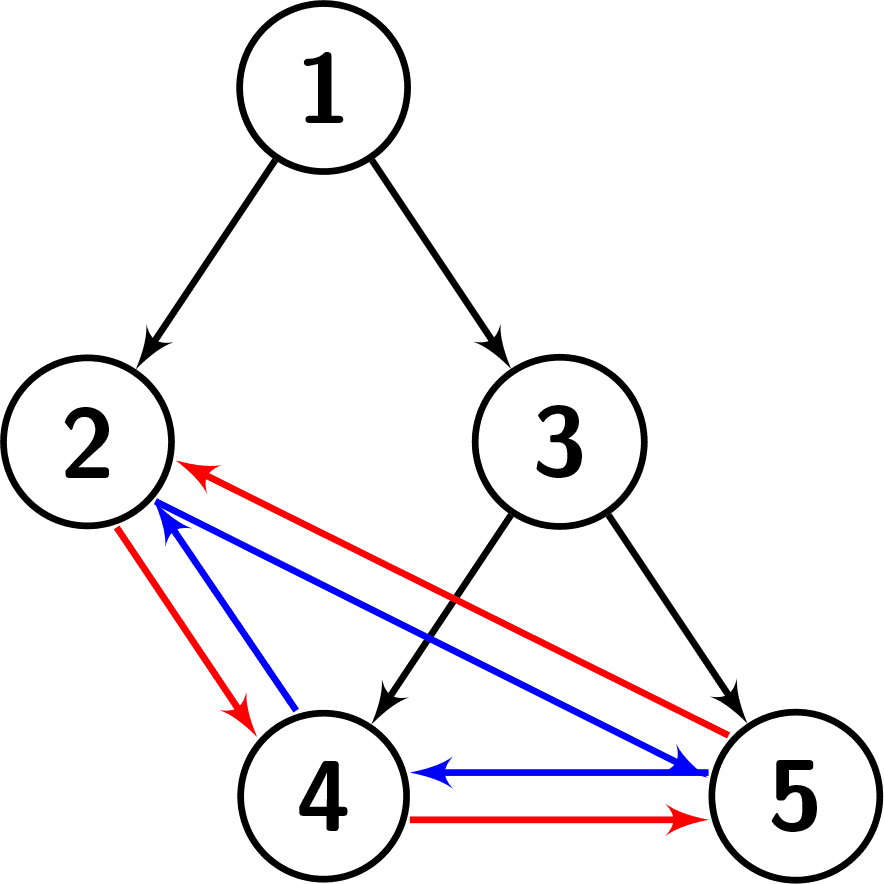
Input: root = [1,2,3,null,null,4,5]
Output: 2
Explanation: The given tree is shown in the following picture. Each leaf's left child is the leaf to its left (shown with the blue edges). Each leaf's right child is the leaf to its right (shown with the red edges). We can see that the graph has a height of 2.
Example 2:
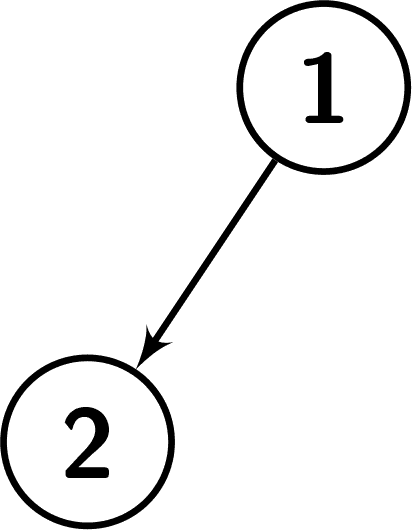
Input: root = [1,2]
Output: 1
Explanation: The given tree is shown in the following picture. There is only one leaf, so it doesn't have any left or right child. We can see that the graph has a height of 1.
Example 3:
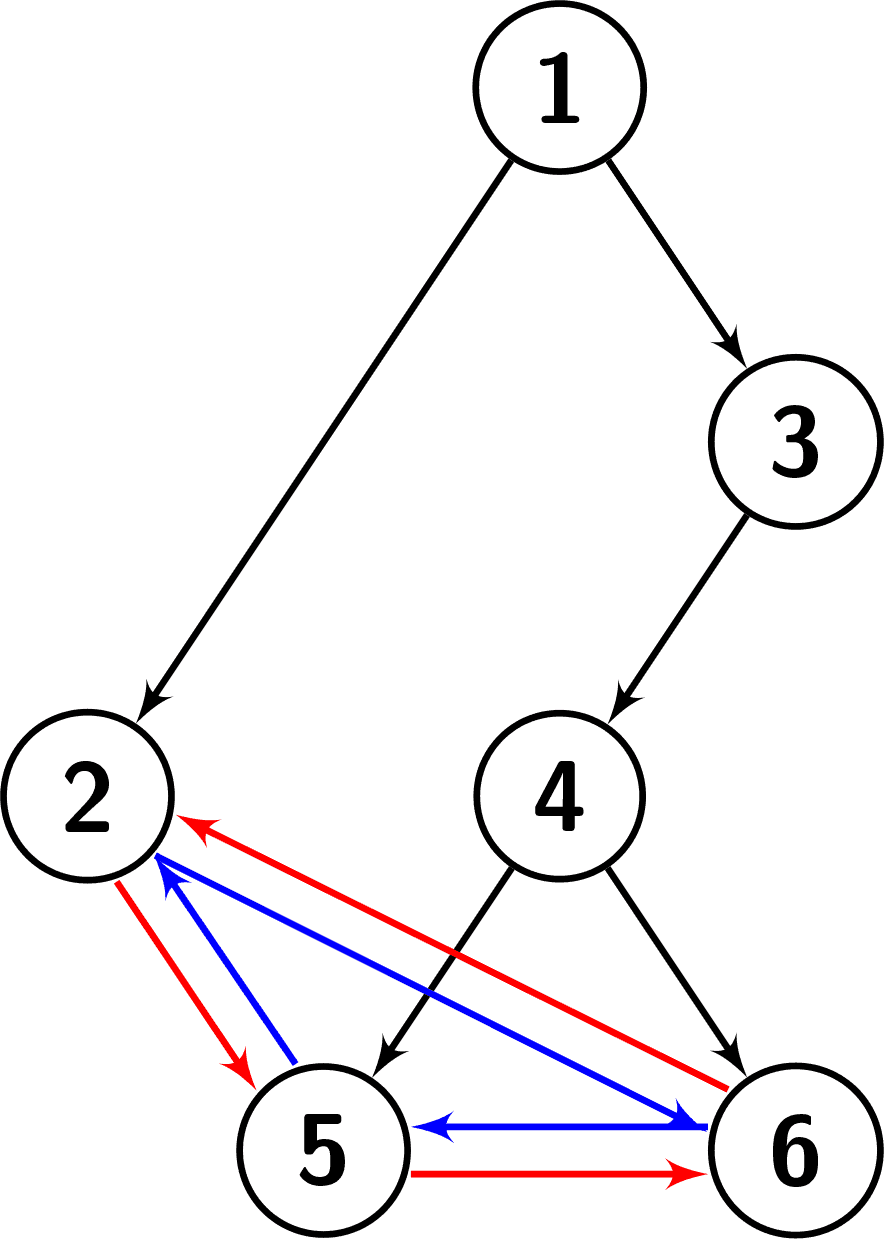
Input: root = [1,2,3,null,null,4,null,5,6]
Output: 3
Explanation: The given tree is shown in the following picture. Each leaf's left child is the leaf to its left (shown with the blue edges). Each leaf's right child is the leaf to its right (shown with the red edges). We can see that the graph has a height of 3.
Constraints:
n == number of nodes in the tree2 <= n <= 1041 <= node.val <= n- The input is generated such that each
node.valis unique.
Solutions
Solution 1: DFS
The key to the problem is how to determine whether a node is a leaf node. We design a function dfs(root, d), where root represents the current node, and d represents the depth of the current node. Each time we search, we update the answer ans = max(ans, d), and then determine whether the current node is a leaf node. If the current node has a left child, and the right child of the left child is not the current node, then we recursively call dfs(root.left, d + 1). If the current node has a right child, and the left child of the right child is not the current node, then we recursively call dfs(root.right, d + 1).
The time complexity is O(n), and the space complexity is O(n). Where n is the number of nodes in the binary tree.
# Definition for a binary tree node. # class TreeNode: # def __init__(self, val=0, left=None, right=None): # self.val = val # self.left = left # self.right = right class Solution: def heightOfTree(self, root: Optional[TreeNode]) -> int: def dfs(root: Optional[TreeNode], d: int): nonlocal ans ans = max(ans, d) if root.left and root.left.right != root: dfs(root.left, d + 1) if root.right and root.right.left != root: dfs(root.right, d + 1) ans = 0 dfs(root, 0) return ans(code-box)
