


Description
You are given a positive integer n which is the number of nodes of a 0-indexed undirected weighted connected graph and a 0-indexed 2D array edges where edges[i] = [ui, vi, wi] indicates that there is an edge between nodes ui and vi with weight wi.
You are also given two nodes s and d, and a positive integer k, your task is to find the shortest path from s to d, but you can hop over at most k edges. In other words, make the weight of at most k edges 0 and then find the shortest path from s to d.
Return the length of the shortest path from s to d with the given condition.
Example 1:
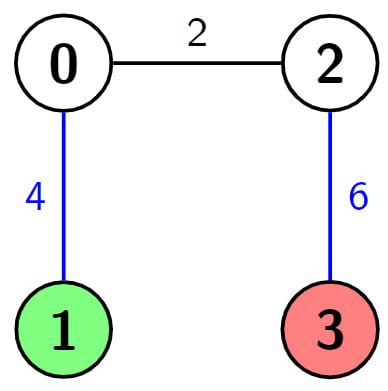
Input: n = 4, edges = [[0,1,4],[0,2,2],[2,3,6]], s = 1, d = 3, k = 2
Output: 2
Explanation: In this example there is only one path from node 1 (the green node) to node 3 (the red node), which is (1->0->2->3) and the length of it is 4 + 2 + 6 = 12. Now we can make weight of two edges 0, we make weight of the blue edges 0, then we have 0 + 2 + 0 = 2. It can be shown that 2 is the minimum length of a path we can achieve with the given condition.
Example 2:
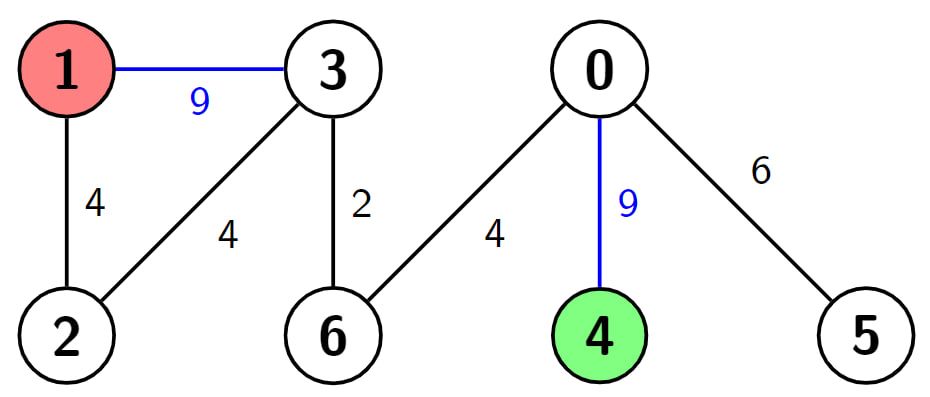
Input: n = 7, edges = [[3,1,9],[3,2,4],[4,0,9],[0,5,6],[3,6,2],[6,0,4],[1,2,4]], s = 4, d = 1, k = 2
Output: 6
Explanation: In this example there are 2 paths from node 4 (the green node) to node 1 (the red node), which are (4->0->6->3->2->1) and (4->0->6->3->1). The first one has the length 9 + 4 + 2 + 4 + 4 = 23, and the second one has the length 9 + 4 + 2 + 9 = 24. Now if we make weight of the blue edges 0, we get the shortest path with the length 0 + 4 + 2 + 0 = 6. It can be shown that 6 is the minimum length of a path we can achieve with the given condition.
Example 3:
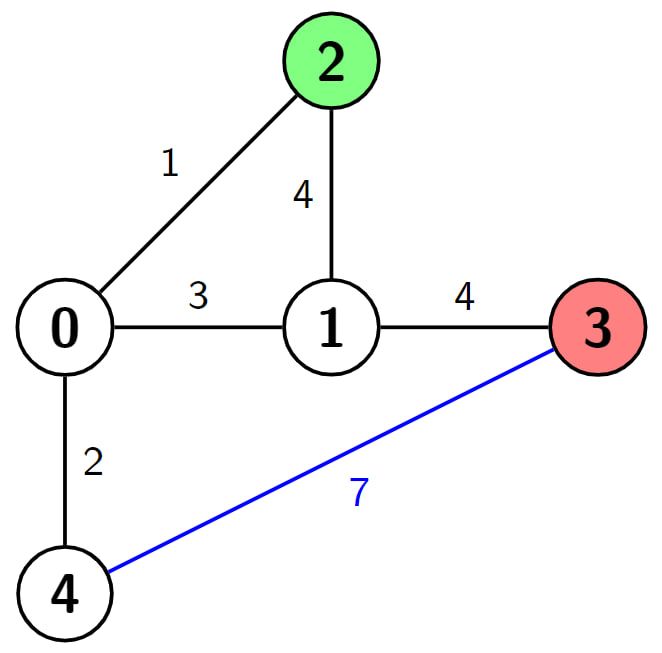
Input: n = 5, edges = [[0,4,2],[0,1,3],[0,2,1],[2,1,4],[1,3,4],[3,4,7]], s = 2, d = 3, k = 1
Output: 3
Explanation: In this example there are 4 paths from node 2 (the green node) to node 3 (the red node), which are (2->1->3), (2->0->1->3), (2->1->0->4->3) and (2->0->4->3). The first two have the length 4 + 4 = 1 + 3 + 4 = 8, the third one has the length 4 + 3 + 2 + 7 = 16 and the last one has the length 1 + 2 + 7 = 10. Now if we make weight of the blue edge 0, we get the shortest path with the length 1 + 2 + 0 = 3. It can be shown that 3 is the minimum length of a path we can achieve with the given condition.
Constraints:
2 <= n <= 500n - 1 <= edges.length <= min(104, n * (n - 1) / 2)edges[i].length = 30 <= edges[i][0], edges[i][1] <= n - 11 <= edges[i][2] <= 1060 <= s, d, k <= n - 1s != d- The input is generated such that the graph is connected and has no repeated edges or self-loops
Solutions
Solution 1: Dijkstra Algorithm
First, we construct a graph g based on the given edges, where g[u] represents all neighboring nodes of node u and their corresponding edge weights.
Then, we use Dijkstra's algorithm to find the shortest path from node s to node d. However, we need to make some modifications to Dijkstra's algorithm:
- We need to record the shortest path length from each node u to node d, but since we can cross at most k edges, we need to record the shortest path length from each node u to node d and the number of edges crossed t, i.e., dist[u][t] represents the shortest path length from node u to node d and the number of edges crossed is t.
- We need to use a priority queue to maintain the current shortest path, but since we need to record the number of edges crossed, we need to use a triple (dis, u, t) to represent the current shortest path, where dis represents the current shortest path length, and u and t represent the current node and the number of edges crossed, respectively.
Finally, we only need to return the minimum value in dist[d][0..k].
The time complexity is O(n2 × log n), and the space complexity is O(n × k), where n represents the number of nodes and k represents the maximum number of edges crossed.
class Solution: def shortestPathWithHops( self, n: int, edges: List[List[int]], s: int, d: int, k: int ) -> int: g = [[] for _ in range(n)] for u, v, w in edges: g[u].append((v, w)) g[v].append((u, w)) dist = [[inf] * (k + 1) for _ in range(n)] dist[s][0] = 0 pq = [(0, s, 0)] while pq: dis, u, t = heappop(pq) for v, w in g[u]: if t + 1 <= k and dist[v][t + 1] > dis: dist[v][t + 1] = dis heappush(pq, (dis, v, t + 1)) if dist[v][t] > dis + w: dist[v][t] = dis + w heappush(pq, (dis + w, v, t)) return int(min(dist[d]))(code-box)
