


Description
Given a 2D grid of size m x n, you should find the matrix answer of size m x n.
The cell answer[r][c] is calculated by looking at the diagonal values of the cell grid[r][c]:
- Let
leftAbove[r][c]be the number of distinct values on the diagonal to the left and above the cellgrid[r][c]not including the cellgrid[r][c]itself. - Let
rightBelow[r][c]be the number of distinct values on the diagonal to the right and below the cellgrid[r][c], not including the cellgrid[r][c]itself. - Then
answer[r][c] = |leftAbove[r][c] - rightBelow[r][c]|.
A matrix diagonal is a diagonal line of cells starting from some cell in either the topmost row or leftmost column and going in the bottom-right direction until the end of the matrix is reached.
- For example, in the below diagram the diagonal is highlighted using the cell with indices
(2, 3)colored gray:<ul> <li>Red-colored cells are left and above the cell.</li> <li>Blue-colored cells are right and below the cell.</li> </ul> </li>
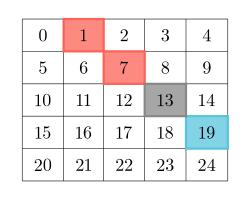
Return the matrix answer.
Example 1:
Input: grid = [[1,2,3],[3,1,5],[3,2,1]]
Output: Output: [[1,1,0],[1,0,1],[0,1,1]]
Explanation:
To calculate the answer cells:
| answer | left-above elements | leftAbove | right-below elements | rightBelow | |leftAbove - rightBelow| |
|---|---|---|---|---|---|
| [0][0] | [] | 0 | [grid[1][1], grid[2][2]] | |{1, 1}| = 1 | 1 |
| [0][1] | [] | 0 | [grid[1][2]] | |{5}| = 1 | 1 |
| [0][2] | [] | 0 | [] | 0 | 0 |
| [1][0] | [] | 0 | [grid[2][1]] | |{2}| = 1 | 1 |
| [1][1] | [grid[0][0]] | |{1}| = 1 | [grid[2][2]] | |{1}| = 1 | 0 |
| [1][2] | [grid[0][1]] | |{2}| = 1 | [] | 0 | 1 |
| [2][0] | [] | 0 | [] | 0 | 0 |
| [2][1] | [grid[1][0]] | |{3}| = 1 | [] | 0 | 1 |
| [2][2] | [grid[0][0], grid[1][1]] | |{1, 1}| = 1 | [] | 0 | 1 |
Example 2:
Input: grid = [[1]]
Output: Output: [[0]]
Constraints:
m == grid.lengthn == grid[i].length1 <= m, n, grid[i][j] <= 50
Solutions
Solution 1: Simulation
We can simulate the process described in the problem statement, calculating the number of distinct values on the top-left diagonal tl and the bottom-right diagonal br for each cell, then compute their difference |tl - br|.
The time complexity is O(m × n × min(m, n)), and the space complexity is O(m × n).
class Solution: def differenceOfDistinctValues(self, grid: List[List[int]]) -> List[List[int]]: m, n = len(grid), len(grid[0]) ans = [[0] * n for _ in range(m)] for i in range(m): for j in range(n): x, y = i, j s = set() while x and y: x, y = x - 1, y - 1 s.add(grid[x][y]) tl = len(s) x, y = i, j s = set() while x + 1 < m and y + 1 < n: x, y = x + 1, y + 1 s.add(grid[x][y]) br = len(s) ans[i][j] = abs(tl - br) return ans(code-box)
