
Description
There is a directed weighted graph that consists of n nodes numbered from 0 to n - 1. The edges of the graph are initially represented by the given array edges where edges[i] = [fromi, toi, edgeCosti] meaning that there is an edge from fromi to toi with the cost edgeCosti.
Implement the Graph class:
Graph(int n, int[][] edges) initializes the object with n nodes and the given edges.addEdge(int[] edge) adds an edge to the list of edges where edge = [from, to, edgeCost]. It is guaranteed that there is no edge between the two nodes before adding this one.int shortestPath(int node1, int node2) returns the minimum cost of a path from node1 to node2. If no path exists, return -1. The cost of a path is the sum of the costs of the edges in the path.
Example 1:
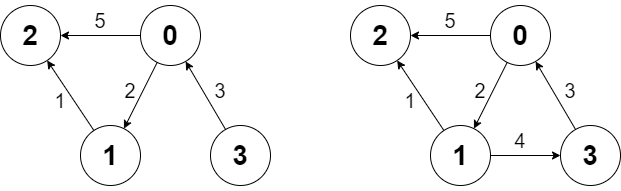
Input
["Graph", "shortestPath", "shortestPath", "addEdge", "shortestPath"]
[[4, [[0, 2, 5], [0, 1, 2], [1, 2, 1], [3, 0, 3]]], [3, 2], [0, 3], [[1, 3, 4]], [0, 3]]
Output
[null, 6, -1, null, 6]

Explanation
Graph g = new Graph(4, [[0, 2, 5], [0, 1, 2], [1, 2, 1], [3, 0, 3]]);
g.shortestPath(3, 2); // return 6. The shortest path from 3 to 2 in the first diagram above is 3 -> 0 -> 1 -> 2 with a total cost of 3 + 2 + 1 = 6.
g.shortestPath(0, 3); // return -1. There is no path from 0 to 3.
g.addEdge([1, 3, 4]); // We add an edge from node 1 to node 3, and we get the second diagram above.
g.shortestPath(0, 3); // return 6. The shortest path from 0 to 3 now is 0 -> 1 -> 3 with a total cost of 2 + 4 = 6.
Constraints:
1 <= n <= 1000 <= edges.length <= n * (n - 1)edges[i].length == edge.length == 30 <= fromi, toi, from, to, node1, node2 <= n - 11 <= edgeCosti, edgeCost <= 106- There are no repeated edges and no self-loops in the graph at any point.
- At most
100 calls will be made for addEdge.
- At most
100 calls will be made for shortestPath.
Solutions
Solution 1: Dijsktra's Algorithm
In the initialization function, we first use the adjacency matrix g to store the edge weights of the graph, where gij represents the edge weight from node i to node j. If there is no edge between i and j, the value of gij is ∞.
In the addEdge function, we update the value of gij to edge[2].
In the shortestPath function, we use Dijsktra's algorithm to find the shortest path from node node1 to node node2. Here, dist[i] represents the shortest path from node node1 to node i, and vis[i] indicates whether node i has been visited. We initialize dist[node1] to 0, and the rest of dist[i] are all ∞. Then we iterate n times, each time finding the current unvisited node t such that dist[t] is the smallest. Then we mark node t as visited, and then update the value of dist[i] to min(dist[i], dist[t] + gti). Finally, we return dist[node2]. If dist[node2] is ∞, it means that there is no path from node node1 to node node2, so we return -1.
The time complexity is O(n2 × q), and the space complexity is O(n2). Where n is the number of nodes, and q is the number of calls to the shortestPath function.
PythonJavaC++GoTypeScriptC#
class Graph:
def __init__(self, n: int, edges: List[List[int]]):
self.n = n
self.g = [[inf] * n for _ in range(n)]
for f, t, c in edges:
self.g[f][t] = c
def addEdge(self, edge: List[int]) -> None:
f, t, c = edge
self.g[f][t] = c
def shortestPath(self, node1: int, node2: int) -> int:
dist = [inf] * self.n
dist[node1] = 0
vis = [False] * self.n
for _ in range(self.n):
t = -1
for j in range(self.n):
if not vis[j] and (t == -1 or dist[t] > dist[j]):
t = j
vis[t] = True
for j in range(self.n):
dist[j] = min(dist[j], dist[t] + self.g[t][j])
return -1 if dist[node2] == inf else dist[node2]
# Your Graph object will be instantiated and called as such:
# obj = Graph(n, edges)
# obj.addEdge(edge)
# param_2 = obj.shortestPath(node1,node2)(code-box)
class Graph {
private int n;
private int[][] g;
private final int inf = 1 << 29;
public Graph(int n, int[][] edges) {
this.n = n;
g = new int[n][n];
for (var f : g) {
Arrays.fill(f, inf);
}
for (int[] e : edges) {
int f = e[0], t = e[1], c = e[2];
g[f][t] = c;
}
}
public void addEdge(int[] edge) {
int f = edge[0], t = edge[1], c = edge[2];
g[f][t] = c;
}
public int shortestPath(int node1, int node2) {
int[] dist = new int[n];
boolean[] vis = new boolean[n];
Arrays.fill(dist, inf);
dist[node1] = 0;
for (int i = 0; i < n; ++i) {
int t = -1;
for (int j = 0; j < n; ++j) {
if (!vis[j] && (t == -1 || dist[t] > dist[j])) {
t = j;
}
}
vis[t] = true;
for (int j = 0; j < n; ++j) {
dist[j] = Math.min(dist[j], dist[t] + g[t][j]);
}
}
return dist[node2] >= inf ? -1 : dist[node2];
}
}
/**
* Your Graph object will be instantiated and called as such:
* Graph obj = new Graph(n, edges);
* obj.addEdge(edge);
* int param_2 = obj.shortestPath(node1,node2);
*/(code-box)
class Graph {
public:
Graph(int n, vector<vector<int>>& edges) {
this->n = n;
g = vector<vector<int>>(n, vector<int>(n, inf));
for (auto& e : edges) {
int f = e[0], t = e[1], c = e[2];
g[f][t] = c;
}
}
void addEdge(vector<int> edge) {
int f = edge[0], t = edge[1], c = edge[2];
g[f][t] = c;
}
int shortestPath(int node1, int node2) {
vector<bool> vis(n);
vector<int> dist(n, inf);
dist[node1] = 0;
for (int i = 0; i < n; ++i) {
int t = -1;
for (int j = 0; j < n; ++j) {
if (!vis[j] && (t == -1 || dist[t] > dist[j])) {
t = j;
}
}
vis[t] = true;
for (int j = 0; j < n; ++j) {
dist[j] = min(dist[j], dist[t] + g[t][j]);
}
}
return dist[node2] >= inf ? -1 : dist[node2];
}
private:
vector<vector<int>> g;
int n;
const int inf = 1 << 29;
};
/**
* Your Graph object will be instantiated and called as such:
* Graph* obj = new Graph(n, edges);
* obj->addEdge(edge);
* int param_2 = obj->shortestPath(node1,node2);
*/(code-box)
const inf = 1 << 29
type Graph struct {
g [][]int
}
func Constructor(n int, edges [][]int) Graph {
g := make([][]int, n)
for i := range g {
g[i] = make([]int, n)
for j := range g[i] {
g[i][j] = inf
}
}
for _, e := range edges {
f, t, c := e[0], e[1], e[2]
g[f][t] = c
}
return Graph{g}
}
func (this *Graph) AddEdge(edge []int) {
f, t, c := edge[0], edge[1], edge[2]
this.g[f][t] = c
}
func (this *Graph) ShortestPath(node1 int, node2 int) int {
n := len(this.g)
dist := make([]int, n)
for i := range dist {
dist[i] = inf
}
vis := make([]bool, n)
dist[node1] = 0
for i := 0; i < n; i++ {
t := -1
for j := 0; j < n; j++ {
if !vis[j] && (t == -1 || dist[t] > dist[j]) {
t = j
}
}
vis[t] = true
for j := 0; j < n; j++ {
dist[j] = min(dist[j], dist[t]+this.g[t][j])
}
}
if dist[node2] >= inf {
return -1
}
return dist[node2]
}
/**
* Your Graph object will be instantiated and called as such:
* obj := Constructor(n, edges);
* obj.AddEdge(edge);
* param_2 := obj.ShortestPath(node1,node2);
*/(code-box)
class Graph {
private g: number[][] = [];
private inf: number = 1 << 29;
constructor(n: number, edges: number[][]) {
this.g = Array.from({ length: n }, () => Array(n).fill(this.inf));
for (const [f, t, c] of edges) {
this.g[f][t] = c;
}
}
addEdge(edge: number[]): void {
const [f, t, c] = edge;
this.g[f][t] = c;
}
shortestPath(node1: number, node2: number): number {
const n = this.g.length;
const dist: number[] = new Array(n).fill(this.inf);
dist[node1] = 0;
const vis: boolean[] = new Array(n).fill(false);
for (let i = 0; i < n; ++i) {
let t = -1;
for (let j = 0; j < n; ++j) {
if (!vis[j] && (t === -1 || dist[j] < dist[t])) {
t = j;
}
}
vis[t] = true;
for (let j = 0; j < n; ++j) {
dist[j] = Math.min(dist[j], dist[t] + this.g[t][j]);
}
}
return dist[node2] >= this.inf ? -1 : dist[node2];
}
}
/**
* Your Graph object will be instantiated and called as such:
* var obj = new Graph(n, edges)
* obj.addEdge(edge)
* var param_2 = obj.shortestPath(node1,node2)
*/(code-box)
public class Graph {
private int n;
private int[,] g;
private readonly int inf = 1 << 29;
public Graph(int n, int[][] edges) {
this.n = n;
g = new int[n, n];
for (int i = 0; i < n; i++) {
for (int j = 0; j < n; j++) {
g[i, j] = inf;
}
}
foreach (var e in edges) {
int f = e[0], t = e[1], c = e[2];
g[f, t] = c;
}
}
public void AddEdge(int[] edge) {
int f = edge[0], t = edge[1], c = edge[2];
g[f, t] = c;
}
public int ShortestPath(int node1, int node2) {
int[] dist = new int[n];
bool[] vis = new bool[n];
Array.Fill(dist, inf);
dist[node1] = 0;
for (int i = 0; i < n; ++i) {
int t = -1;
for (int j = 0; j < n; ++j) {
if (!vis[j] && (t == -1 || dist[t] > dist[j])) {
t = j;
}
}
vis[t] = true;
for (int j = 0; j < n; ++j) {
dist[j] = Math.Min(dist[j], dist[t] + g[t, j]);
}
}
return dist[node2] >= inf ? -1 : dist[node2];
}
}
/**
* Your Graph object will be instantiated and called as such:
* Graph obj = new Graph(n, edges);
* obj.AddEdge(edge);
* int param_2 = obj.ShortestPath(node1,node2);
*/(code-box)


